Key takeaways
- Sound carries about 64 blocks from a jukebox, so one jukebox covers a reasonably sized building and two in range will overlap badly.
- The chest that drives a playlist has to sit directly above the jukebox, which forces the layout more than people expect.
- A music room works when the collection is visible – item frames on the wall do more for the space than any amount of furniture.
Music rooms are a build type that only became worth doing recently. Before jukebox playlists, a room built around a jukebox was a room where you stood next to a block for three minutes and then swapped a disc. There was no reason to furnish it, because nobody stayed.
With a chest above the jukebox acting as a queue, the room has a function. This guide covers the constraints the mechanic puts on your layout, three room shapes that work, and the detailing that makes it read as a music room rather than a storage closet with a jukebox in it.
The constraints you are building around
Three, and all three shape the room.
The chest must be directly above the jukebox. Not beside, not one block up and over. That means the jukebox cannot sit under a ceiling at head height – you need a block of clearance above it for the chest, and you need to reach that chest.
Sound radius is about 64 blocks. Generous for one building. Problematic if you put a second jukebox in the next room, because the two tracks will overlap in the space between them.
The jukebox needs front access. Ejecting the current disc is how you skip a track, so the jukebox face has to be reachable even with a chest on top of it.
Together these push towards a specific shape: the jukebox at roughly waist or chest height on a plinth, the chest above it at head height, and open floor in front. That is a lectern-like arrangement, and designing around it rather than against it is most of the job.
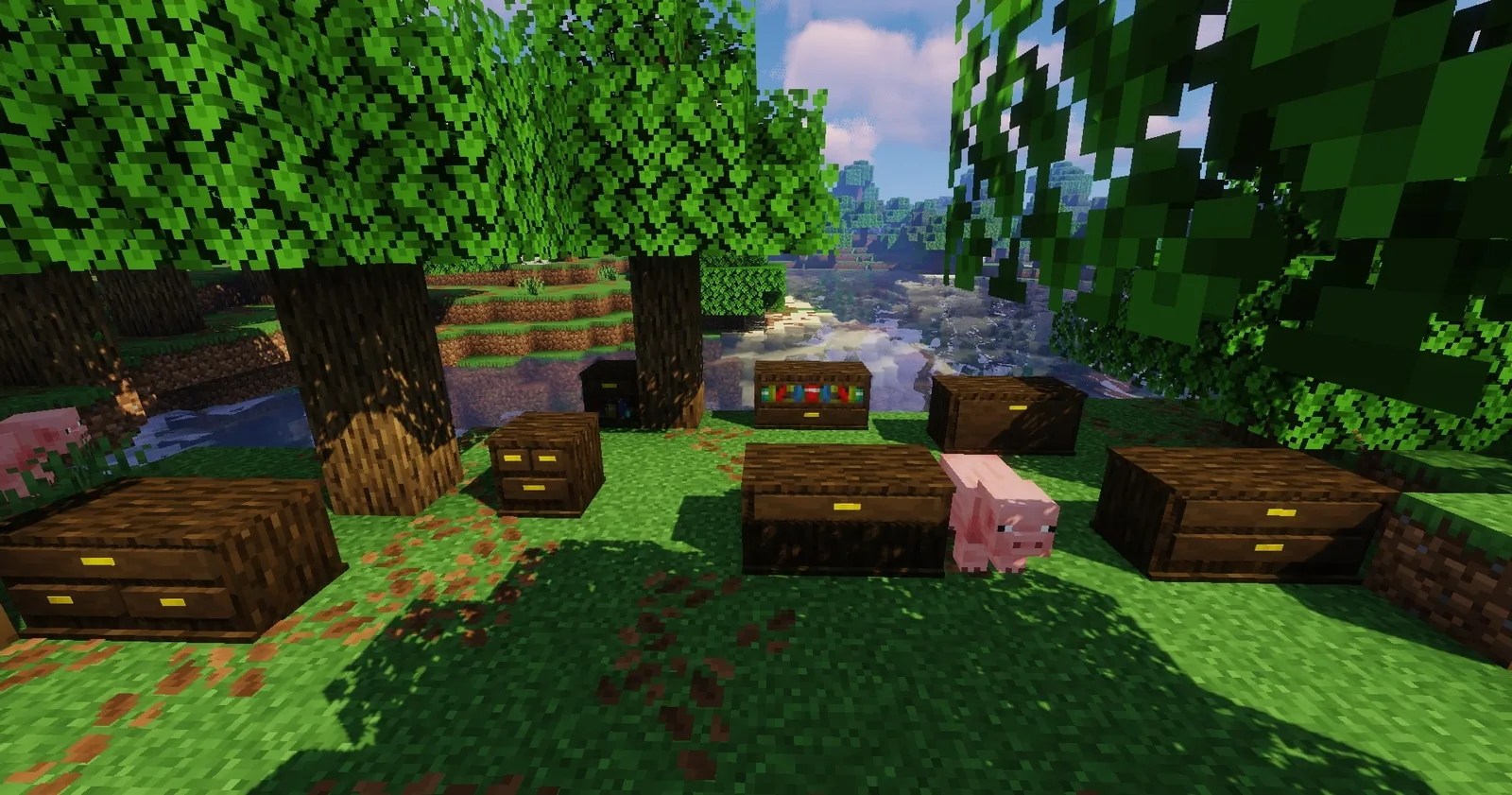
Three room shapes
The alcove. A recess in a wall, two blocks wide and one deep, with the jukebox on a plinth and the chest above it. The recess frames the whole assembly and gives you somewhere to put trapdoors, lanterns and a banner without cluttering the room. This is the smallest version that reads properly and it fits in a corridor.
The listening room. A dedicated space, five by seven or larger, with the jukebox assembly on the short wall and seating facing it. Seating in vanilla means stairs with signs as armrests, or a carpet-and-trapdoor arrangement. The point of the extra space is the wall opposite, which is where the collection goes.
The basement club. Low ceiling, dark palette, light sources hidden in the floor, and the jukebox assembly recessed into a wall with note blocks beside it. Our interior lighting guide covers getting a dim room that does not spawn mobs, which is the whole technical problem with this one.
Displaying the collection
This is the part that makes the room. A music room without visible discs is a room with a jukebox in it.
Item frames are the tool, and three details matter:
- Frame them against a contrasting block. Discs are small and mostly dark. On a dark wall they disappear. A pale block behind each frame – calcite, diorite, quartz, bone block – makes each disc read.
- Grid them evenly. Fifteen discs in a 5×3 grid is a strong visual unit. Scattered frames look like storage.
- Leave the gaps visible. An empty frame where a disc you do not own would go turns the wall into a collection in progress, which is more interesting than a complete one.
Glow item frames are worth considering here. They make the disc visible in a dark room without adding a light source, which solves the basement club problem neatly. Our detail blocks guide covers the rest of the small-piece toolkit.
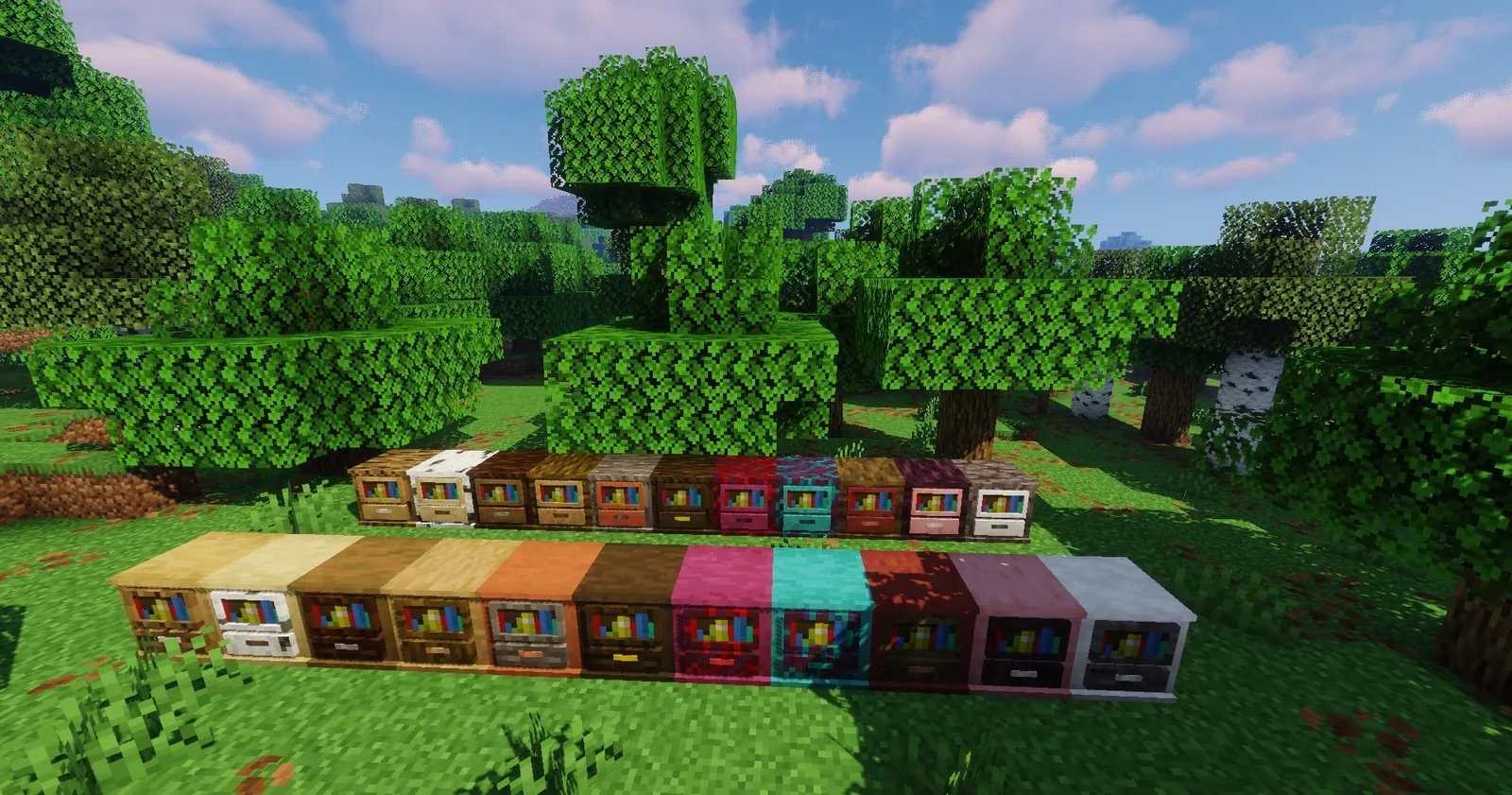
Note blocks as the second instrument
A music room can hold both recorded music and played music, and note blocks are the second half.
The useful facts: a note block’s instrument comes from the block beneath it, its pitch comes from right-clicking, and a row of them wired to a redstone line plays a sequence. Sixteen blocks under note blocks give sixteen instruments – wood for bass, stone for bass drum, sand for snare, glass for hat, gold for bells, and so on.
In a build, a bank of note blocks reads as an instrument even when nobody is playing it, which is the point. A wall of them behind the jukebox assembly makes the room’s purpose unambiguous at a glance.
The practical note: note blocks need a block of air above them to sound. Do not build them into a shelf. Our redstone basics guide covers the clock that drives a sequence, and our observer circuit guide covers the timing side if you want something more than a repeater chain.
The comparator lighting trick
Worth building because it costs almost nothing and nobody expects it.
A jukebox outputs a comparator signal whose strength depends on which disc is playing. With a playlist running, the disc changes automatically every few minutes, which means the signal changes automatically. Feed that into a redstone lamp array and the room lighting changes with the track.
The simplest version is a comparator into a single lamp – lit for high-signal discs, dark for low. The elaborate version decodes signal strength into different coloured lighting. Our comparator guide covers reading the levels, and our music disc guide covers which disc produces which signal.
Two cautions. Keep the redstone out of sight – a music room with exposed dust on the floor looks unfinished. And make sure the lighting never drops low enough to allow spawns, which our light levels guide covers.
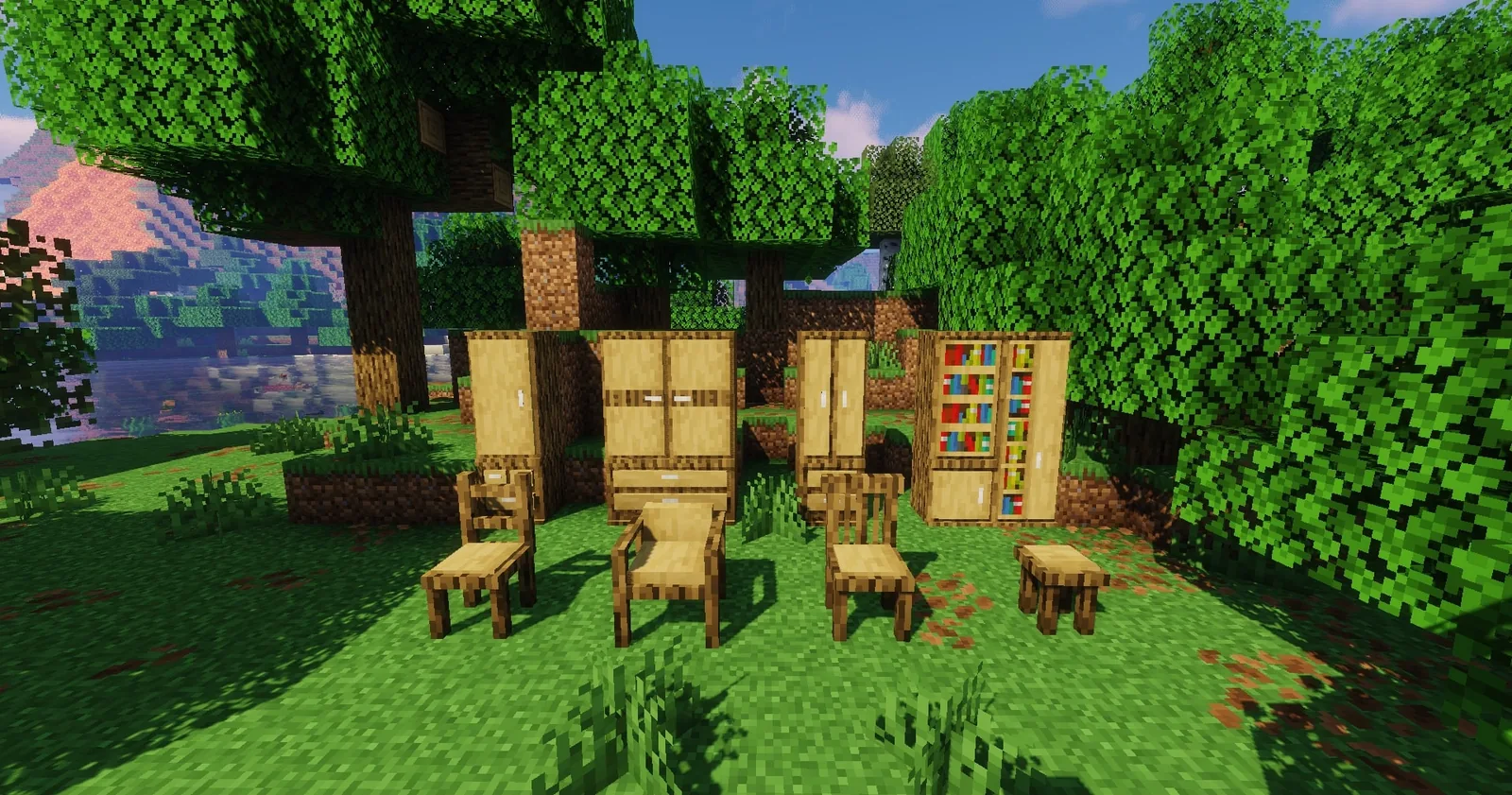
Materials that work
Music rooms want warmth and softness, which in Minecraft means wood, wool and carpet rather than stone.
A reliable palette: dark oak or spruce as structure, wool or carpet on the floor, bookshelves on at least one wall, and a single metallic accent – copper, gold blocks, or a few iron bars. The bookshelves matter more than they sound, because they are the only vanilla block with a texture that reads as “furnished interior” on its own.
What to avoid is a stone box. Our interiors without furniture mods guide covers building soft interiors from vanilla blocks, and our block palette guide covers the ratio between structure and accent that keeps a small room from feeling busy.
Images: Macaw’s Furniture project gallery.