Key takeaways
- Four block types – stairs, slabs, trapdoors, item frames – cover most furniture shapes.
- A room reads as lived in because of clutter and light, not because of furniture count.
- Scale matters: furniture that is one block too tall makes the whole room read as a doll’s house.
Furniture mods are convenient and they solve a problem that is mostly solvable already. Before installing one, it is worth knowing what the vanilla blocks can do, because a room built from them will survive every game update and every mod list change.
The parts list
Stairs make seats, sofas and worktops. Slabs make tables, shelves and low surfaces. Trapdoors make cabinet doors, shutters, and the fronts of anything that should look built rather than placed. Item frames hold the objects that make a surface look used – tools on a workshop wall, food on a kitchen counter.
Add carpets for softness, buttons and pressure plates for small details like handles and taps, and the vocabulary is essentially complete.
Rule one: scale down
A table should be one block high, not two. A chair should be a stair block, not a stair with a wall behind it. Beginners consistently build furniture a block too large, which makes a room feel like a set built for giants.
The reference is the player model: two blocks tall. Anything meant to be waist height is one block.
Rule two: light from fixtures
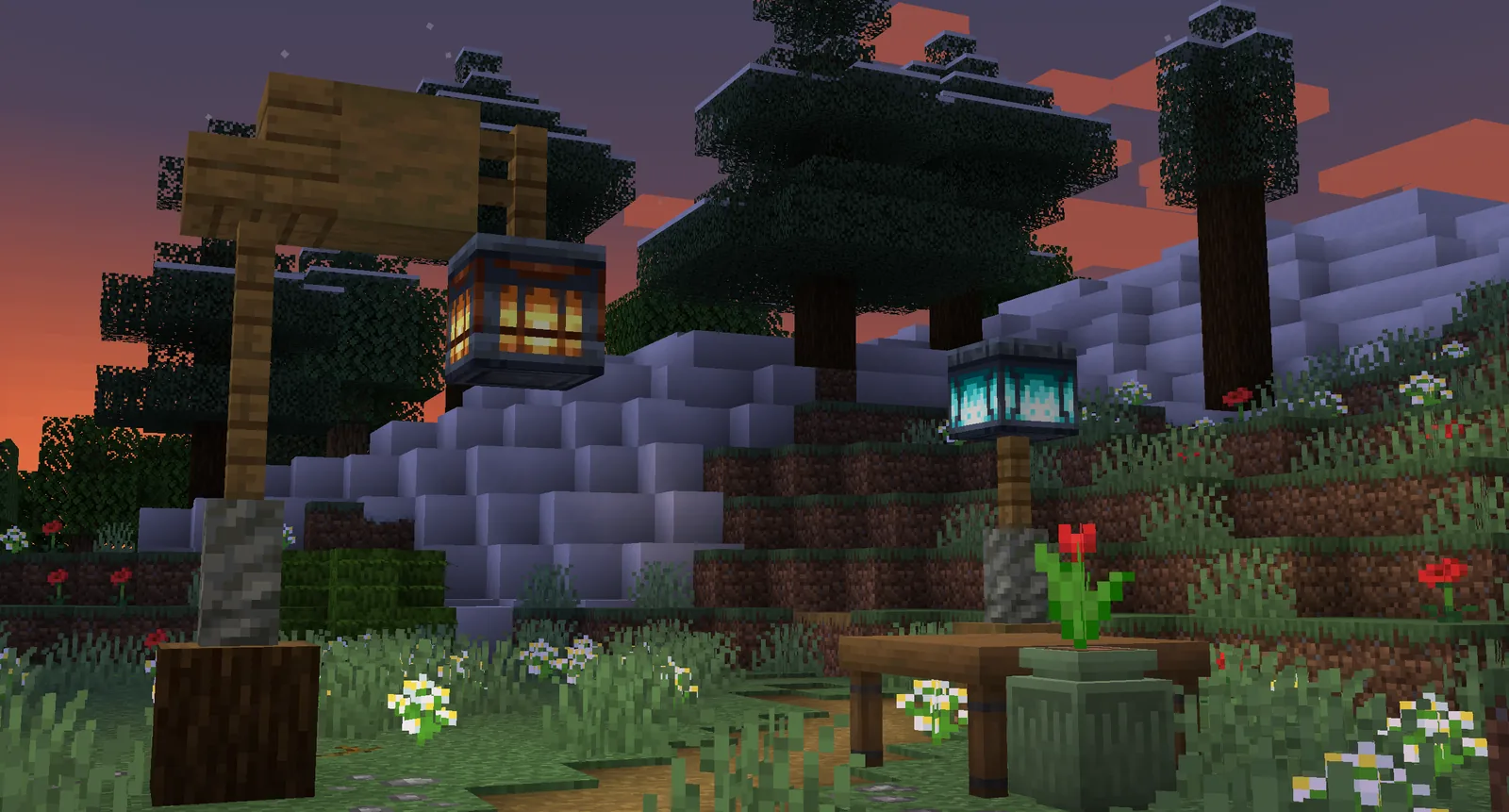
Torches on the wall read as survival lighting. A lantern hanging from a chain, a candle on a table, glowstone hidden behind a trapdoor or under a carpet – these read as designed. The light level is the same; the impression is not.
Rule three: clutter in one place
An immaculate room reads as unused. One corner of mess – stacked barrels, a couple of item frames, an open chest, a tool leaning against a wall – does more for believability than another piece of furniture.
Our view is that interiors are where most Minecraft builds stop, and the reason is that exteriors get photographed. A build that is finished outside and empty inside is extremely common on servers, and walking into one is the moment the illusion ends.
When a furniture mod is worth it
When you are furnishing dozens of rooms and the repetition is the problem, or when you need shapes vanilla genuinely cannot make – chairs with backs at the right scale, functional drawers, sitting animations. For one house, the vanilla blocks are faster than installing anything, and the palette question is covered in the palette guide.
Room by room
A kitchen needs a work surface, a heat source and storage: slabs for the counter, a furnace or smoker set into it, barrels underneath. A bedroom needs a bed, something beside it and a light. A workshop needs a bench, tools on the wall in item frames, and materials stacked where someone would actually put them.
Build to the function rather than to a shopping list of furniture, and the room fills itself.
The ceiling
Most interiors are built with a flat ceiling one block thick, because that is what the exterior left behind. Adding exposed beams – a line of fences, trapdoors or stripped logs – across the ceiling is the single cheapest way to make a room feel constructed, and it costs a dozen blocks.
Storage as decoration
Barrels, chests and shulker boxes are functional objects that also read as furniture. A wall of labelled storage is one of the few things in Minecraft that looks better the more used it is, which is why workshops and basements tend to be the best rooms in a survival base.
The organisation side of that is covered in the shulker storage guide.
When to stop
A room is finished when a player walking through it can tell what it is for. Adding detail past that point produces clutter rather than character, and the usual symptom is a room where you cannot actually reach the crafting table. Leave the floor space – people have to stand somewhere.
Scaling to a whole build
What works in one room becomes tedious across twenty. At that scale, either accept repetition – real buildings repeat, and identical rooms in a barracks read correctly – or install a furniture mod and spend the time on layout instead.
The block variety question underneath this is the same one every builder hits, and it is covered in the Blockus review.
Lighting an interior without torches
The quickest upgrade to any room is removing visible torches. Lanterns on chains, candles on surfaces, glowstone or sea lanterns hidden behind trapdoors or under carpet, and light sources tucked into ceiling beams all give the same light level with none of the survival look.
Light placement also directs attention. A brighter corner reads as the important part of a room, which is a free way to tell someone where to look – and it is the detail that most clearly separates a decorated room from a designed one.
Images: Twigs project gallery on Modrinth.