Rocket League is the only major esport where nobody had to explain the objective. Cars, a ball, a goal – a first-time viewer understands the win condition in three seconds, which is a structural advantage no other competitive title has.
Why readability matters in esports
Most competitive games are unwatchable without knowledge. A Dota teamfight is fifty simultaneous decisions rendered as coloured effects; a Counter-Strike round is information warfare with almost nothing visible. Both are excellent games and both require an investment before they become spectacle.
Rocket League requires none. The skill ceiling is enormous and the objective is a ball going into a net, which means a viewer can appreciate a play long before they understand it.
The competitive structure
- Ranked ladder – separate ranks per playlist, from Bronze through Supersonic Legend.
- Playlists – 1v1, 2v2 and 3v3 ranked separately, because they are genuinely different games.
- Tournaments – in-client bracket events on a schedule, open to any rank tier.
- The professional circuit – regional events feeding into international championships.
Ranking playlists separately is the design decision worth noting. A player can be excellent at 1v1 and mediocre at 3v3, because rotation and positioning in a team of three are a different skill from mechanical dueling.

Rotation, the invisible skill
What separates high-level play from mid-level play is not aerial mechanics. It is rotation – the constant repositioning that keeps one player back, one challenging and one available.
It is also almost invisible to a new viewer, which produces the strange situation where the most important skill in the game is the one nobody watches.
The mechanical ceiling
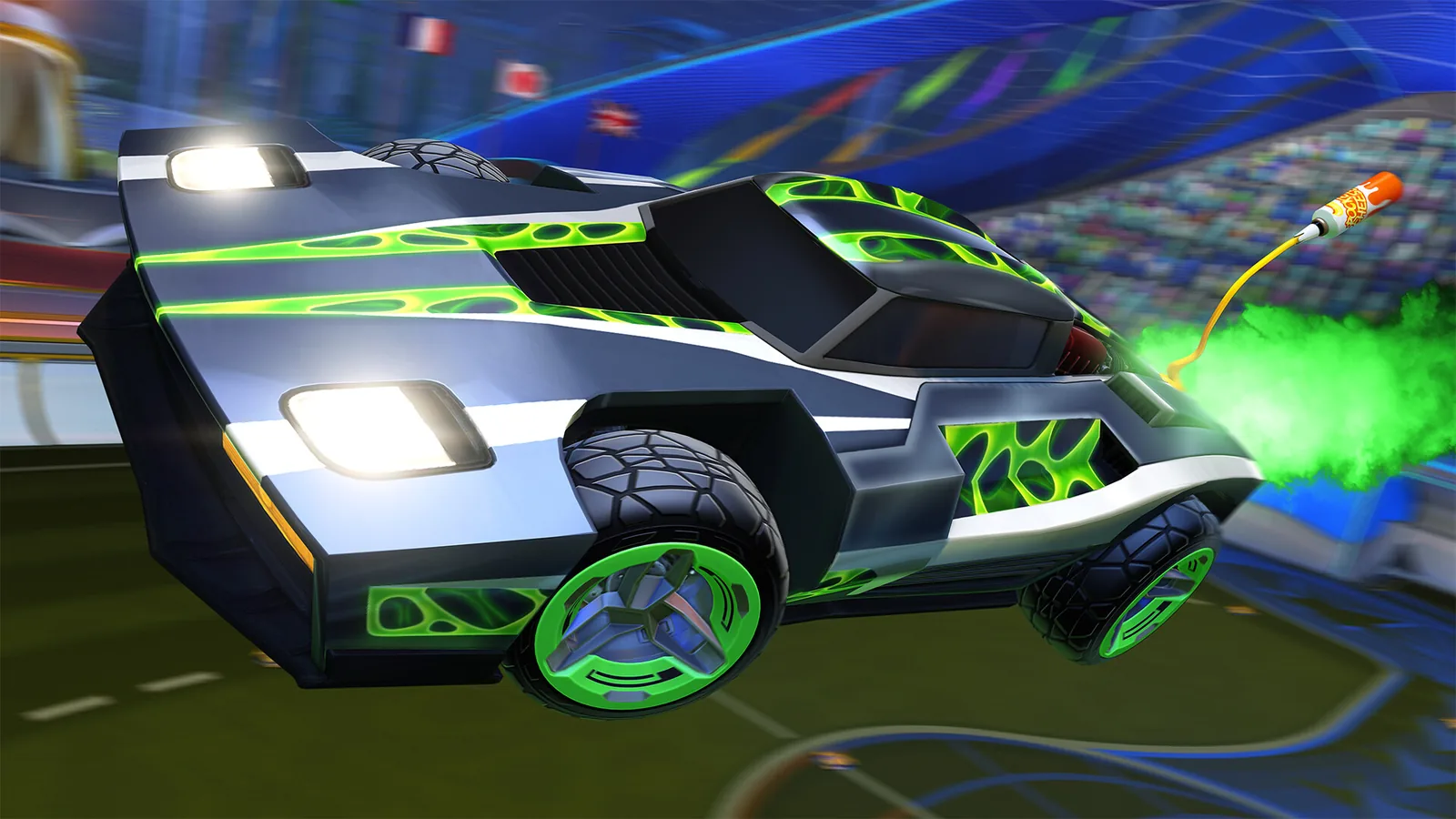
Aerials, flip resets, ceiling shots, air dribbles – the mechanical vocabulary has expanded continuously since 2015 without any changes to the game’s physics. Players found things the developers did not put there.
That is unusual and it is the same quality that keeps speedrunning communities alive: a system simple enough to be fully understood and deep enough to never be exhausted.
Why the game has not changed
Rocket League’s physics have been broadly stable for a decade. No new mechanics, no meta patches, no balance passes in the sense other esports mean.
That stability is the product. A player who learned a mechanic in 2017 still has it, and a viewer who understood the game then still understands it. Compare that to any game with a seasonal meta and the difference in accumulated community knowledge is enormous.
The cost of stability
Nothing new to learn also means nothing new to talk about. Games with patch cycles generate constant discussion; Rocket League generates discussion about players rather than about the game.
Whether that is a strength depends on what you want from a competitive scene. It produces deep player narratives and thin game narratives.
Cars as an identity system
Hitboxes are standardised across a small number of presets, so car choice is cosmetic in effect and identity in practice. The Octane’s dominance at high level is a hitbox story rather than a car story.
Standardising the mechanical properties while leaving the appearance free is a reasonable answer to the cosmetics-versus-fairness problem, and more competitive games could use it.
Where it sits now
A mature esport with a stable player base, a defined competitive structure, and the unusual property that its skill ceiling is still rising after a decade because the physics never moved.
Released in July 2015 by Psyonix, it remains one of the few competitive titles whose fundamental design has needed no revision.
The tournament structure in client
In-client tournaments run on a fixed schedule, are open to any rank, and seed you against teams near your tier. That lowers the barrier to competitive play further than almost any other esport manages – there is no sign-up process, no third-party platform and no minimum rank.
Most competitive scenes have a gap between ranked play and tournament play that players have to deliberately cross. Removing that gap is a structural decision worth more attention than it gets.
What it shares with other ladder systems
The underlying approach – visible tiers, seasonal resets, separate ratings per mode – is common across competitive titles, and the differences between implementations are mostly about how much rank decay and reset they apply.
The version Counter-Strike settled on is covered in the Premier rating piece, and the contrast is instructive: a single visible number against a tiered ladder produces different player behaviour at the same skill level.
Where the scene sits
- A stable regional structure feeding international events.
- A skill ceiling still rising after a decade of unchanged physics.
- An unusually low barrier between ranked and competitive play.
- A spectator product that needs no explanation.
Four properties most esports would trade something significant for, all of which came from decisions made before the game shipped.
A note on spectator ceilings
An esport’s audience is capped by comprehensibility more than by quality, and the games that need the least explanation reach the widest audiences regardless of their competitive depth. This one is the clearest demonstration of that in either direction.
What that costs everyone else, and what a broadcast has to do to close the gap, is covered in the observer piece.
Images: Rocket League store assets, Psyonix. Official site: rocketleague.com.