Mushroom fields is the rarest overworld biome in Minecraft and the only one where hostile mobs do not spawn naturally on the surface. That combination – rare, safe, visually unlike anything else – makes it the biome people specifically go looking for, and the one the world generator is least willing to hand over.
What makes it worth finding
Three things, in descending order of importance.
No surface hostile spawns. Mycelium blocks a large part of the normal spawning logic, which means a mushroom island is the only place in the overworld you can build without spawn-proofing the surrounding terrain. Caves underneath still spawn mobs normally, so this is not total immunity, but it removes the entire outdoor problem.
Mooshrooms. The only source of mushroom stew from a bowl and a cow, and the only mob that converts to a second variant when struck by lightning. Brown mooshrooms are a lightning conversion of red ones, not a natural spawn.
Huge mushrooms. An effectively unlimited supply of mushroom blocks, which are one of the better underrated building materials – brown mushroom blocks in particular have a texture that does not match anything else in the game.
Why they are hard to find
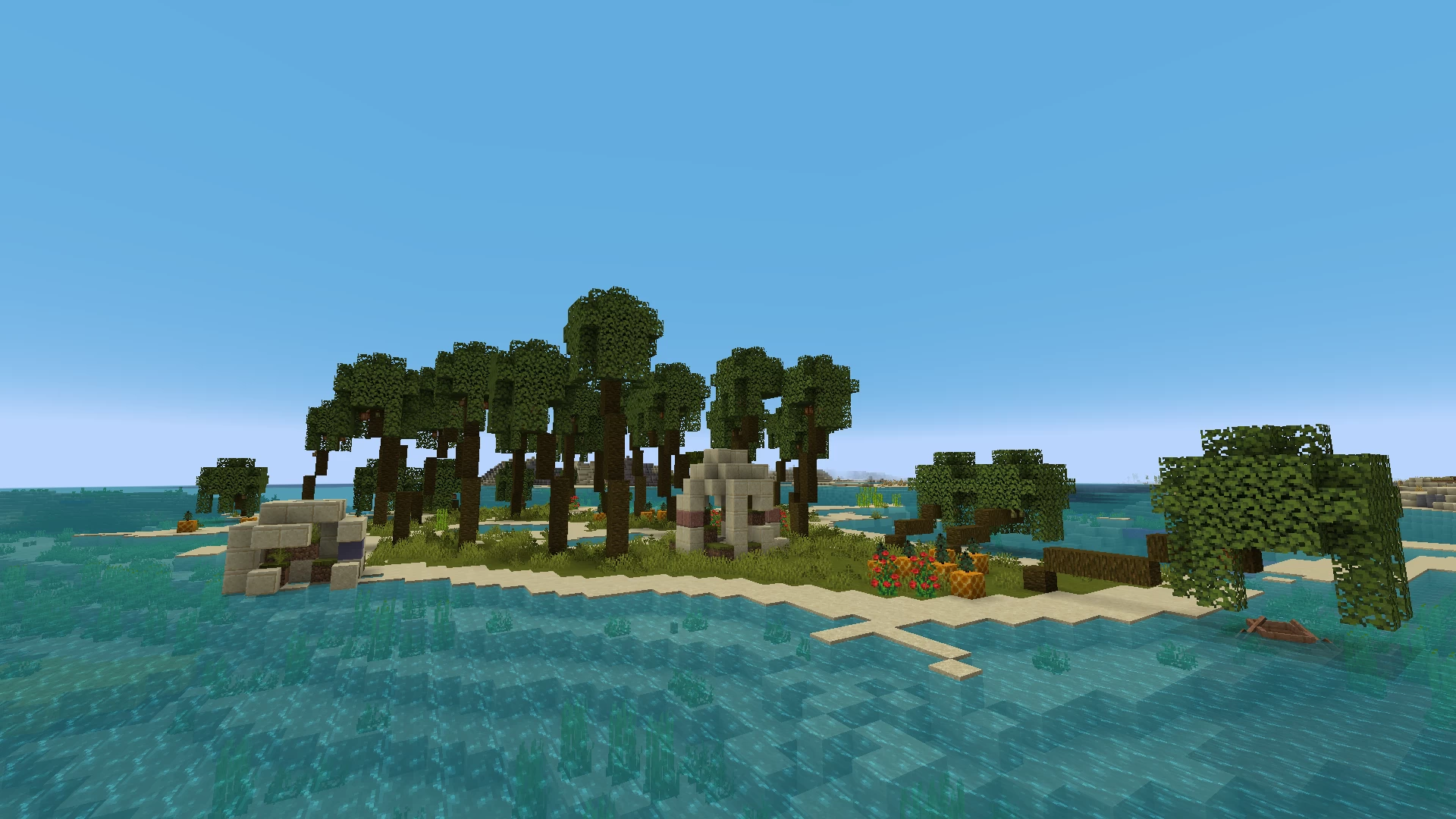
Mushroom fields generate as small islands surrounded by deep ocean, isolated from other land. That isolation is the defining placement rule: the biome is deliberately placed where you have to sail to reach it.
Practically that means overland exploration will almost never find one. You need to be crossing ocean, and you need to be looking. Render distance is the limiting factor – the islands are small enough that a normal render distance will sail you past one a few hundred blocks away without ever drawing it.
This is the single strongest argument for running a long-range terrain mod while you explore. Anyone who has done the search with LOD terrain rendering on will tell you it turns a multi-hour search into a twenty-minute flight.
Search strategy that works
- Use an elytra and rockets. Boats are too slow and too low. Altitude is what finds islands.
- Fly a grid, not a line. Pick a direction, fly two thousand blocks, turn ninety degrees, fly a few hundred, turn back. Lines miss everything either side of them.
- Look for the colour. Mycelium reads as purple-grey against ocean blue and green against every other biome. At distance the colour is the tell, not the shape.
- Follow deep ocean. Mushroom fields sit in deep ocean, not shallow. If you are over a shallow shelf, you are in the wrong water.
If you are not yet elytra-equipped, this is a reasonable thing to defer. The biome is not needed for anything, and searching for it on a boat is a genuinely poor use of an evening. A survival island start is a much easier way to get an isolated base if isolation is what you actually want.
What to do once you have one
The obvious move is a base, and the obvious mistake is clearing the mycelium to build on. Mycelium spreads like grass but cannot be created by the player – no bone meal, no silk touch shortcut, nothing. If you cover it with a floor and it converts to dirt underneath, you do not get it back easily.
Build on stilts or build up. Leave the mycelium layer intact and put your floor a block above it. This also preserves the no-spawn property, which is the actual reason you came.
The second move is a mooshroom pen, which is trivially easy since they breed like normal cows. Keep a few brown ones separated if you convert any, because lightning conversion is one-directional in practice and re-rolling is tedious.
The third, and the one most people skip, is lighting the caves underneath. Surface spawning is disabled; the cave system below is not, and a mushroom island with an unlit cave under it produces exactly the same night-time problem as anywhere else, just with fewer visible sources. The usual spawn-proofing rules apply below ground.
Reading a seed for one
If you are picking a world from a seed rather than exploring, mushroom fields are one of the few biomes worth filtering for at world creation, precisely because finding one later is so expensive. A seed with mushroom fields within a couple of thousand blocks of spawn is a materially different world from one where the nearest is fifteen thousand blocks out.
The rest of what to check before committing to a world is covered in reading a seed in the first ten minutes, but mushroom proximity is the one that most changes what a long survival world can do early.
Mushroom blocks as a building material
One underrated reason to keep a mushroom island on the map: the blocks themselves. Brown and red mushroom blocks, and mushroom stem, have textures that exist nowhere else in the game – organic, slightly irregular, and in the brown case a warm mid-tone that is hard to match with wood or stone.
They are awkward to farm at scale without a huge mushroom farm, which is exactly why they read as unusual when used. A roof in mushroom stem, a wall detail in brown mushroom block, or a set of organic shapes built from all three will not look like anything a viewer has seen a hundred times.
Collect them with a silk touch tool or an axe while you are there. Hauling a few stacks home from a biome you may not visit again is worth the inventory space.
Images: William Wythers’ Overhauled Overworld project gallery.