Portal shipped in 2007 as part of a bundle, ran about three hours, and is now one of the most-cited games in design discussion. It also began as a student project – and the way it was made is a better argument for the student-project pipeline than any amount of advocacy.
The mechanic
Two portals, linked. Momentum is preserved through them. Everything else in the game is a consequence of those two rules applied consistently.
That is the shape of most good experimental design: one rule, implemented without exceptions, explored until it is exhausted.
The teaching structure
Portal is the standard reference for teaching without a tutorial. The first chambers introduce one property at a time, in a space where the wrong answer is obvious and harmless, and the player discovers rather than reads.
- Show the mechanic working before the player controls it.
- Give them one portal, not two.
- Introduce momentum in a chamber where nothing else is happening.
- Combine two known properties before adding a third.
- Only then present a problem with no obvious solution.
That sequence has been copied so widely it now reads as obvious. It was not obvious in 2007.
Where it came from
The mechanic originated in a student project at DigiPen, whose team was hired and whose prototype became the commercial game. That story is the clearest example of the student pipeline producing something a commercial studio would not have generated internally.
The prototype and what happened to it are covered in the Narbacular Drop piece.
Why studios do not generate ideas like this
Because a commercial pitch has to survive a room, and “you shoot two holes and walk through them” does not survive a room without a playable prototype. The prototype is the argument.
Student teams and mod developers can build the prototype first because nobody is asking them to justify it in advance.
Scope as a feature
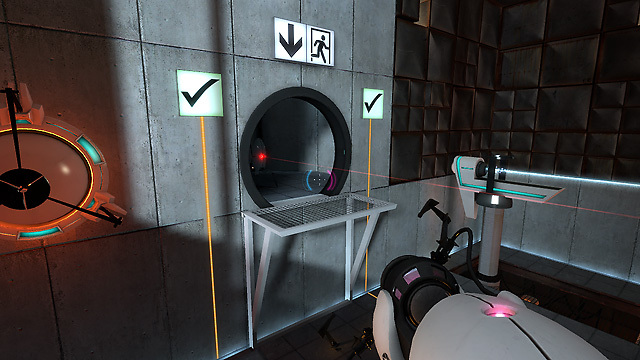
Three hours, nineteen chambers, one mechanic and no filler. Portal is short because the idea is fully explored in that time, and extending it would have meant repeating puzzles.
Knowing when an idea is finished is a rarer skill than having one, and commercial pressure almost always pushes the other way.
The showcase route
Prototypes that reach commercial games usually pass through somewhere that developers see them – a student showcase, a festival, a workshop session at a conference. Those venues are the transmission mechanism.
The one this site’s domain is associated with ran for two decades in exactly that role, and what it showed and what came of it is documented on our impact page.
What the game demonstrated
- A single mechanic can carry a full game if it has enough properties.
- Teaching can be environmental rather than textual.
- Short is a valid length.
- Tone can carry a game with almost no narrative machinery.
All four were contrarian positions at the time and all four are now standard advice, which is a reasonable definition of influence.
Its afterlife
Portal’s puzzle structure appears in dozens of subsequent games, its teaching approach in hundreds, and its tone in an entire era of independent writing. Very few three-hour games have that reach.
The route from a student prototype to that outcome is the whole argument for funding, showing and paying attention to work that has no commercial case yet.
The companion cube
A crate with a heart on it that the game asks you to destroy. It is the most-cited emotional beat in a game with almost no narrative machinery, and it works because the player has spent twenty minutes carrying it through puzzles.
Attachment produced by mechanical interaction rather than by writing is the same principle the rest of the game runs on, applied to feeling rather than to teaching.
Momentum as the second mechanic
Portals alone would be a teleportation puzzle game. Preserving momentum through them turns it into a physics game, and almost every memorable chamber in the game depends on that second rule rather than the first.
One mechanic with two properties produces far more than two mechanics with one each – a general principle that shows up repeatedly in experimental design.
Length as a commercial risk
Three hours was a difficult sell in 2007, which is why the game shipped in a bundle rather than alone. It has since become a reasonable length for a commercial release, largely because independent games proved an audience existed.
Knowing when an idea is finished is rarer than having one, and it is a recurring property of work that comes through the experimental pipeline – covered in the game jams piece.
Images: Portal store assets, Valve. Official site: thinkwithportals.com.