Deckbuilders were a card game subgenre for a decade and then became one of the most reliably interesting structures in independent games. The reason is that a deck is a readable representation of a strategy, and watching your own strategy accumulate is a different pleasure from executing one.
What a deckbuilder actually is
You start with a weak set of cards. You acquire more. The cards you add change what your deck does, and the cards you remove change it as much. Each run is a strategy assembled from what was offered rather than chosen in advance.
The critical mechanic is not adding cards. It is removing them, because a deck with everything in it does nothing reliably.
Why it pairs with run-based structure
A deck is state that only makes sense within a run. Carrying it between runs would remove the point; resetting it each time makes every run a fresh assembly problem.
That pairing – deck as run state, knowledge as permanent progress – is the same structure that makes roguelikes work, and the two genres merged almost immediately once someone tried it.
Readability as the advantage
The reason deckbuilders are unusually easy to learn and unusually deep is that the whole strategy is visible. You can look at your deck and see what you are trying to do.
Compare that to a character build in an action game, where your strategy is distributed across stats, gear and muscle memory and cannot be inspected. The deck is a design document you assembled by accident.
Randomness done right
- Offered choices are random; which you take is not.
- Draw order is random; deck composition is not.
- Enemy patterns are usually deterministic and telegraphed.
- Removal opportunities are limited, which makes them decisions.
The distinction between random offers and random outcomes is the whole craft here. A game that randomises what you are given is generating decisions; one that randomises what happens is generating frustration.
The card game inheritance
Collectible card games solved several problems first – resource curves, card advantage, tempo – and deckbuilders inherited all of it without inheriting the collection economy.
Removing the collection is what made the genre viable as a single-purchase product. The strategy layer was already proven; what changed was that nobody had to buy packs.
Rotation, and why card games need it
The economics that deckbuilders escaped are the ones that make competitive card games need rotation. An ever-growing card pool becomes unbalanceable and unapproachable, so older sets are retired.
That is a structural necessity rather than a monetisation choice, though it functions as both, and every long-running card game has arrived at it.
Where the design idea came from
The mechanic predates video games – the tabletop deckbuilding genre established it – and the translation into a run-based digital structure is the innovation. That is a common pattern in experimental design: an existing mechanic moved into a context that changes what it means.
The same pattern shows up repeatedly in the prototypes that reached wider audiences, and the Braid piece covers another instance of one idea carried into a genre that had not used it.
What the genre still has not solved
- Late-run decisions that are obvious rather than interesting.
- Runs that are decided early and take another hour to finish.
- Difficulty scaling that makes certain starts non-viable.
- Making deck removal feel as good as deck addition.
That last one is the open design problem. Every player knows removal is the strongest move and almost no game makes it feel like a reward.
Why it keeps producing good games
Because the structure is cheap to build and expensive to exhaust. A small team can make a deckbuilder; nobody has made the definitive one, and the space of card interactions is effectively unbounded.
The three-act shape of a run
- Early – the deck does nothing, and every card is an improvement.
- Middle – a strategy is visible, and the question becomes what to cut.
- Late – the deck does one thing well, and the remaining decisions are small.
The middle act is where the genre lives, and the late act is where most deckbuilders lose players – once a strategy is assembled, executing it is mechanical.
The designs that handle this best add a late-run pressure that forces the deck to adapt rather than execute.
Comparison with a collectible card game
A competitive card game front-loads the deck decision entirely – you build before you play, and the match tests execution. A deckbuilder inverts it, building during play and testing assembly.
Those are almost opposite skills, which is why players of one are frequently uninterested in the other despite the shared surface.
Why it survived the roguelike merge
Because a deck is a natural run-scoped object. Roguelikes struggled for years with what should carry between runs; a deck answers that question by existing only inside one.
The version of that answer in a platformer is covered in the Spelunky piece, where the equivalent run-scoped object is the player’s own knowledge.
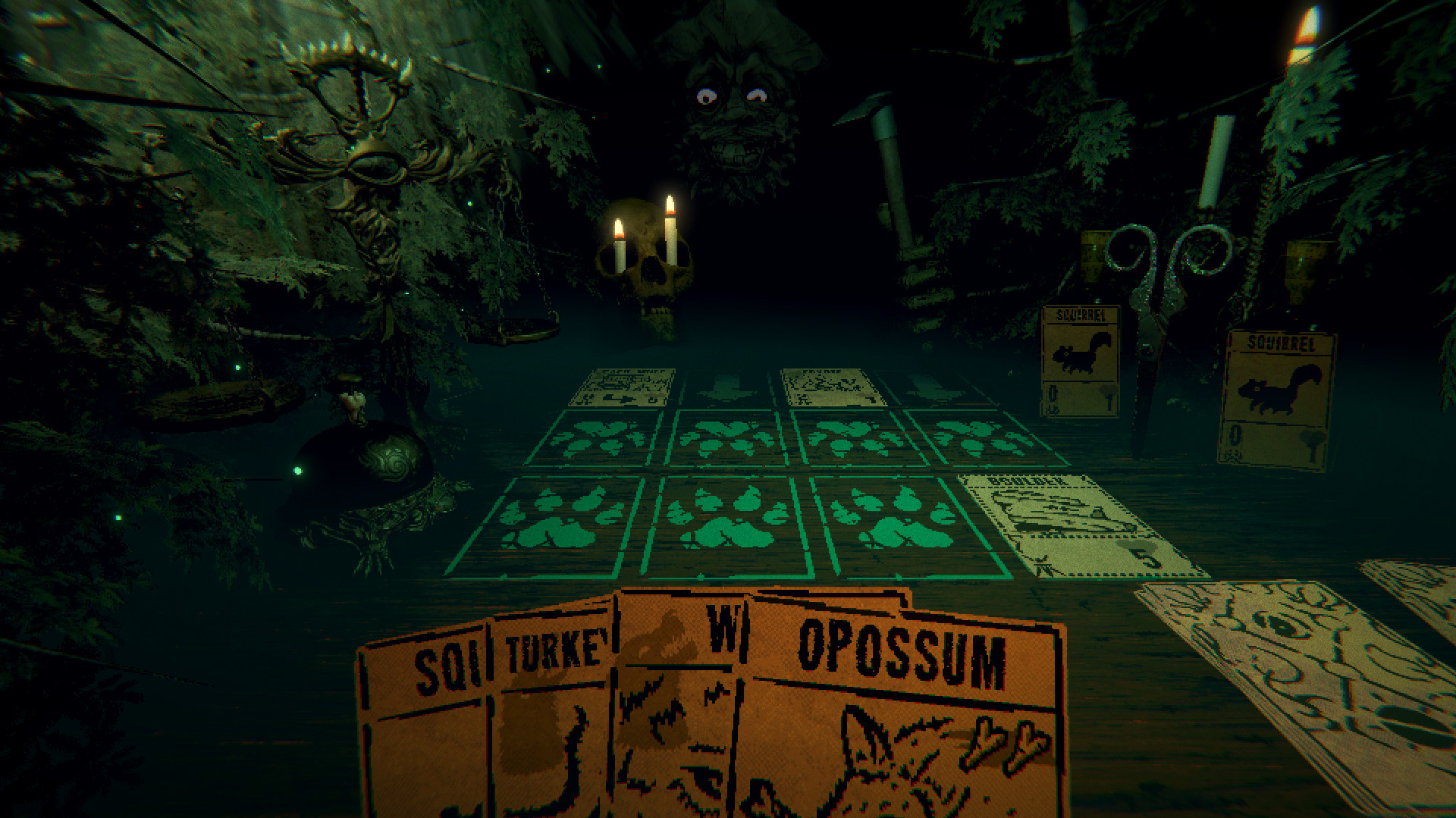
Images: Inscryption store assets, Daniel Mullins Games. Official site: inscryption.com.