Spelunky was released as freeware in 2008, remade in HD in 2012, and produced a sequel in 2020. In between, it changed what “roguelike” meant to an entire generation of developers – and it did so by taking one idea from a 1980 game and putting it in a platformer.
The idea it borrowed
Permadeath with procedural generation. Not the turn-based grid, not the ASCII art, not the inventory systems – just the two structural properties that make a run meaningful: the level is different every time and death ends it.
Separating those two properties from everything else the genre carried is the move that made the modern roguelike possible.
Why it works in a platformer
Because a platformer’s difficulty is mechanical and immediate. A roguelike’s difficulty is informational and cumulative. Combining them means every run tests both your execution and your knowledge, and the knowledge persists across deaths even though nothing else does.
That is the genre’s central pleasure: you get better, not your character.
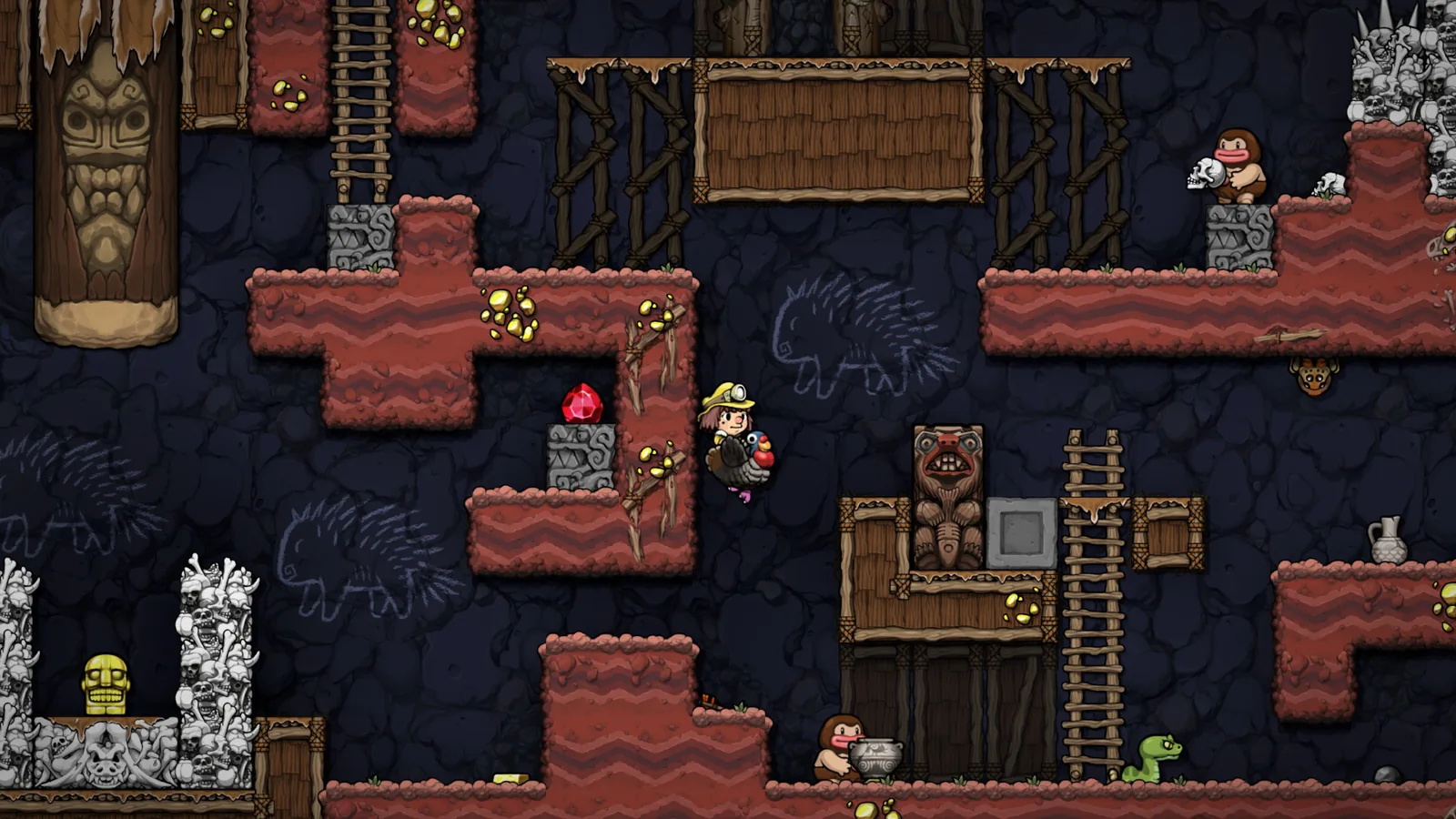
Systemic interaction
Spelunky’s reputation rests on emergent situations that nobody scripted. A shopkeeper angered by an accidental bomb, an arrow trap that kills the thing chasing you, a boulder that clears a path and then a room.
The design principle is that every object obeys consistent rules and interacts with every other object. Nothing is special-cased, which means combinations the developer never considered still behave sensibly.
What that requires
- A small number of objects with well-defined behaviour.
- Rules that apply universally rather than contextually.
- Physics and damage that treat the player like everything else.
- Resisting the urge to special-case anything.
That last point is the discipline. Every special case removes an interaction, and enough of them turn a systemic game into a scripted one.
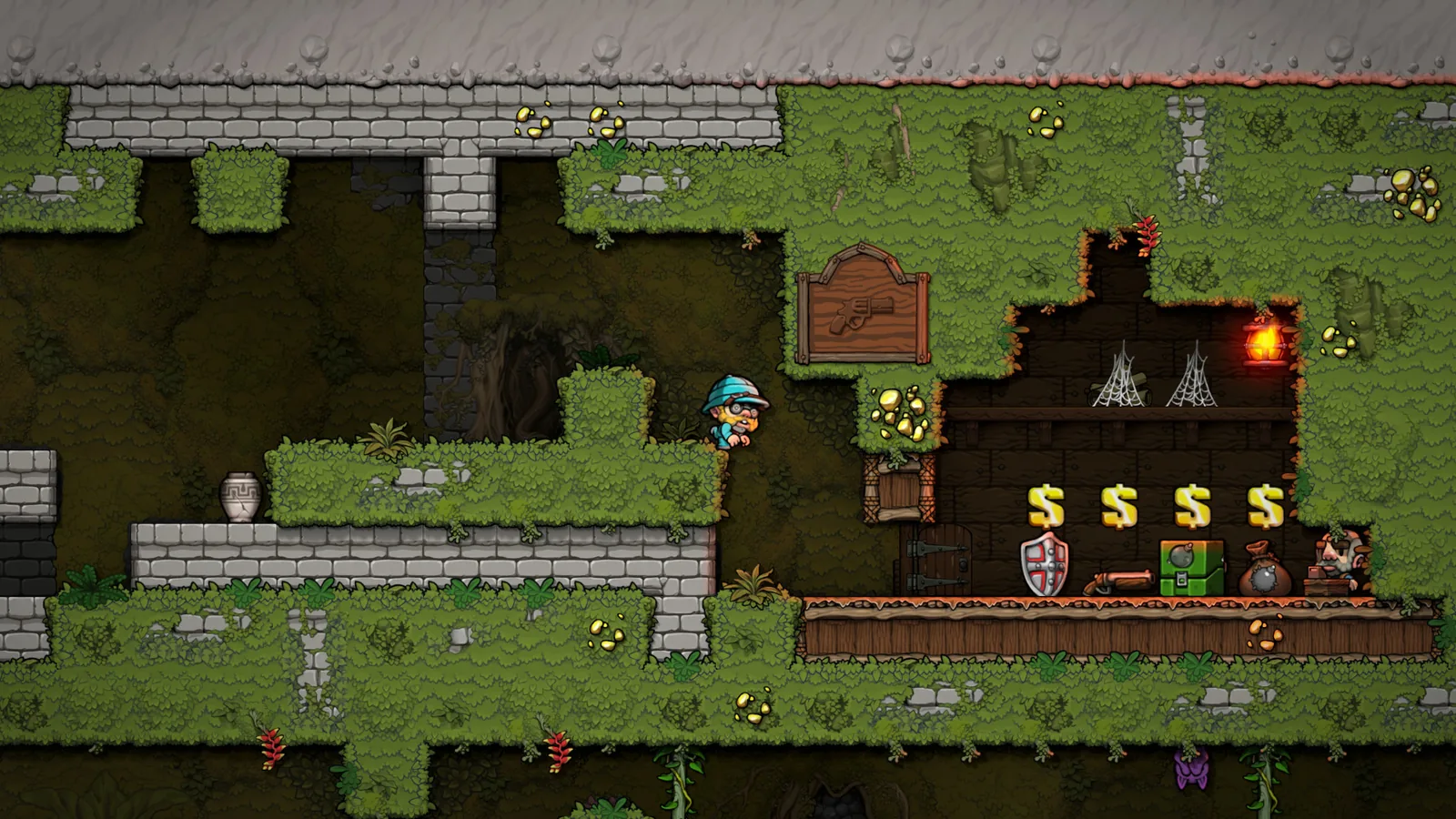
The generation
Levels are assembled from hand-authored room templates placed along a guaranteed path, with the rest filled in. That hybrid – authored pieces, procedural arrangement – is now the standard approach and was not obviously the right answer in 2008.
Pure procedural generation produces incoherent spaces. Pure authoring produces repetition. The hybrid gives you variety with a floor on quality.
What it enabled
The decade after Spelunky produced an enormous number of games built on the same structural insight applied to different genres – card games, shooters, dungeon crawlers, deckbuilders. The common ancestor is visible in all of them.
That kind of influence is what experimental work is for, and it rarely comes with credit attached. The pipeline that carries ideas from a prototype to the mainstream is the subject of our longer piece on the last two decades.
The freeware version mattered
It was free, it was small, and anyone could try it. That distribution model is why the idea spread rather than staying a curiosity – developers played it because there was no barrier to playing it.
The same property made the Experimental Gameplay Project’s output influential: a prototype anyone can download in a minute reaches more developers than a commercial release. The World of Goo story is the clearest example of that route working.
Difficulty as a design position
Spelunky is hard and does not apologise. Death is frequent, runs are short, and the game assumes you will lose hundreds of times before winning once.
That was a commercially risky position in 2008 and is close to a genre convention now, which is itself a measure of the game’s influence.
Where it sits
One of the small number of independent games whose structural ideas became genre defaults. Twenty years on, almost every run-based game owes it something, and most of them do not know it.
The shopkeeper
The most-discussed single element in the game, and a good case study in systemic design. Anger a shopkeeper and he hunts you for the rest of the run, with a shotgun, at a speed you cannot outrun.
Nothing about that is scripted as a punishment. He is an entity with rules, and the rules produce a consequence proportional to the provocation. Players talk about him constantly because the situations he creates are their own stories rather than the developer’s.
Daily challenges
One seed, one attempt, shared by everyone. That format has been widely copied and it works because it converts a single-player run-based game into a comparable performance.
It also solves the replayability problem for run-based games without adding content, which is the cheapest possible feature with that effect.
What the genre took and what it left
- Took – permadeath, procedural levels, systemic interaction, short runs.
- Took – knowledge as the progression, at least initially.
- Left – the difficulty. Most modern successors are considerably gentler.
- Left – the absence of meta-progression, which almost everything since has added.
That last point is the genre’s biggest divergence from its ancestor, and it is a commercial decision rather than a design one – permanent unlocks keep players returning in a way pure skill progression does not.
Images: Spelunky 2 store assets, Mossmouth. Official site: spelunkyworld.com.