Nvidium 0.4.4-beta5 released on 29 August 2026 with a fix that explains a bug players had been reporting for months: chunks failing to render entirely in areas with a lot of glass or water. The cause was a counter that could not count high enough.
The bug, technically
Translucent quads – the faces of transparent blocks – were counted in a 16-bit signed integer, which tops out at 32,767. A chunk section with more translucent faces than that overflowed, and the section did not render.
Bumping the type from short to int raises the ceiling to a number no Minecraft chunk will ever reach.
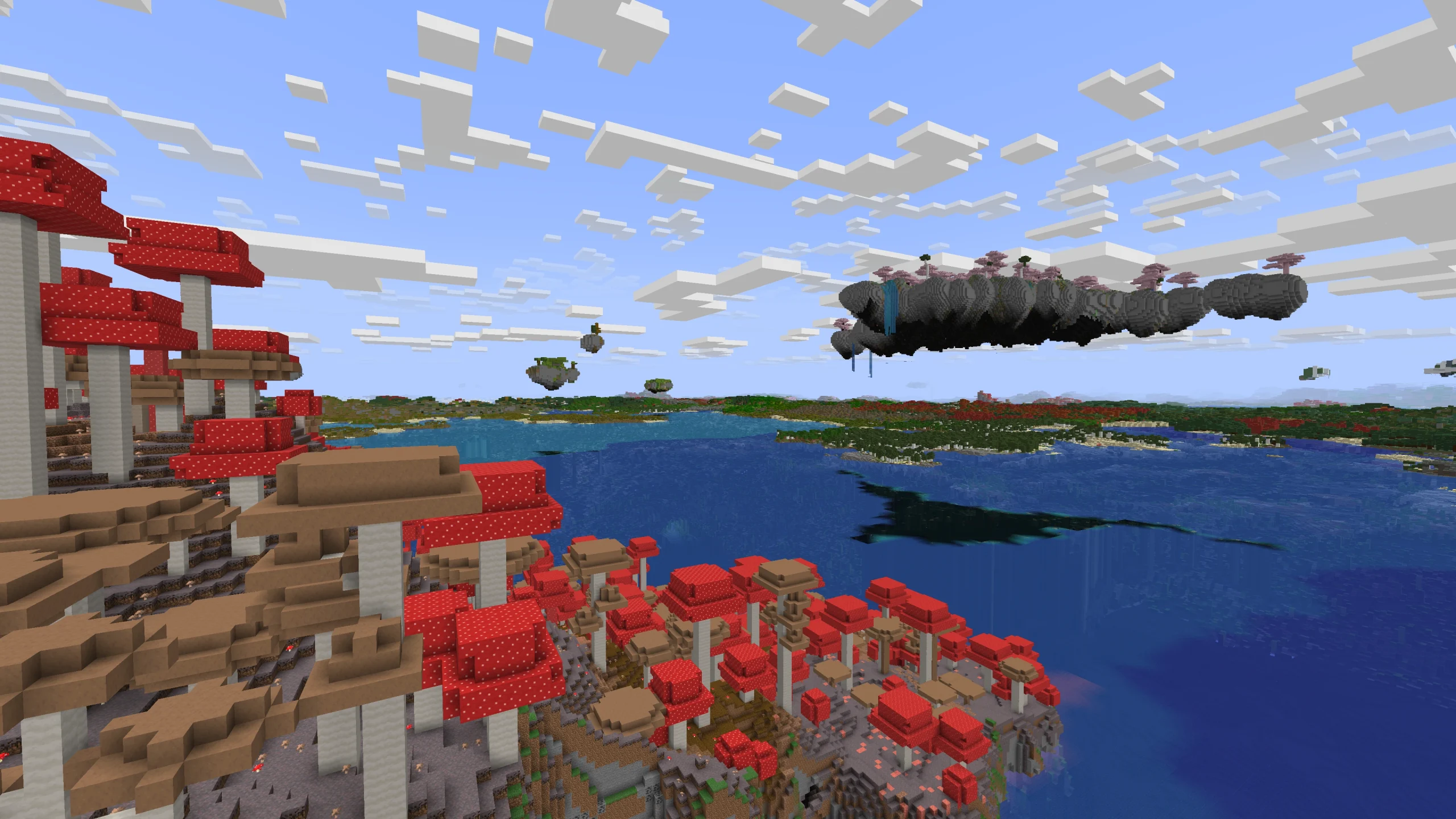
Where it showed up
- Large glass structures – greenhouses, domes, glass towers.
- Ocean monuments and deep water viewed from distance.
- Ice fields, which are translucent and easy to forget.
- Any build with stained glass used at scale.
Players hitting it saw a hole in the world where a section should be. Players not building with glass never saw it at all, which is why it took so long to characterise.
Why transparency is expensive everywhere
Because transparent faces cannot be drawn in arbitrary order – they have to be sorted by distance every frame the camera moves. That sorting is the reason transparency costs more than opaque geometry in every renderer, not just this one.
It is also why the vanilla game did its own transparency work this year, and why glass-heavy builds feel the difference. How the game decides what to draw covers the opaque half of the same problem.
The vendor-specific tradeoff
Nvidium exists because targeting one GPU vendor allows assumptions a general renderer cannot make. The gain is large. The cost is bugs like this one – failure modes that most players cannot reproduce and that take months to pin down.
That is the deal, and it is a reasonable one if you have the hardware and can tolerate a beta.
Render distance and the other bottleneck
The reason to run Nvidium is high render distance, and high render distance moves the limiting factor to how fast chunks can be built rather than drawn. That shows up as stutter while moving, not as a low frame rate.
Anyone raising render distance after installing it should read what actually helps with chunk loading stutter first, because the two problems get confused constantly.
Release line
- 0.4.4-beta2, 16 July 2026.
- 0.4.4-beta3, 17 July 2026 – GlProgram caching fix.
- 0.4.4-beta4, 25 August 2026.
- 0.4.4-beta5, 29 August 2026 – translucent quad counter fix.
Builds ship for 26.1 and 26.2 in parallel. Requires Sodium and an Nvidia GPU; there is no fallback path.
Why a 16-bit counter was there at all
Memory. A renderer tracking millions of small pieces of geometry saves real space by using smaller types, and 32,767 translucent faces per section looked like far more than anyone would build.
Players build more than anyone expects. That is the recurring lesson of every fixed limit in this game.
How to tell it was this bug
- A whole chunk section missing, not individual blocks.
- Only in areas with heavy glass, ice or water.
- Reappearing when you move away and back, sometimes.
- Nvidia GPU, Nvidium installed.
The last item narrows it immediately. Disable the mod; if the section returns, it was this.
Translucency versus transparency
Minecraft treats them separately. Transparent blocks like leaves are either drawn or not per pixel. Translucent ones like glass and water blend with what is behind them, which is what forces the distance sorting.
Ice, stained glass, water and honey blocks are all translucent. A build with a glass roof over a water feature is hitting both.
Reporting renderer bugs
- Note the exact GPU and driver version.
- Say which rendering mods are installed, all of them.
- Describe what is missing – blocks, sections, or entities.
- Say whether it persists across a relog.
- Screenshot from a fixed position.
Vendor-specific bugs are unreproducible for most people, which makes a precise report the difference between a fix and a closed ticket.
Is it worth running?
If you have the hardware, want render distances above 32 chunks, and can live with occasional beta behaviour – yes, and nothing else matches it. Otherwise Sodium alone is the sane configuration and always has been.
Fixed limits in Minecraft have a long history of being discovered by builders rather than by developers, and the pattern is always the same: a number chosen as obviously-large-enough, and someone eventually building past it. Height limits, entity counts, chunk section geometry, and now translucent quads. It is a reasonable way to write software and a guarantee of eventual bug reports, because the one thing this game’s players reliably do is exceed the expected scale.
Images: Nvidium and Distant Horizons project galleries on Modrinth.