Key takeaways
- Tekken 8 uses a single points ladder with 29 named ranks, from Beginner to God of Destruction, and points carry across the whole climb.
- Rank is tied to individual characters, while Tekken Prowess is the account-level number that reflects progress across the roster.
- Points gained scale with the skill gap, so beating someone above you is worth more than grinding wins against players below.
Fighting game ladders have two jobs that pull against each other. They have to measure skill accurately enough that matchmaking works, and they have to feel like progress so people keep playing. Most games pick one. Tekken 8 tries to do both with a single long points ladder and a lot of named milestones along it.
The result is a system that is easy to understand and surprisingly hard to argue about, which is rare in this genre. Here is how it actually works and where the design shows its seams.
The ladder, in order
Tekken 8 removed the Kyu ranks that Tekken 7 used below Dan and replaced them with a continuous climb. The groupings, with the points needed to enter each:
Entry. Beginner at 0, then 1st Dan at 400 and 2nd Dan at 1,000.
The core climb. Fighter 1,600. Strategist 2,600. Combatant 3,400. Brawler 4,200. Ranger 5,400. Cavalry 6,400. Warrior 7,400. Assailant 9,200. Dominator 10,800. Vanquisher 12,400. Destroyer 14,700. Eliminator 16,600.
Dragon ranks. Garyu 18,500. Shinryu 23,100. Tenryu 27,300.
Ruler ranks. Mighty Ruler 31,500. Flame Ruler 36,500. Battle Ruler 41,100.
Deity ranks. Fujin 45,700. Raijin 52,300. Kishin 58,500. Bushin 64,700.
Tekken ranks. Tekken King 70,900. Tekken Emperor 79,100. Tekken God 87,900. Tekken God Supreme 97,300. God of Destruction 109,700.
Twenty-nine named ranks is a lot, and that is deliberate. The gap between thresholds widens as you climb, so early ranks arrive fast and late ones take a very long time – but there is always a next name visible, which is the whole point of a long ladder.
How points move
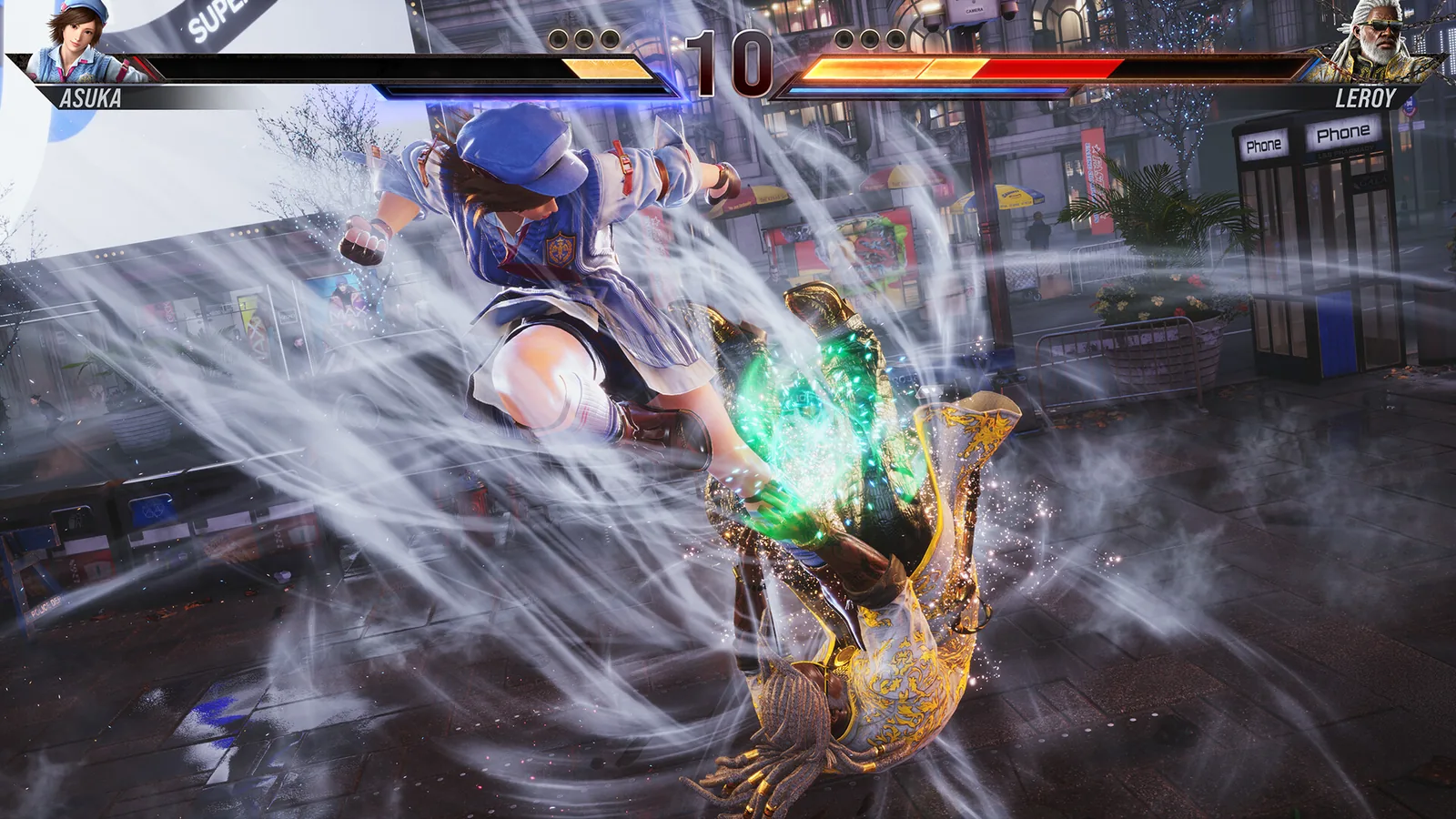
Ranked matches are the only way to move the number. Wins add points, losses subtract them, and the amount depends on the skill difference between you and your opponent.
That scaling is the most important mechanic in the system and the most misunderstood. Beating someone well above your rank is worth a large chunk; beating someone below it is worth very little. Losing to someone below you costs more than losing to someone above.
Two consequences:
- Grinding down is pointless. You cannot climb meaningfully by beating people worse than you, which closes the most common way players inflate a rank in other games.
- Playing above your level is cheap. The downside of losing to a stronger opponent is small, which makes challenging up the correct strategy.
Demotion exists – you can drop a rank by losing points – which is what keeps the number honest. Offline rank does not lose points and is described as a measure of experience rather than skill, so the two should not be compared.
Rank is per character
This is the structural decision that defines the whole system. Ranks are tied to individual characters, not to your account. An experienced player picking up someone new starts at a very early rank and climbs again.
The argument for it. Character knowledge is a large fraction of fighting game skill – matchups, combo routes, frame data, punishes. Someone with two thousand matches on one character and twenty on another is genuinely two different players, and a single account rating would mislead both the matchmaker and the opponent.
The argument against it. It taxes experimentation heavily. Trying a new character means losing to players well below your actual level, which is unpleasant for both sides, and many players respond by never switching. In a game with a large roster that is the opposite of the intended behaviour.
Street Fighter 6 made the same choice and runs into the same problem – our breakdown of that system covers how it differs, most notably by switching to a separate rating number at the top rather than continuing one ladder.

Tekken Prowess
Prowess is the account-level number that sits alongside per-character rank. It mainly reflects overall progress through the ranks across the roster, and it rises as you climb with any character.
The important behaviour: Prowess stalls if you only play one character. Once that character’s rank stops moving, Prowess stops moving, because a large part of the calculation comes from ranks achieved across the roster rather than from one peak.
That is a clever patch on the per-character problem. The ladder punishes you for switching characters; Prowess rewards you for it. Neither system is adjusted – a second number is added that pulls the other way.
Whether it works is a different question. Prowess is visible but it does not gate anything, it does not affect matchmaking, and the exact calculation is not published. A reward that is purely a displayed number competes poorly against a ladder that costs you a visible rank, and most players optimise for the thing with teeth.
What the design gets right
The skill-gap scaling. Making wins against stronger players worth more and wins against weaker players worth almost nothing is the cleanest possible answer to rank inflation, and it requires no extra systems.
One continuous ladder. Twenty-nine ranks on one points scale means there is never an ambiguous boundary, never a separate rating system to learn, and never a point where the rules change under you. Compare that to systems that switch models at the top – our CS2 Premier breakdown covers a game that went the other way with a single rating number and no names at all.
Widening thresholds. Early ranks arrive quickly, which keeps new players engaged. Late ranks take thousands of points, which keeps the top ranks meaningful. The curve does the pacing work that a tier system would otherwise need rules for.
Where it strains
Twenty-nine names is too many to be legible. Nobody outside the community knows whether Vanquisher is above or below Dominator, and the groupings are not labelled in game. A rank system people cannot read at a glance loses most of its social function.
The per-character tax has no relief valve. Prowess is not a solution, it is an acknowledgement. There is no reduced-stakes ranked environment for learning a new character, which means the game’s large roster is effectively smaller than it looks for any individual player.
Demotion in a game with no team to blame. Losing rank in a one-on-one game is a purely individual signal, and fighting games have the steepest variance in match quality of any competitive genre. Our notes on ladder design cover why that pressure shapes how often people queue at all.
Overall it is a well-reasoned system whose main flaw is doing too much of its communication through names. The mechanics are sound; the interface to them is a list you have to memorise.
Images: Tekken 8 project gallery.