Nobody reads the manual and nobody wants a tutorial. The games that solve this do not solve it with better text boxes – they solve it by building the first ten minutes so that the only available action is the one the player needs to learn.
It is a level design problem wearing a UX costume, and it is worth looking at how three very different games handled it.
The constraint that makes it work
Teaching without instruction requires the designer to control what is possible, not what is suggested. A hint says “try jumping”. A corridor with a gap in it says the same thing and cannot be ignored.
The critical property is that the player must not be able to proceed by accident. If a mechanic can be bypassed, half the audience will bypass it and then hit a wall forty minutes later without knowing what they missed.
This is why opening areas in well-taught games are small. A large space offers too many options for the designer to guarantee anything.
Subnautica: the shallow water is the tutorial
You start floating next to a burning ship. The water immediately around you is shallow, bright, and contains nothing dangerous. Everything the game will later ask you to do – swim, dive, hold breath, gather, craft – is available in that first area with the consequences turned down.
The depth gradient does the teaching. Go a little deeper, it gets darker and your air becomes a consideration. Go deeper still and it becomes the consideration. The game never explains the oxygen system as a system; it lets you discover the limit by hitting it in water shallow enough to survive.
What makes this work is that the danger increases continuously rather than in steps. There is no moment where the difficulty jumps, so there is no moment where a player who missed something gets punished for it.
Hollow Knight: geometry as instruction
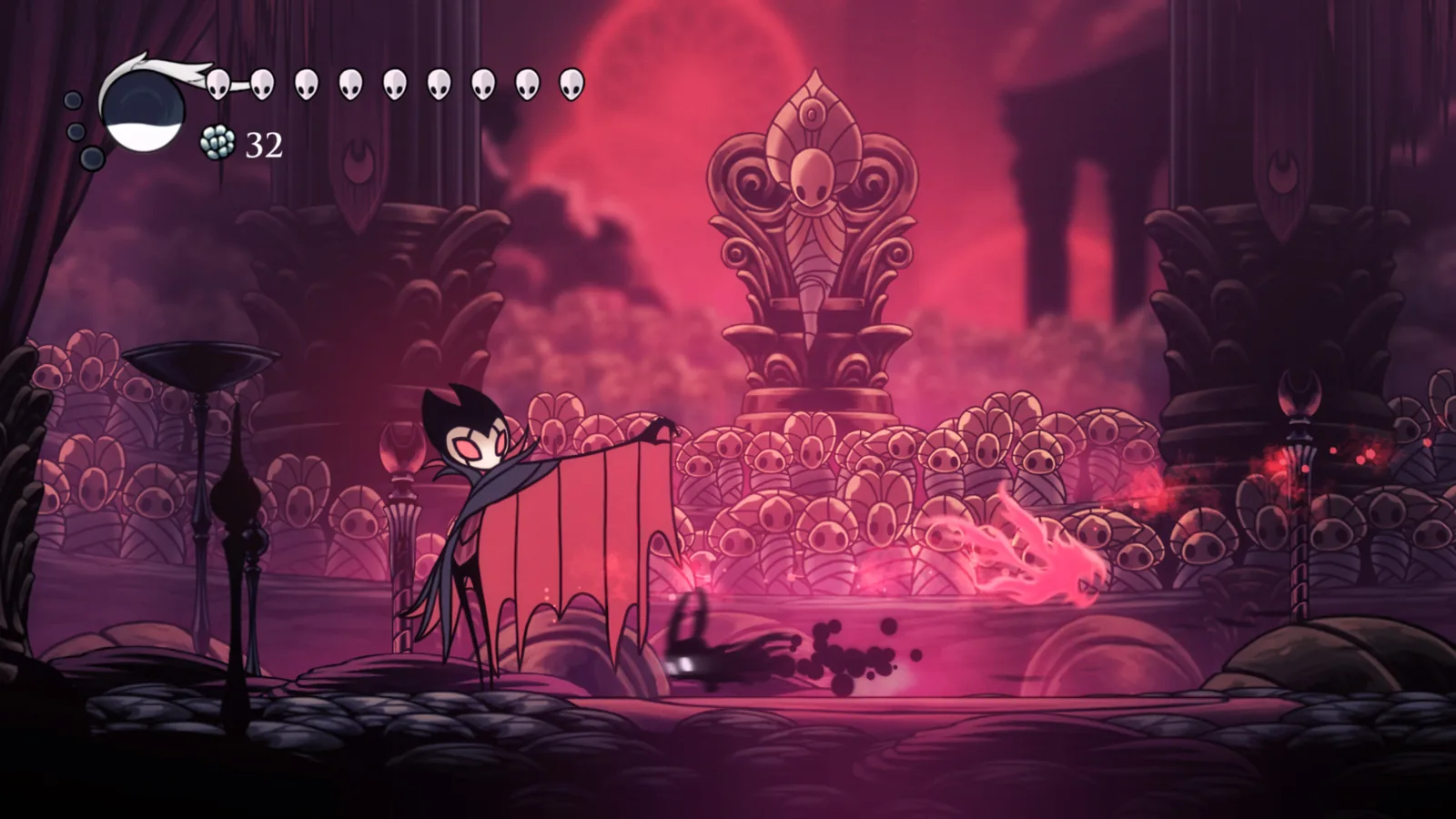
Hollow Knight opens with a long walk and very little happening, which is deliberate. By the time you reach anything that can hurt you, you have already learned the movement speed, the jump arc and the attack range, because there was nothing to do except use them.
The game then teaches through gaps. A ledge slightly too high tells you there is a jump upgrade you do not have. A gap slightly too wide tells you the same about dashing. Neither is explained; both are unmistakable.
That gap technique is doing double duty – it teaches the mechanic when you get it, and before you get it, it marks the map. Every impassable ledge is a note to return, and the player writes that note themselves, which is why they remember it.
Portal: the enclosed room as a sentence
Portal’s early chambers are the most structured version of this idea. Each room contains one new element and no way out except the one that uses it. The room is a sentence with one verb.
The design is so tight that the chamber numbering functions as a syllabus, and the escalation is built so that each room’s solution is the previous room’s solution plus one step. By the time the game removes the walls, the player has a vocabulary they were never told they were learning.
Portal also had the advantage of starting life as a student project with a tiny scope, which forced exactly this economy – a history covered in how Narbacular Drop became Portal. A large budget would have permitted a tutorial level, and the game would have been worse.
What these three share
None of them explains a system. All three constrain the space so that using the system is the only way forward, then widen the space once it has been used.
They also share a tolerance for the player being slightly confused. A short period of not knowing what to do is not a failure state – it is the gap that makes the eventual understanding feel like the player’s own. Games that panic about this and add a hint after four seconds destroy the effect they were trying to create.
The third shared property is that the teaching is repeatable. A player who walks away for a month comes back and the geometry still says the same thing, because geometry does not depend on remembering a text box.
Where this breaks down
It does not scale to systems with no spatial expression. You cannot teach a crafting tree or an economy with a corridor. Games built around information rather than movement have to find another mechanism, and the usual answer is one of two things.
The first is structured deduction, where the player learns the system by being handed a problem it is the only tool for.
The second is knowledge as the progression itself, where nothing is unlocked except understanding and the game simply waits.
It also costs content. An opening area built to constrain the player is an area that cannot be interesting on its own terms, and studios under content pressure tend to cut exactly that. The tutorial level is cheaper than the tutorial-shaped first hour.
The test
Watch someone play your first ten minutes with the sound off and no hints enabled. If they do the intended thing, the space taught them. If they do something else, no amount of text was going to fix it – the space was telling them something you did not intend.
That is a harsher test than it sounds, and it is the only one that measures the thing being claimed.
Images: Hollow Knight and Subnautica project galleries.