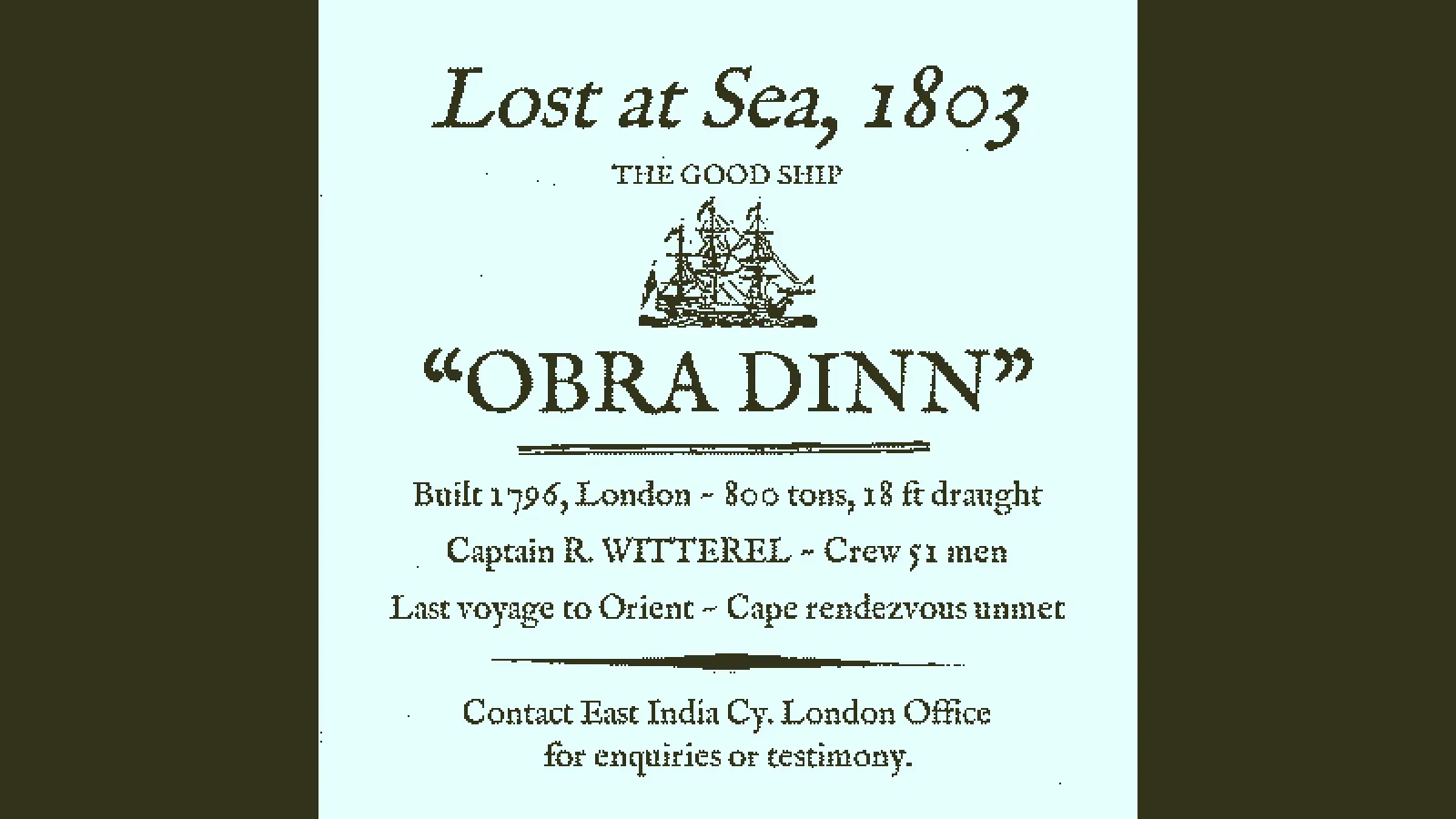
Return of the Obra Dinn is a game about determining the fate of sixty people on a ship. There is no combat, no failure state and no time pressure. It is a deduction game where the only thing that improves is your understanding, and it is the clearest demonstration in years that knowledge can be the sole progression system.
The structure
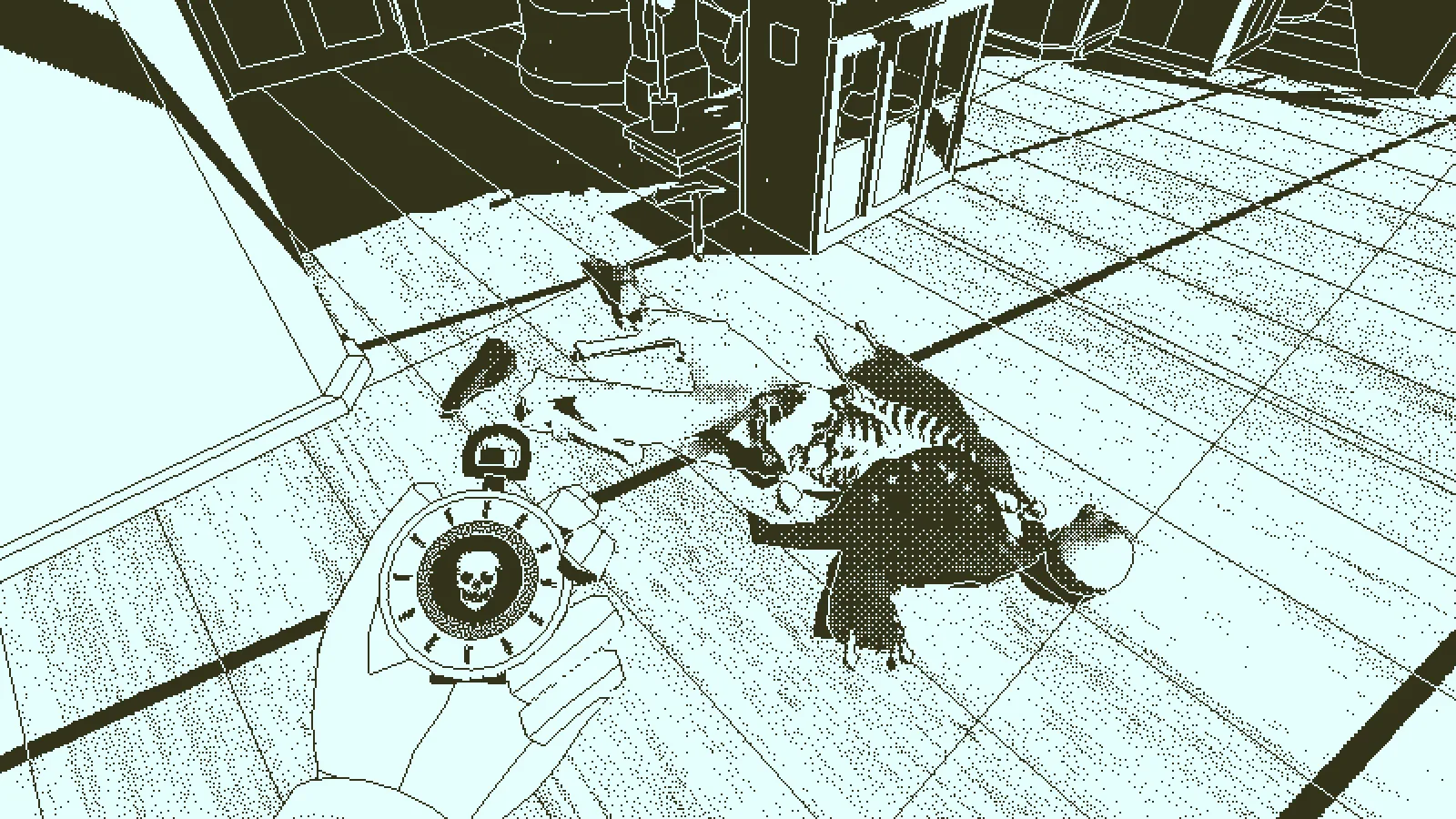
You have a book listing the crew and a device that shows you the moment of a person’s death as a frozen scene. From those scenes you determine identity and fate for each of the sixty.
The game confirms answers in batches of three, which is the single most important design decision in it.
Why batches of three
Confirming one at a time would let players brute-force, guessing until something sticks. Confirming none would leave them with no feedback at all.
Three is enough that guessing is impractical and few enough that a genuine deduction gets rewarded. It is a tuning decision that carries the entire game, and it is invisible.
Knowledge as the only progression
Nothing in the game changes as you play. No new abilities, no unlocks, no improved tools. What changes is what you know, and the game is over when you know enough.
That makes it unusually honest about what a lot of games are actually doing. Most progression systems are a proxy for player understanding; this one removes the proxy.
The visual style as a mechanic
The one-bit dithered rendering is usually described as an aesthetic choice. It is also functional: it flattens detail, which forces you to look at posture, position and object placement rather than at faces.
A photorealistic version of the same game would be easier and worse, because identification would come from appearance rather than from reasoning.
The lineage
It comes from the same developer as a game about checking documents, and the two share a design instinct: take a procedure, implement it faithfully, and let the player’s engagement with the procedure be the experience.
The earlier one is covered in the Papers, Please piece, and the through-line between them is more instructive than either alone.
Why deduction games are rare
- They cannot be replayed, which is a commercial problem.
- They require the player to do work the game cannot verify.
- Difficulty cannot be scaled – a deduction is solvable or it is not.
- They are hard to explain in marketing.
Every one of those is a reason a publisher would decline the pitch, which is why the genre lives almost entirely in independent development.
What it does with failure
Nothing. There is no penalty for a wrong answer beyond not getting a confirmation, which means the game never punishes experimentation and never rewards guessing.
Removing failure states is an underused option. In a game about thinking, failure adds nothing except friction.
The unrepeatable problem
Once solved, it cannot be unsolved, and the game has no second playthrough. Several games in this space have tried to engineer replayability and the attempts generally weaken the first experience.
Accepting that some games are played once is an easier position for a small team than for a studio with a revenue target, which is most of why this kind of work stays independent.
What it demonstrated
That a game can consist entirely of the player understanding something, with the software doing nothing but presenting information and confirming conclusions.
That is close to the minimum a game can be while still being a game, and it is one of the better ones of the last decade.
Fate and identity as separate problems
Each entry requires two answers: who the person is, and what happened to them. Frequently one is easy and the other is not, which lets partial deductions accumulate rather than stall.
That separation is what keeps the game moving. A design where each person were a single yes-or-no answer would produce long periods of no progress at all.
Deduction chains
- Some identities come from a passenger manifest and a seating chart.
- Some come from accent, clothing or who a person is standing next to.
- Some are only solvable after another identity is established.
- A few are deliberately available only through a chain of four or five inferences.
The chained ones are the game’s best work, and they are also why the batch-of-three confirmation matters – a chain gives you three at once, which is exactly the reward size the system pays out.
What it borrowed
The structure is closer to a logic puzzle than to a video game, and the developer’s earlier work had already established that a procedure can be a design – in that case checking documents rather than identifying bodies.
The through-line between the two is covered in the Papers, Please piece, and it is one of the clearest authorial signatures in independent games.
Images: Return of the Obra Dinn store assets, Lucas Pope / 3909 LLC. Official site: obradinn.com.