Papers, Please is a game about checking documents. It sold millions of copies, won an armful of awards, and is now the standard reference for a particular design idea: that a bureaucratic procedure, implemented faithfully, can carry more weight than any amount of narrative framing.
The mechanic
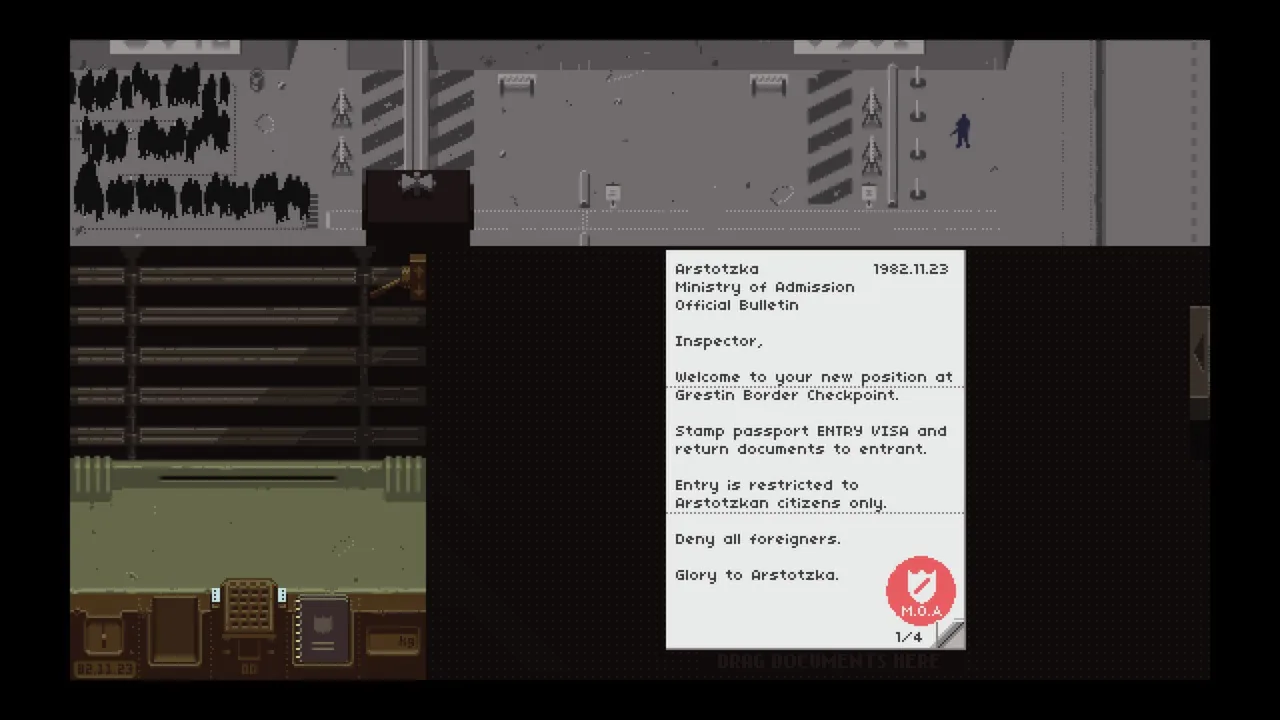
You are a border inspector. People present documents. You compare the documents against a rulebook that grows more complicated every day, and you stamp approved or denied. You are paid per person processed and you have a family to feed.
That is the entire game. There is no combat, no exploration and almost no movement.
Why it works
Because the rules and the situation pull against each other continuously. The rulebook says deny; the person in front of you has a reason. Following the rules is the profitable choice and the uncomfortable one, and the game never resolves that for you.
The discomfort is produced by the mechanic rather than described by the writing, which is the distinction that makes it a design achievement rather than a well-written game.
Rules as content
Each in-game day adds a rule. By the end you are cross-referencing six documents against a rulebook that contradicts itself in places, under time pressure, for money you need.
The escalation is the difficulty curve and it is also the story. Nothing else in the game increases in difficulty because nothing else needs to.
The lineage it belongs to
Games where the interesting part is a procedure rather than an action have a long history in experimental work – and a short history in commercial releases, because a procedure is hard to put in a trailer.
The route from prototype to commercial release for that kind of idea runs through the same channels experimental games have always used, which the workshop piece covers.
What came after
The design idea – that administration, inspection and deduction can be a game’s core loop – shows up repeatedly in the following decade. Detective and deduction games, document-forgery games, and several bureaucracy simulators all trace to the same demonstration.
Its author’s later work extended the same instinct in a different direction, building a game around a deduction procedure with no combat and no failure state.
Why it was made small
One developer, a limited art style, a constrained scope. That combination is not a limitation working against the idea – it is what allowed the idea to exist, because no publisher would have funded it and no team would have kept it this austere.
The visual style in particular does real work. A more detailed art direction would have made the people at the window individuals in a way the game deliberately avoids until it chooses to.
The broader design argument
- A mechanic that produces a feeling is stronger than writing that describes one.
- Constraints are more interesting than abilities.
- A system the player must follow generates more tension than a system they can exploit.
- Scope limits are frequently what make an idea legible.
Those four points describe a lot of the best experimental work of the last two decades, and this is the clearest single demonstration of all four at once.
Where it sits now
Released in 2013 by Lucas Pope, it remains the reference anybody reaches for when arguing that a game’s mechanics can carry a moral argument. That is a durable place to be, and it was earned by a game about stamping passports.
The economic layer
You are paid per person processed and charged for rent, heat, food and medicine. A slow day means choosing which family member goes without something, and the game presents that choice as a spreadsheet at the end of each shift.
That framing does more work than any cutscene would. A moral decision rendered as an arithmetic problem is a specific and uncomfortable thing, and the game commits to it entirely.
Endings and branching
Twenty endings, reached by the accumulation of small decisions rather than by chosen branches. Most players get an ending that reflects a pattern of behaviour they did not realise they had.
That is branching narrative done through systems rather than through dialogue trees, and it is considerably more effective than the alternative.
The developer’s later work
The same instinct – a faithful procedure as the core loop, with the player’s reasoning as the content – appears again in a game about determining the fate of a ship’s crew.
That one takes the idea further by removing the economic pressure entirely, and it is covered in the Obra Dinn piece.
What it does not do
It does not tell you what to think about any of it. There is no character who explains the moral, no scoring of your choices as good or bad, and no reward for kindness. That restraint is most of why it works.
Images: Papers, Please store assets, Lucas Pope / 3909 LLC. Official site: papersplea.se.