Katamari Damacy came out of a games course at a company-run school, was made by a designer with no previous shipped credit, and became one of the most-cited examples of a game built on a mechanic nobody had tried. It is also a useful counter to the idea that experimental work only happens at the margins.
The mechanic
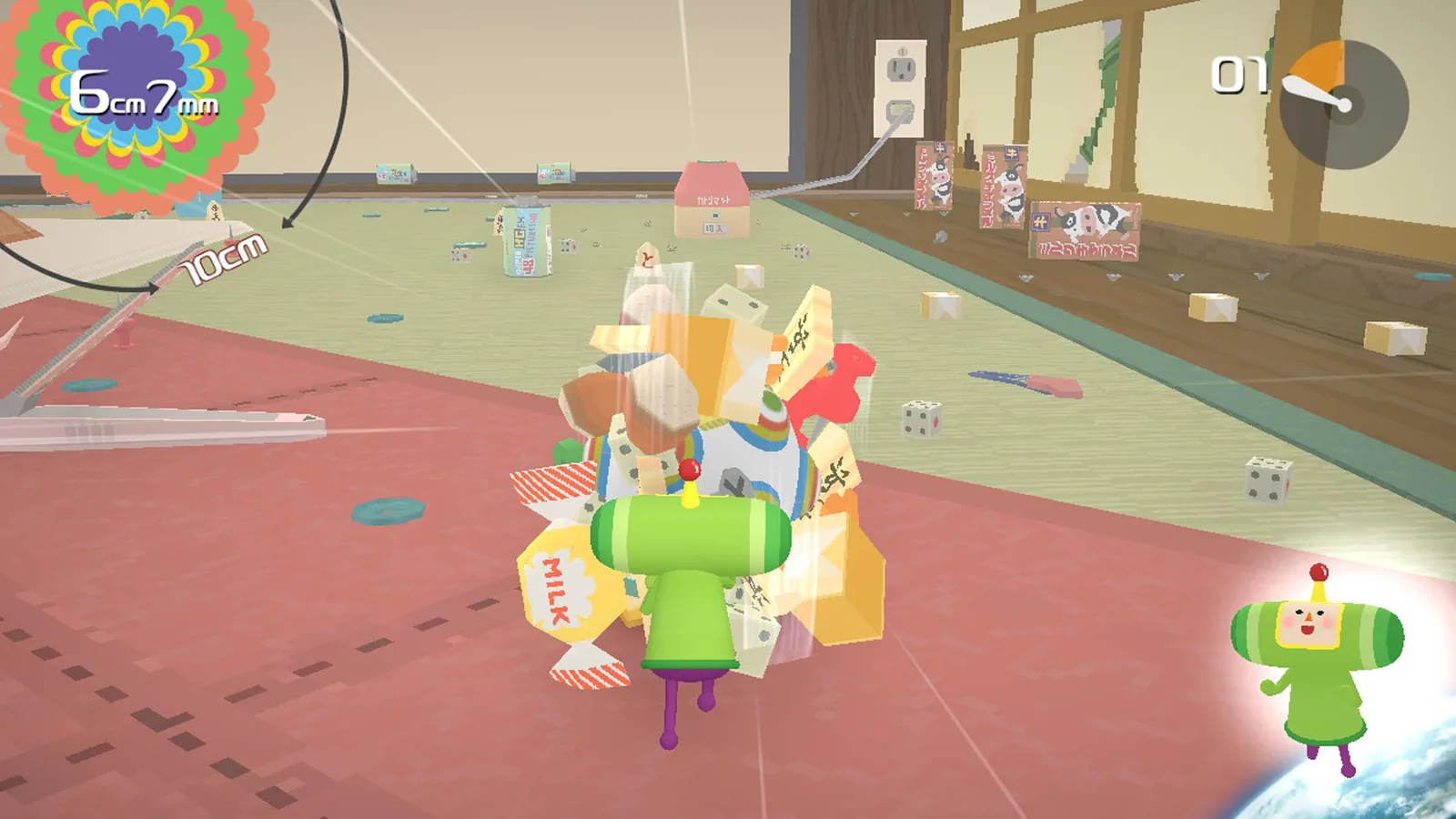
You roll a ball. Things smaller than the ball stick to it. The ball gets bigger, so more things stick. That is the entire system.
It is a growth curve rendered as a physical object, and it produces the same feeling as an exponential progression bar while being something you can see and steer.
Why it works
Because the scale change is continuous and visible. You start picking up thumbtacks and end picking up buildings, and there is no cut, no transition and no level break between those two states.
Very few games make scale itself the content. Most use scale as a backdrop and change what you do at each tier; this one changes nothing about what you do and lets the world reinterpret you.

Control as character
The two-stick control scheme is deliberately awkward. It is not a failure of design – it makes the ball feel like a physical object with inertia rather than a cursor.
That awkwardness is the same decision a lot of experimental games make and most commercial games reject: friction that communicates something is worth more than frictionless control that communicates nothing.
Where it came from
An internal training programme rather than a pitch process. The designer was given time and an expectation of learning rather than of shipping, which is the same permission structure that produces student games and jam prototypes.
That structure is the common factor across most of the work in this category – somebody was allowed to make something without having to argue for it first.
Tone as a design element
The game is funny, and the humour is structural rather than written – it comes from the absurdity of the scale progression and from the premise, not from dialogue.
Humour that comes from a mechanic is durable in a way written comedy is not, because it works every time the mechanic does.
Why it was never really copied
Several games have used object-absorption mechanics since and none have reproduced the effect, largely because the effect depends on the scale range being enormous and the world being built at every scale within it.
That is an expensive thing to build and a difficult thing to justify, which is why it remains close to singular.
The broader category
Games built on one novel verb – roll, rewind, portal, stack – are the category experimental showcases exist to surface. They are hard to pitch, easy to demonstrate, and frequently influential out of proportion to their sales.
The route those ideas take from prototype to industry is what the workshop piece covers, and the pattern is consistent across two decades.
Its standing
Released in 2004 and still referenced whenever anyone argues that a game can be built from a single idea. Most games in that conversation were independent; this one was made inside a large publisher, which is the part worth remembering.
Experimental work is not a property of budget. It is a property of whether somebody was allowed to try something before they had to defend it.
Scale as content
The game’s levels are the same spaces at different magnifications, and the pleasure of the later stages comes entirely from recognising what was an obstacle an hour ago being absorbed without slowing down.
That requires building a world that reads correctly at every scale between a thumbtack and a skyscraper, which is a considerable amount of work for an effect that is over in seconds each time.
The soundtrack
Rarely mentioned in design discussion and inseparable from the game’s identity. The music sets a tone that makes the absurdity read as joyful rather than as random, and a more conventional score would have produced a game people found strange rather than delightful.
Where the one-verb idea shows up since
- Games built on a single traversal mechanic.
- Games where growth is physical rather than numerical.
- Games where the only input is a direction.
The category is small and consistently interesting, and it is the category experimental showcases surface most often – the route those ideas take is covered in the game jams piece.
Images: Katamari Damacy REROLL store assets, Bandai Namco Entertainment. Official site: bandainamcoent.com.