Every battle royale has the same problem: how do you score a format where surviving and killing are both valuable and neither alone should win? Apex Legends Global Series has one answer, and the answer tells you a lot about what the competitive scene wants the game to be.
The scoring problem
Pure placement points reward hiding. Pure kill points reward third-partying every fight and dying in fourth place. Either extreme produces a tournament that does not resemble the game people play.
Every battle royale circuit has converged on a hybrid, and the exact weighting is the single most consequential rule in the format.
How the hybrid works
- Placement points, scaled steeply so the top three are worth far more than the rest.
- Kill points, usually flat per elimination, sometimes capped.
- A match win worth substantially more than second place.
- Points accumulated across a series of games rather than a single match.
The multi-game series is what makes it work. A single battle royale match is enormously variable; twelve of them is a measurement.

Why weighting changes the game
Shift points toward placement and teams play passively, rotating early and avoiding contact. Shift toward kills and every ring closure becomes a bloodbath.
Tournament organisers tune this deliberately, and a circuit that feels stale is often one where the weighting has settled into a single dominant strategy. Changing the scoring changes how the game is played more directly than any balance patch.
The third-party problem
In a sixty-player lobby, the team that wins a fight is weakened and audible. A third team arriving at that moment gets two kills for minimal risk.
Every battle royale has this and none have solved it. Scoring can discourage it by making placement dominant, which reintroduces passivity. It is a genuine design tension rather than an oversight.
Legends as a constraint
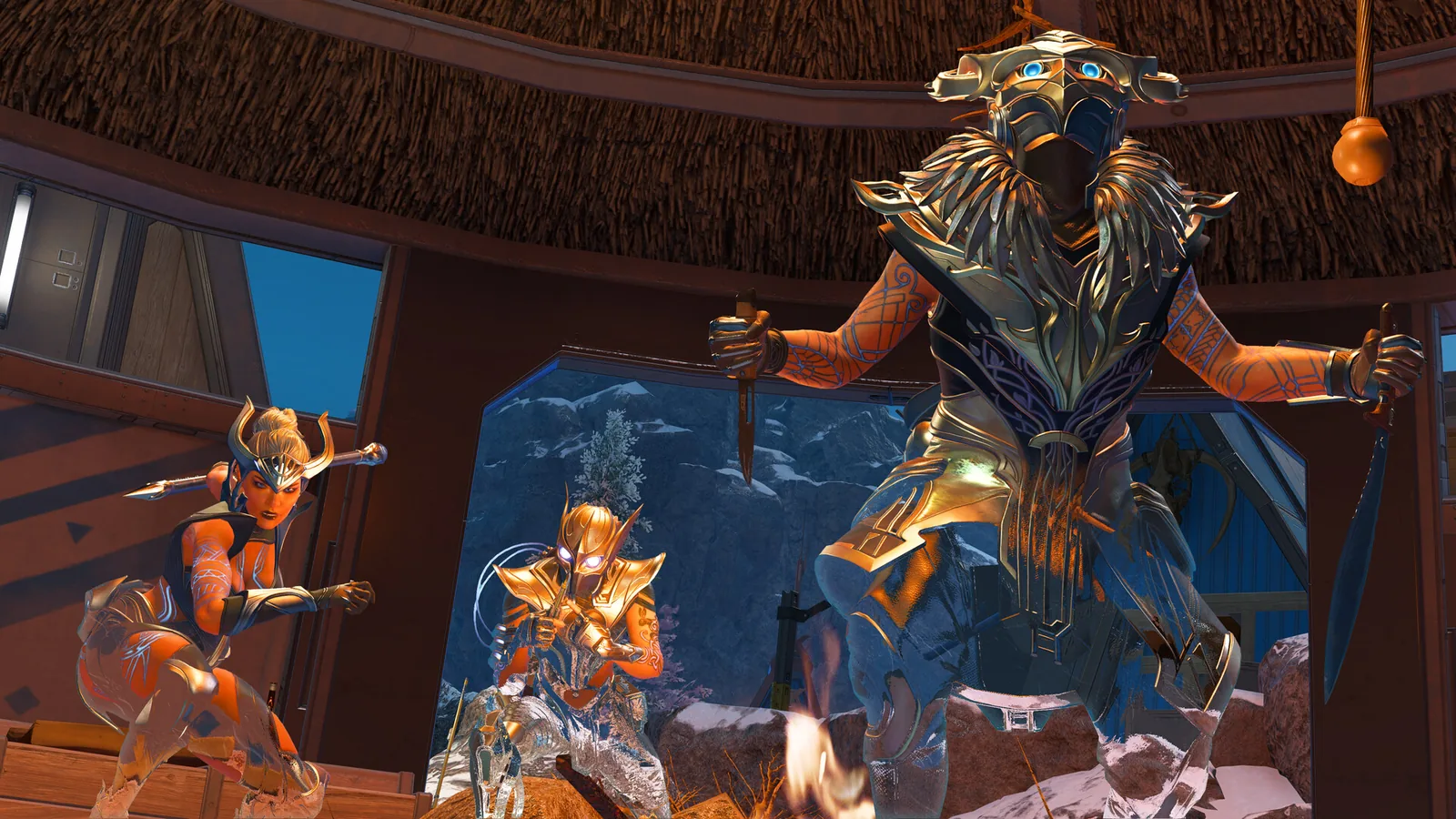
Apex’s character abilities change the calculation, because rotation and repositioning are abilities rather than pure movement. A team composition is a set of rotation tools, which is why the meta is more about mobility than about damage.
That makes the competitive game read differently from the public game, where combat legends are more popular and rotation is less considered.
Movement as the skill floor
Apex inherited a movement system from its studio’s earlier work, and the result is a battle royale where traversal is a mechanical skill rather than a walk between fights.
That raises the skill ceiling considerably and it makes the game harder to watch, because a large part of what a good player is doing is invisible to anyone who has not tried to do it.
What the format rewards overall
- Consistency across a series rather than a single great game.
- Positioning and rotation over raw aim.
- Knowing when not to fight, which is most of the time.
- Endgame execution, where the points concentrate.
That is a reasonable description of what the game rewards in ranked play too, which is the sign of a well-tuned format – competitive and public play pulling in the same direction.
The broader lesson
Battle royale is the only major esport genre where the rules of competition are written by tournament organisers rather than by the game. Every other esport has a win condition built in; this one has a scoring table.
That makes the format itself a design artefact worth paying attention to, and it changes more often than the game does.
Series length as a fairness mechanism
A single battle royale match is close to a coin flip between good teams. The scoring format compensates by running long series, where consistency separates teams that variance would otherwise level.
Six to twelve matches per day is the usual range, and shorter formats are reliably criticised for producing winners nobody expects. That is variance doing its job, not a flaw in the teams.
Compared with round-based formats
A tactical shooter plays thirteen to twenty-four rounds per map and three maps per series, which is dozens of independent samples. A battle royale gets twelve, each of which is longer and noisier.
That is why battle royale circuits are structurally less able to identify the best team, and why their formats keep being revised. The round-based comparison is covered in the Premier rating piece, which deals with the same sampling question at the individual level.
The alternative formats
- Points across a series – the standard, and the most used.
- Match point – teams must reach a threshold then win a game outright. Produces tense endings.
- Elimination brackets – rare, because a battle royale bracket is arbitrary.
- Kill-race formats – used in showmatches, unrepresentative of the game.
Match point is the most interesting because it adds a second win condition on top of the scoring table, which is a rule about a rule.
The mechanic underneath the format
None of the scoring debate exists without the compression mechanic that forces matches to end. The circle sets the pacing, decides when fights happen, and creates the late-game concentration that placement points are measuring.
Why that mechanic is universal across the genre, and why nobody has found an alternative, is covered in the circle design piece.
Images: Apex Legends store assets, Respawn Entertainment and Electronic Arts. Official site: ea.com/games/apex-legends.