Key takeaways
- A league is a scheduled economy reset with a new mechanic attached, and the reset is doing more work than the mechanic.
- The cycle solves a problem permanent-character games cannot solve any other way – an item economy with no sink inflates until the loot stops meaning anything.
- Its cost is that the game has two populations with incompatible needs, and most of the friction in the genre comes from trying to serve both at once.
The action RPG season is one of the most copied structures in games. Diablo does it, Last Epoch does it, Path of Exile built its entire identity on it. Our breakdown of Diablo 4 seasons covers the implementation most players meet first.
What is less often examined is why the structure exists. It is usually explained as a content delivery schedule, which is the least interesting thing about it. The league cycle is primarily an economic instrument, and understanding it that way explains most of the decisions that look arbitrary from outside.
The inflation problem
Start with the thing the reset is solving.
An ARPG generates items continuously and destroys almost none. Players kill monsters, items drop, items accumulate. Currency enters the economy at a steady rate and leaves it only through crafting failures and trade friction. There is no meaningful sink.
In a permanent economy that produces a predictable curve. Early on, a good item is valuable because few exist. Six months in, enough exist that the price collapses. Twelve months in, the item that defined the early game is a vendor trash. New players enter an economy where the gear that should carry them through fifty hours of progression is handed to them in ten minutes.
That is fatal for an ARPG specifically, because the entire activity is acquiring items. If items are free, there is no game. Our piece on scarcity in sandbox design covers the general principle – scarcity is not a restriction on the fun, it is frequently the source of it.
There are two ways out. Build sinks aggressive enough to match generation, which is extremely hard and tends to feel punitive. Or reset the economy on a schedule.
Why the reset is total
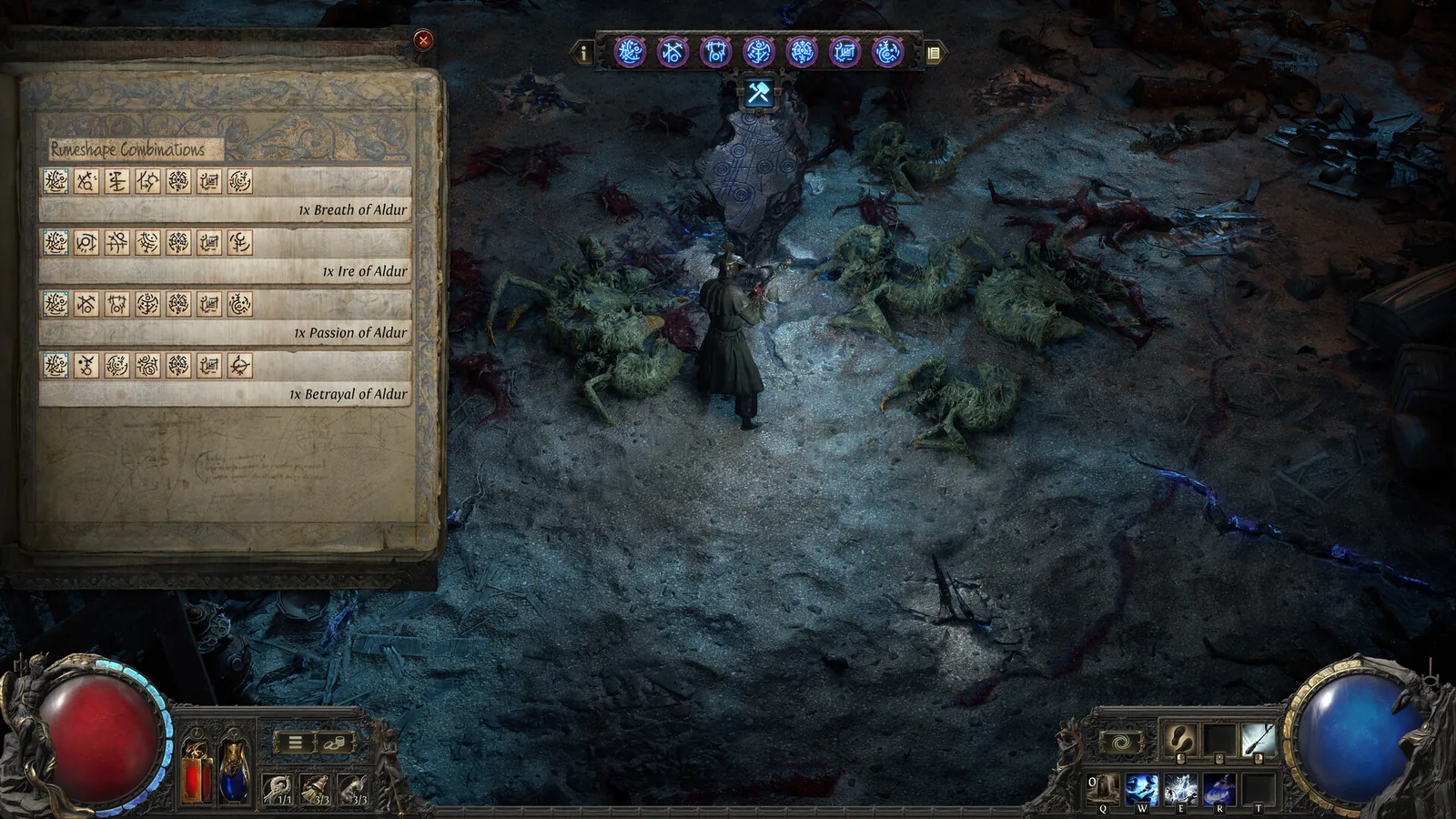
The design choice that confuses newcomers most is that a league reset is not a soft reset. Characters do not carry over. Gear does not carry over. You start at level one with nothing.
The reason is that partial resets do not work. If anything carries forward, that thing immediately becomes the entire economy – the carried wealth dominates the fresh market, the people who played last league start ahead, and within a week you have the old economy wearing a new hat.
The total reset also restores something harder to quantify: the early game. In a mature economy, levels one to forty are a formality you skip past with handed-down gear. In a fresh league they are a genuine progression where a rare drop changes your build. For a lot of players that first week is the actual product, and everything after it is the long tail.
Our look at Rust wipe cycles covers the same mechanism in a survival game, where the argument is even starker – the wipe is not a concession to balance, it is the thing people are there for.
The mechanic is the marketing
Every league ships with a new mechanic – a new encounter type, a new crafting system, a new way to modify maps. These get the attention, and they are genuinely where the design experimentation happens.
But structurally, the mechanic serves the reset rather than the other way round. It gives the reset a reason, a name and a trailer. It gives returning players something they have not optimised. And it functions as a live experiment – mechanics that work get folded into the permanent game, mechanics that do not get retired when the league ends.
That last part is the underrated benefit. A time-boxed league is a system with a built-in exit. A studio can ship something genuinely experimental because it has already announced that it ends in three months. Permanent systems do not get that freedom, which is why permanent systems are more conservative.
Our look at the Dota 2 patch cycle covers the contrasting model – no reset, but large periodic rebalances that achieve some of the same renewal through a completely different mechanism.
The two populations
Here is the structural tension the genre has never resolved.
Every league-cycle game has two populations with incompatible needs.
The cycle players treat each league as a fresh run. They engage hard for two to four weeks, often race the early economy, and leave before the league ends. For them, the reset is the product and the content after week three barely matters.
The persistent players treat the game as a long-term project. They want their characters to keep meaning something, they are frustrated by the reset, and they are usually the ones with the deepest system knowledge.
Serving both means running a standard, non-resetting realm alongside the league realm. Everyone does this, and on every game the standard realm is a ghost town with a broken economy – which is exactly what the theory predicts, and also exactly what the persistent players said they wanted.
This is the genre’s unsolved problem, and it is worth being honest that it may not have a solution. Our piece on roguelite meta progression covers the closest thing to one – small permanent gains across runs that soften the reset without undermining it – but ARPG item economies are a much harder case than roguelite unlocks, because the carried value is tradeable.
Pacing inside the cycle
The three-month cycle has its own internal rhythm, and the design has to account for all of it.
Week one is the peak. Economy is fresh, everything is valuable, the new mechanic is unsolved. This is when the game is at its best and when the servers are at their worst.
Weeks two to four are the real content window. The economy settles, builds mature, the mechanic gets solved. Most of the engaged playtime happens here.
Weeks five onward are decline. The economy inflates, goals get thinner, players leave. A studio can slow this with mid-league events but cannot stop it – and the longer a league runs, the more it recreates in miniature the exact inflation problem the reset was for.
This is why league length is one of the most consequential numbers in the design. Too short and players cannot finish anything, which makes the reset feel like a punishment. Too long and the last six weeks are dead air. The industry has largely converged on three to four months, which says something about where the curve flattens.
Our notes on ranked ladder decay cover a related timing problem in competitive games – any system that resets has to decide how much of the player’s investment it is willing to destroy, and the answer determines who stays.
What this structure is actually good at
Worth stating plainly, because the critique is easier to write than the credit.
The league cycle lets a game keep its difficulty curve intact indefinitely. That is rare and valuable. Most long-running games get easier over time as players accumulate advantages, and the only fixes are power creep in the content or gating in the progression – both of which degrade the game for the people who stayed.
A scheduled reset sidesteps the whole problem. The game is as hard in year ten as in year one, because everyone starts from the same place every time. The accumulated advantage is knowledge, which cannot be inflated and does not need balancing.
The price is that you ask players to let go of things on a schedule, which is a real cost and not everyone will pay it. But it buys something no other structure delivers: a game that does not slowly dissolve.
Images: Path of Exile 2 project gallery.