Key takeaways
- A market stall only reads as a stall if it has four things: a roof, a counter, visible goods and an open side facing the street.
- Fences, trapdoors and lanterns do most of the work, because a stall is mostly frame and the frame is thin.
- Stalls fail when they are identical – a market needs variation in height, roof direction and goods, not repetition.
Market stalls are the single most useful small build in Minecraft. They fill the dead space in a village square, they give a server spawn something to look at, and they are the cheapest way to make a settlement look inhabited rather than constructed. They are also the build most people get subtly wrong, because a stall that is just a roof on four posts reads as a bus shelter.
This is a guide to the parts a stall actually needs, the block choices that do the heavy lifting, and how to arrange a row of them so the market reads as a market rather than a row of identical units.
The four parts a stall needs
Miss any of these and the build stops reading as a stall.
A roof, and it should be the biggest element. Stalls are defined by their cover. A flat two-high roof feels like a canopy, a steep one feels like a tent, and a single-slope awning feels like a shopfront. Pick the one that matches your settlement’s style and keep it consistent – our roof shapes guide covers getting a small roof that is not just a stair triangle.
A counter at waist height. This is the part people leave out. A stall without a counter is a shelter. The counter can be a single row of slabs, a trapdoor laid flat, a barrel, or a fence post with a pressure plate on top – what matters is that there is a horizontal surface at one block height facing the street.
Visible goods. Item frames, flower pots, barrels with their lids up, armour stands, a cauldron of water, a composter with crops in it. The goods are what tell the viewer what the stall sells, and a stall that sells nothing is furniture.
An open side. Three enclosed sides and one open side facing the path. A stall open on all four sides has no interior and nowhere for the stallholder to stand. A stall open on none is a shed.
The blocks that do the work
A stall is mostly frame, and frame means thin blocks. Five categories:
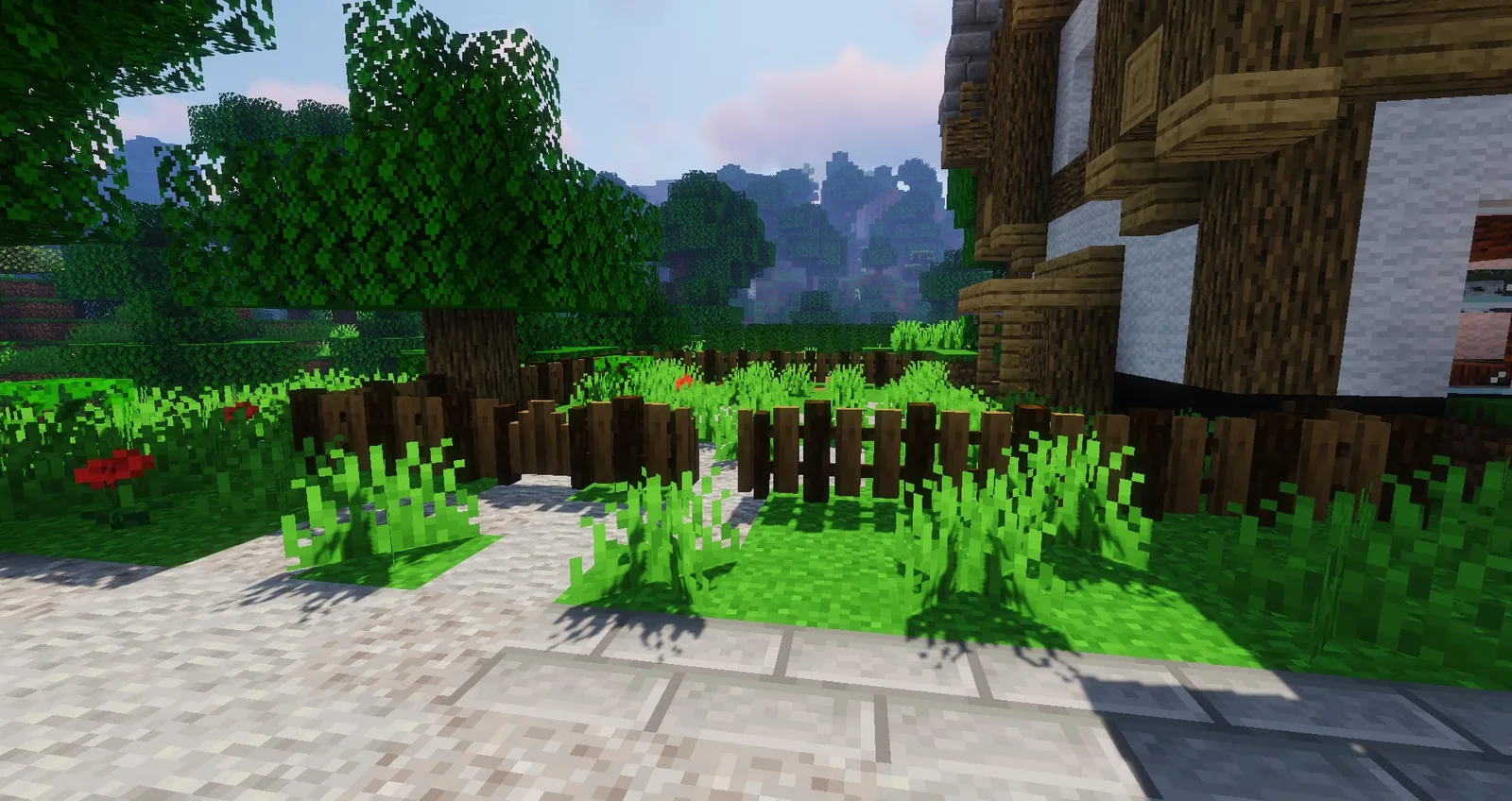
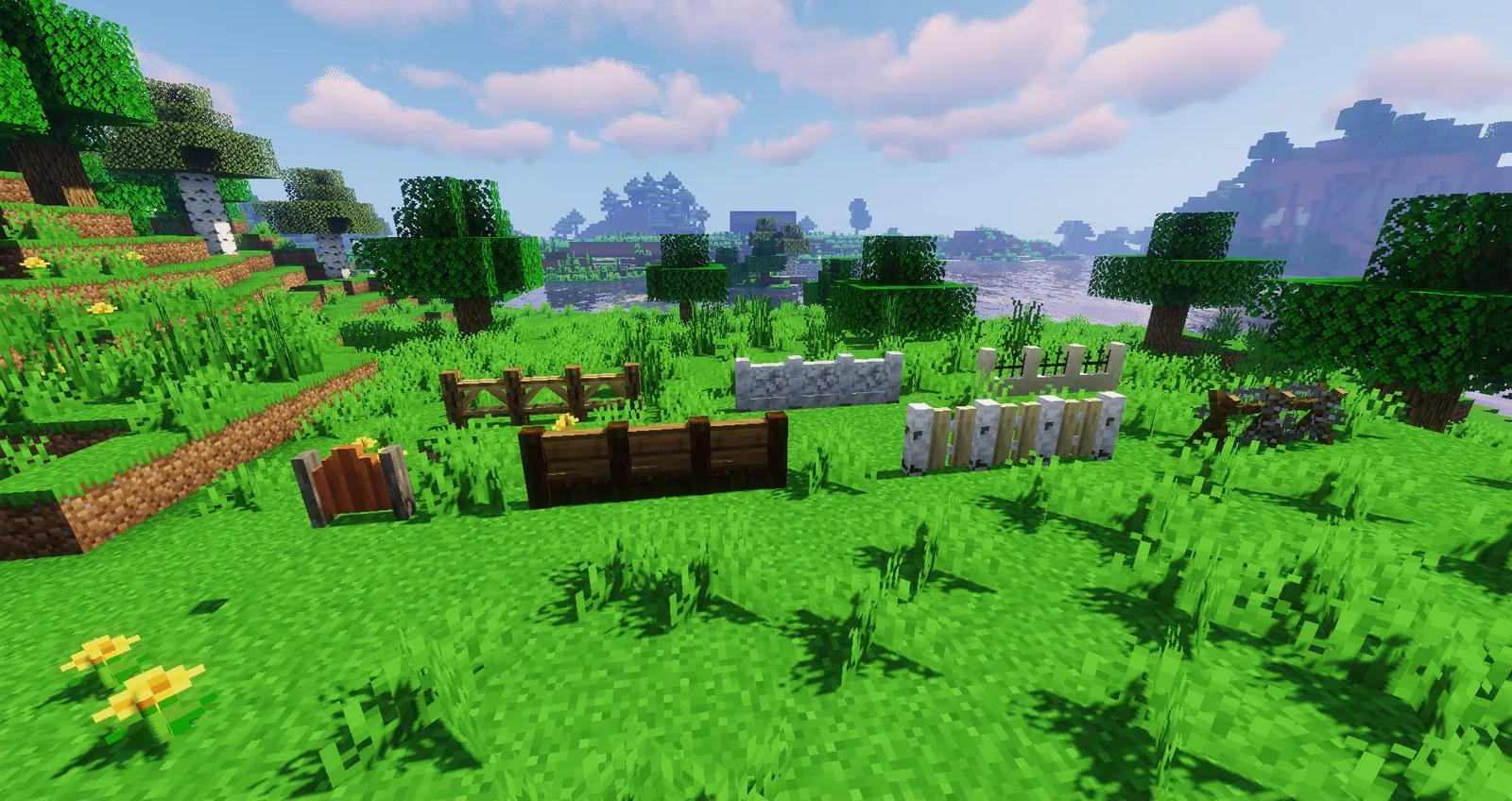
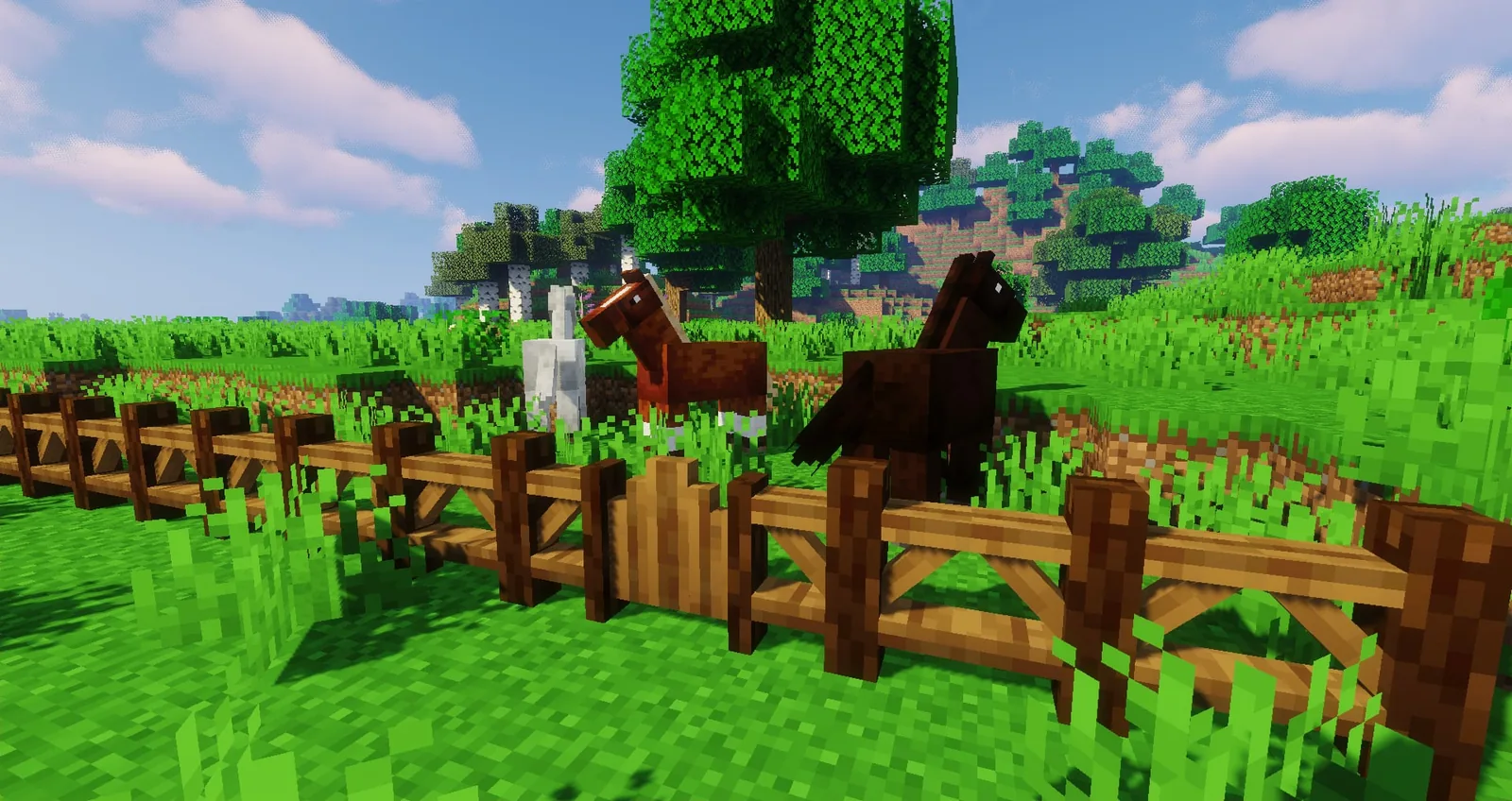
- Fences and fence gates. Fence posts are the best stall uprights in the game because they are thinner than a full block and they connect visually to the counter. Fence gates laid as a counter edge give you a lip.
- Trapdoors. The most versatile stall block. Vertical as a side panel, horizontal as a counter or a shelf, angled open as an awning edge. Our detail blocks guide covers the full range.
- Slabs and stairs. Counters, roof edges, and the step up into the stall. Upside-down stairs under a counter edge give you an overhang.
- Lanterns and campfires. A hanging lantern at the front corner of a stall is the single most effective detail. A campfire inside a food stall gives you smoke, which is the only animated element available.
- Wool, carpets and banners. The awning. A wool or carpet strip along the roof front edge, or a banner hung from the frame, is what turns a wooden roof into a market canopy.
Note what is not on that list: full blocks. A stall built from full blocks is too heavy. If you find your stall looking like a small building rather than a stall, the fix is almost always replacing full blocks with slabs, trapdoors and fences.
Three stall types worth building
The awning stall. Two fence posts at the front, a single-slope roof of stairs or trapdoors sloping forward, a slab counter, and wool along the leading edge. The simplest of the three and the one that fits tightest against an existing wall. Build this one against building fronts.
The tent stall. Four posts, a pitched roof, wool or banner sides partially closed. Taller than the awning stall and better as a freestanding unit in the middle of a square. The pitched roof gives you a visual break in a row of flat canopies.
The cart. A stall on wheels – barrels or trapdoors as sides, a cauldron or chest as the body, fences as the handles, and goods piled on top. No roof. This is the variation that keeps a market row from looking repetitive, and it fits in gaps too small for a real stall.
Arranging a market
This is where most markets fail. Six stalls built from the same template in a straight line with equal spacing reads as a product grid.
Four rules that fix it:
- Vary the height. Not the floor level, the roof height. Two blocks of difference between neighbouring stalls is enough to break the line.
- Vary the roof direction. Alternate which way the slope faces, or rotate every third stall ninety degrees. The roofline is the silhouette and a uniform roofline is the thing that reads as copy-paste.
- Do not space them evenly. Two stalls tight together, a gap, one stall, a wide gap with a cart in it. Even spacing is the strongest signal that something was placed rather than grown.
- Give each one a different trade. Fish on one, crops on the next, tools, pots, cloth. The goods are what make six stalls six different stalls rather than one stall six times.
Our symmetry and asymmetry guide covers why deliberate irregularity reads as organic, and our modular settlement guide covers how to get variation out of a template rather than designing each unit from scratch.
Where to put the market
Three placements work, in descending order of how often they are the right answer.
Against a wall, facing the path. The cheapest and most convincing. Stalls want a back, and an existing building gives them one for free. Our paths and roads guide covers getting the path right first, because a market with no path through it has no reason to be arranged the way it is.
Around a central feature. A well, a tree, a statue, a fountain. Stalls facing inward create a plaza, and the plaza needs a middle. Our threshold design guide covers how people enter a space like that.
Along both sides of a narrow street. The most atmospheric and the most work, because every stall needs a back and you have to build the street first. Worth it for a server spawn.
The detail that sells it
If you only add one thing beyond the four required parts, add clutter at the base. Barrels stacked beside the stall, a crate that did not fit inside, a composter, a pile of hay bale, a bucket. Stalls in reality overflow, and a stall whose contents are entirely inside its own footprint looks staged.
Second priority is lighting. A hanging lantern at the front corner, a campfire in the food stall, a torch on the frame post. A market at night with no light sources is dark and will spawn mobs – our lighting design guide covers doing it without the lanterns becoming the most prominent thing in the build, and our light levels guide covers the thresholds you need to hit to keep it safe.
Images: Macaw’s Fences and Walls project gallery.