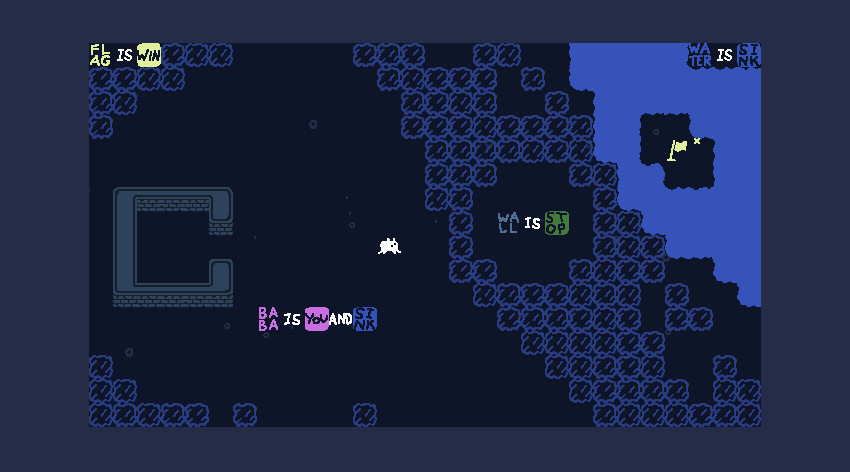
Baba Is You is a puzzle game where the rules are objects on the board. Push the words BABA IS YOU apart and you stop being Baba. Push WALL IS STOP into WALL IS WIN and the wall becomes the goal. It is the most complete execution of an idea that experimental design has been circling for years.
The mechanic
Rules are formed by word blocks arranged in sentences. Any sentence that parses is active. Any sentence you can physically push apart stops being active.
The player’s moves and the game’s rules occupy the same space, which means there is no separation between playing and reprogramming.
Why this is difficult to build
- Every noun must interact correctly with every property.
- The rule parser has to handle contradictions and simultaneous states.
- Levels must be solvable without the developer having anticipated the solution.
- Undo must work perfectly, because experimentation is the entire loop.
That third point is what makes it an achievement rather than a gimmick. Many puzzles have solutions the author did not intend, and the game accepts them because the system is consistent rather than scripted.

Undo as a core mechanic
Instant, unlimited undo is not a convenience here – it is the reason the game is playable. A system this open produces states that are unrecoverable, and without undo every experiment would risk a restart.
Removing the cost of trying something is what converts a hostile system into an inviting one, and it is a lesson applicable well beyond puzzle games.
The lineage
Games that make their own rules manipulable are a recurring experimental idea – rule-editing, self-modifying systems, games about their own code. Most have been demonstrations rather than complete games.
What is unusual here is that the idea survived contact with a full-length design. Two hundred levels is a long way to take a concept that could have been exhausted in twenty.
Teaching without instruction
The first levels teach the syntax by making it the only thing available. You learn that sentences are rules because you accidentally break one, and the game lets you break it rather than preventing you.
That is the same environmental teaching approach that Portal established, applied to a system with far more possible states.
Where it came from
A game jam. The original prototype was made in a weekend, which is the clearest possible demonstration of what jams are for – the idea is provable in forty-eight hours and expandable over years.
That path, from a jam entry to a full commercial release, is one of the three routes experimental work reliably takes, alongside mods and student projects.
Difficulty and its audience
It is extremely hard in the later chapters, in a way that excludes most players. The game does not scale difficulty and does not offer hints.
That is a defensible position for a puzzle game whose appeal is the moment of understanding – hints remove the product. It also means the audience is smaller than the concept deserves.
What it demonstrated
- A game’s rules can be diegetic objects without the game becoming incoherent.
- Consistency beats authorial control – unintended solutions are fine.
- Free undo transforms what a player is willing to try.
- A jam prototype can carry a full release.
The second is the most useful and the hardest for designers to accept. Letting players solve a puzzle a way you did not plan requires trusting your own system more than your own level design.
Level design under an open system
Designing a puzzle where the player can rewrite the rules means you cannot control the solution space. The designer’s job shifts from authoring a solution to constructing a situation where at least one exists and most obvious attempts do not.
That is a considerably harder design problem than a conventional puzzle, and it is why the game took years to expand from its jam prototype.
The syntax as a language
- NOUN IS PROPERTY – defines behaviour.
- NOUN IS NOUN – transforms one thing into another.
- NOUN HAS NOUN – defines what is left behind.
- Conjunctions, negations and operators that compose with all of the above.
A small grammar with compositional rules produces an enormous state space, which is the same property that makes any formal system interesting and is rarely used as a game mechanic directly.
What the jam version proved
That the parser worked and that people found rewriting rules delightful rather than confusing. Everything after that was level design, which is time-consuming and not risky.
Separating the risky question from the expensive work is exactly what a prototype is for, and the general case is covered in the game jams piece.
Images: Baba Is You store assets, Hempuli Oy. Official site: hempuli.com/baba.