Ruins are the easiest thing in Minecraft to build badly and one of the most rewarding to build well. The failure mode is recognisable: a building with random holes in it. A convincing ruin is not a damaged building – it is a building that fell down in a way that makes sense.
Think about how it failed
Every ruin needs a story, even a one-sentence one. The roof collapsed inward. Fire took the upper floor. The foundation subsided on one side. One wall fell outward and the rest stayed.
That decision governs everything else, because collapse patterns are not random. A roof that fell inward leaves debris on the floor and the walls mostly standing. A wall that fell outward leaves rubble outside and a clean break above the foundation.
Debris goes somewhere
The single most common mistake is a ruined wall with nothing beneath it. Blocks that left the wall are on the ground, partly buried, in a pile that spreads away from where they fell.
- Rubble piles at the base of every broken section.
- Individual blocks scattered further out, decreasing in density.
- Slabs and stairs in the rubble, not just full blocks.
- Vegetation growing through the pile, because time has passed.
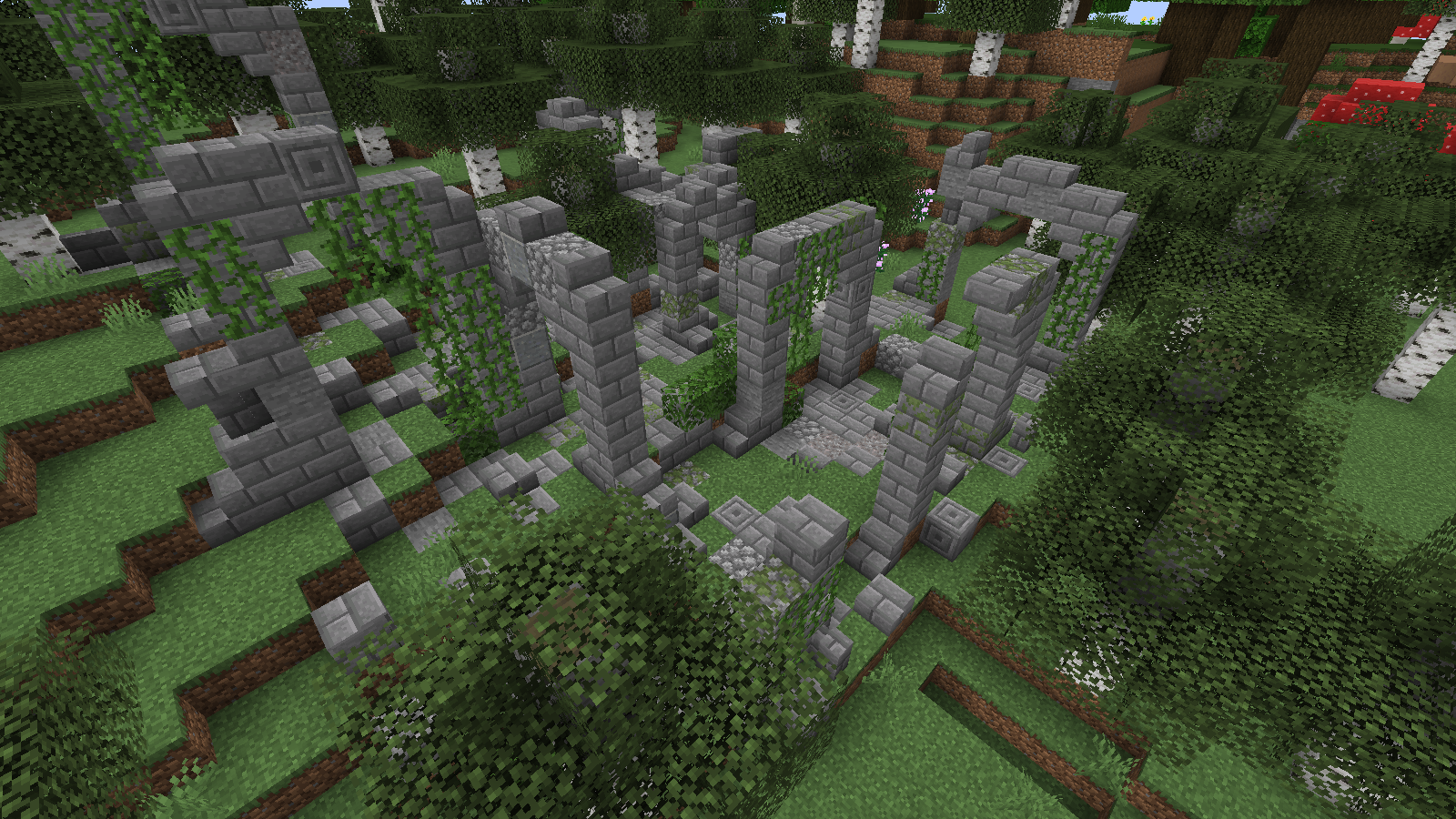
Break along structural lines
Buildings fail at their weak points – openings, corners, the tops of walls. A wall breaks down from the top, not out from the middle. A doorway collapses at the lintel.
Ruins built by removing random blocks look like a build with holes, because that is what they are. Ruins built by removing the top courses of walls and letting corners survive look like ruins.
Corners survive
This is the detail that does the most work. Corners are the strongest part of a masonry structure, so in almost every real ruin the corners stand higher than the walls between them.
Building to that rule alone – corners tall, wall centres low – makes a ruin read correctly before any other detail is added.
Material ageing
A ruin is old, which means the material is not what it was when built. Mossy variants, cracked variants, algae, and a mix of the original block with its weathered forms.
- Cracked stone brick and mossy stone brick mixed with plain.
- Moss carpet and moss blocks in the corners and on the north side.
- Gravel and coarse dirt where the floor was.
- Vines, but sparingly – vines on everything is the second most common mistake.
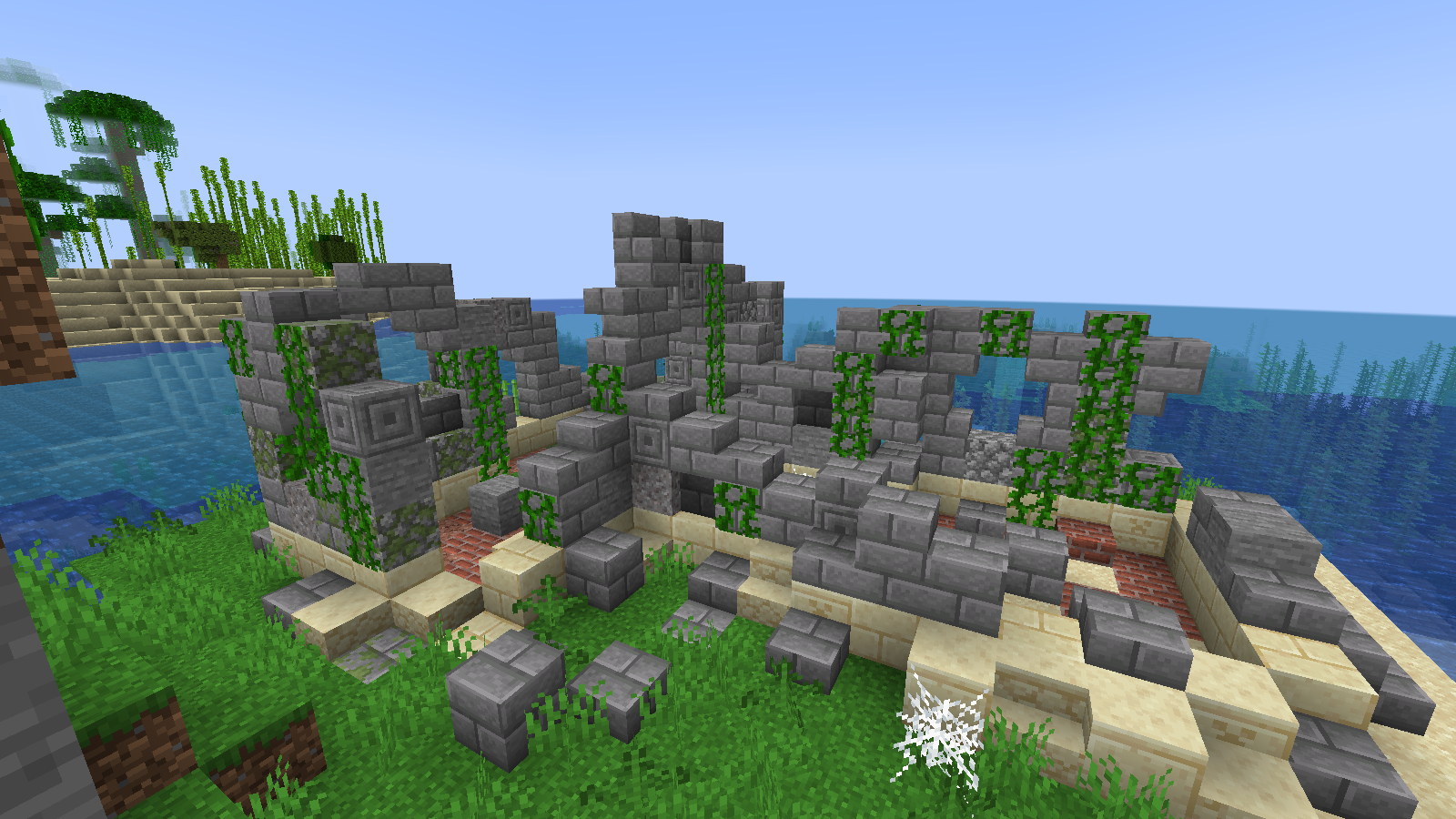
Interior traces
What survives inside says what the building was. A collapsed hearth, the remains of a staircase, a floor pattern still visible under debris, the outline of a room division at floor level.
Partial information reads as history. A completely empty interior reads as a shell that was never finished.
Vegetation and time
How overgrown a ruin is communicates how long it has been abandoned. Light moss and a few saplings reads as decades. Full canopy growing through the roof reads as centuries.
Pick one and be consistent. A ruin with a tree through the roof and clean-swept floors is telling two stories.
Learning from generated ruins
Minecraft’s own ruined structures are a good reference, and the mods that expand them are better ones. The common feature of the convincing ones is that they read as buildings first and as ruins second.
There is a whole argument here about why broken buildings read better than intact ones, and why broken buildings read better covers it – the short version is that incompleteness invites the viewer to finish the picture.
Scale and placement
Ruins work best when they are not alone. A single ruined tower is an object; a ruined tower with a fragment of wall and a collapsed outbuilding is a place.
They also need terrain that participates – subsidence, a slope that explains the collapse, ground that has grown over the foundations. That terrain work is where most of the convincing happens, and it is covered in sitting a build into terrain.
A build order for a ruin
- Build the complete structure first.
- Decide how it failed.
- Remove the top courses, keeping corners high.
- Put the removed blocks on the ground as rubble.
- Age the remaining material with cracked and mossy variants.
- Add vegetation last, and less than you want to.
Building it whole first is the step people skip and the one that makes the difference. You cannot convincingly ruin something that was never coherent.
Partial floors
An upper floor that has partly collapsed is the single most effective ruin detail, because it shows the building had levels. A few joists – fences or stripped logs spanning the gap – with a fragment of floor still attached at one end reads instantly.
The debris from the rest of that floor belongs on the ground below it, which reinforces the collapse story.
What to avoid
- Vines on every surface.
- Perfectly circular holes in walls.
- Cobwebs, which read as a video game rather than as age.
- Uniformly mossy blocks, rather than moss concentrated where water sits.
- Ruins with no debris, which is the fundamental error.
Ruins as a building exercise
Building a ruin teaches structure faster than building anything intact, because it forces you to think about what holds a building up. Anyone struggling with why their builds look flimsy should build one ruin and pay attention to which parts they decide would have survived.
Images: Philips Ruins project gallery on Modrinth.