Key takeaways
- Ruins work because the missing parts imply a history the player fills in.
- Convincing decay is structural – walls fall from the top and the corners, not randomly.
- Vegetation should follow water and shade, not be scattered evenly.
Ask a player to remember a structure from a survival world and they will usually name something broken. Intact buildings are places. Ruins are events, and people remember events.
Why incomplete reads as older
A complete building says someone lives here. A building missing its roof and half its north wall says someone did, and something happened. The player supplies the story, which is why a ruin with no lore attached still feels like it has one.
This is the cheapest narrative device available in a game with no writing, and it costs nothing but removed blocks.
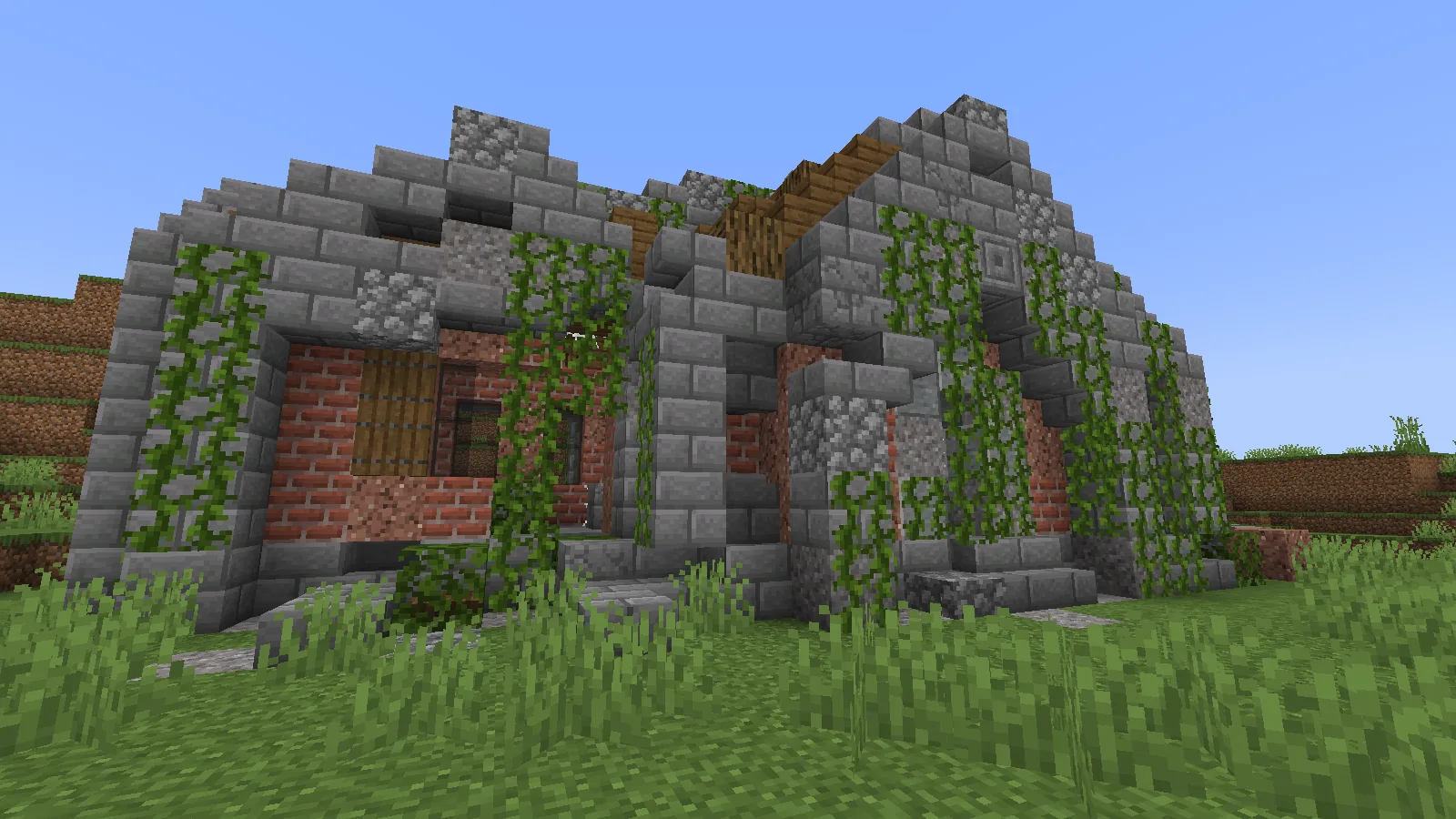
Decay has rules
Buildings do not crumble at random. Roofs go first because they are unsupported and exposed. Corners survive longest because two walls brace each other. Openings – doors, windows – are weak points where collapse starts.
A ruin built by deleting random blocks looks like a ruin built by deleting random blocks. One built by removing the roof, breaking the middle of the long walls and leaving the corners standing reads as a building that fell down.
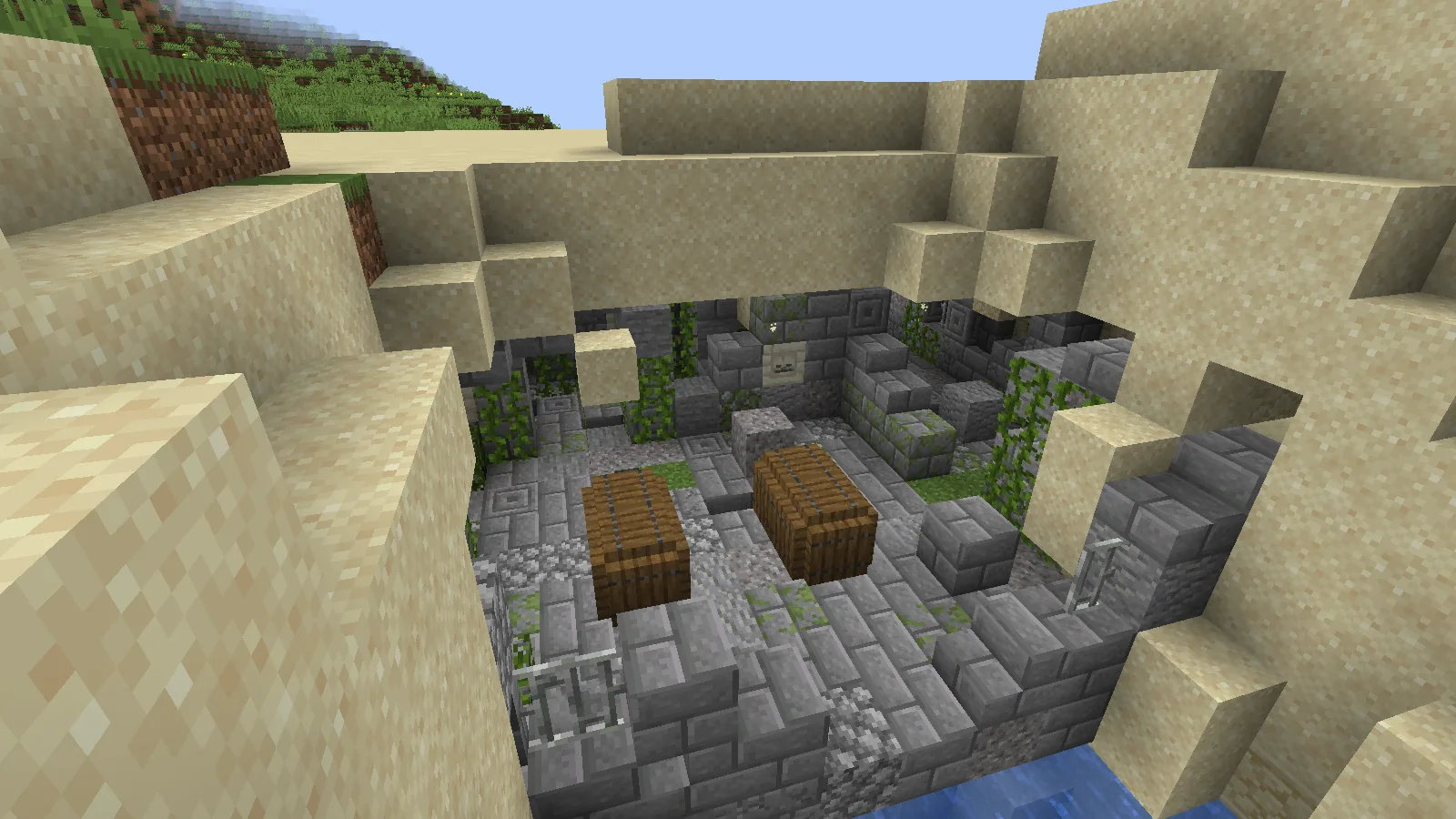
Where the plants go
Vegetation follows water and shade. Moss on the north side and the base, vines where something overhangs, grass in the corners where debris collected. Evenly scattered moss reads as texture rather than as time.
Debris matters too. A collapsed wall left the stone somewhere, and a pile of the same material at the base of the gap does more for believability than any amount of moss.
Stealing it for your own builds
The useful exercise is to build a small structure complete, then ruin it: remove the roof, break two wall sections, add debris where the pieces landed, then moss the shaded faces. Doing it in that order produces something that reads as decay, because it actually is.
Our view is that this is the most transferable technique in generated-structure design, and the one builders most often skip because it feels like destroying work. The build looks better ruined than it did intact, which is an uncomfortable thing to learn and a useful one.
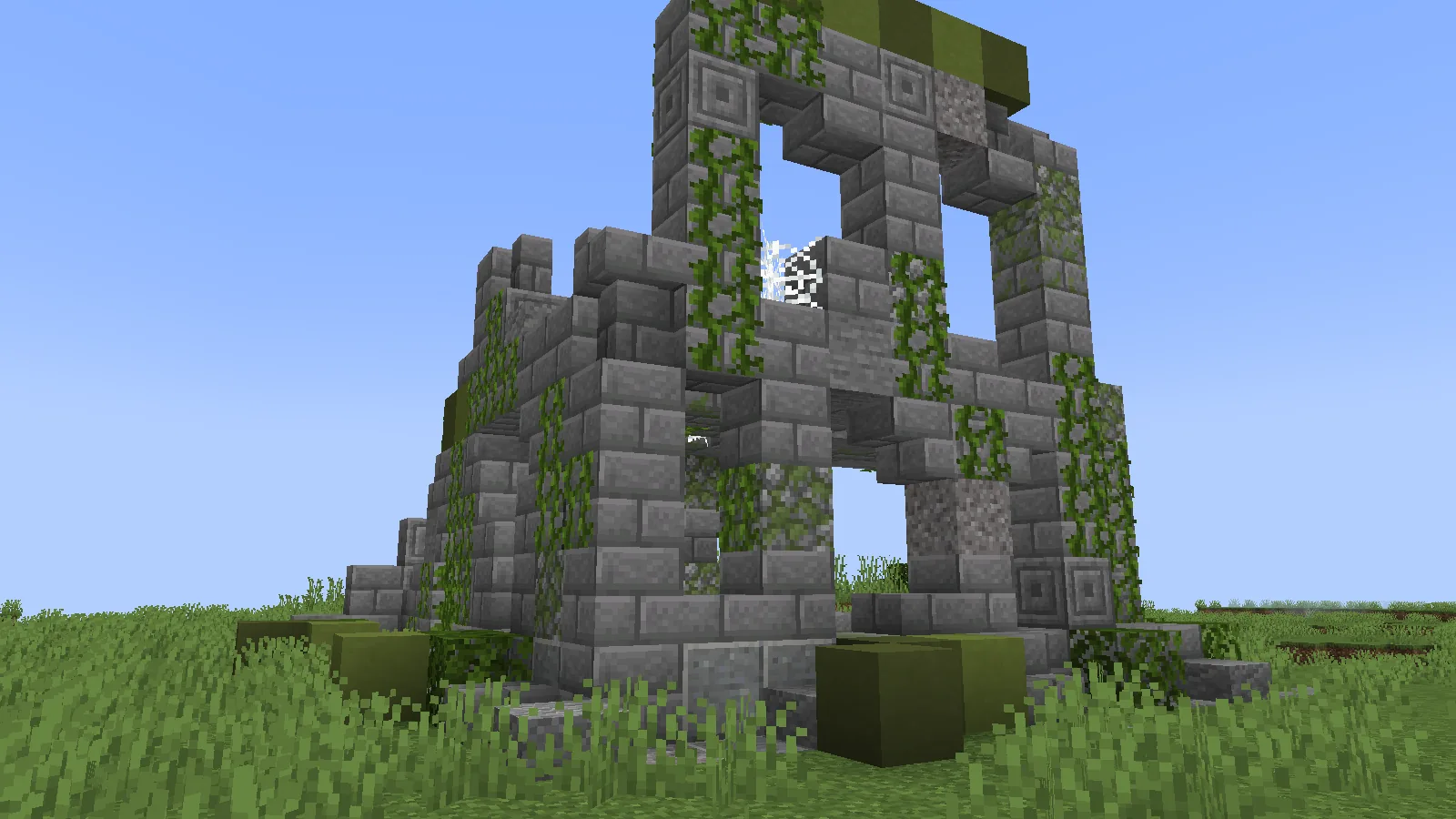
In a world
Ruins also solve a placement problem. An intact building in the middle of nowhere raises the question of who maintains it. A ruin does not, which is why structure mods lean on them so heavily and why the good ones still feel like part of the world at hour two hundred.
The material tells the age
Stone bricks that have partly become cracked and mossy variants read as centuries. Plain cobblestone reads as recent and abandoned. Mixing the two families deliberately – intact stone brick at the base, cracked and mossy higher up where weather reached – implies a timeline without a single sign.
Deepslate and blackstone read as much older again, which is why underground ruins feel ancient with no extra work.
Negative space is the design
The gap where a wall used to be is the part players look at. That means the shape of the hole matters as much as the shape of the remaining wall, and a ruin with a single large, deliberate gap reads far better than one with a dozen small random ones.
Frame the gap. Leave a column standing on one side, a fragment of lintel above, and the eye reads it as a doorway that failed rather than as missing blocks.
Lighting a ruin
A ruin lit with torches stops being a ruin. If you need it mob-free, hide the light: under carpets, behind trapdoors, inside the debris pile, or in the ceiling above a broken roof. The rule is that the light should have no visible source, because a maintained light implies a maintainer.
Ruins as a server landmark
On a multiplayer world, a ruin at a junction does something a sign cannot – it marks a place without claiming it. Players navigate by it, meet at it, and eventually build near it, which is how a server develops geography rather than a scattering of unrelated bases.
What makes a structure worth walking to in the first place is covered in the exploration piece, and the same three tests apply to a ruin you build yourself.
Ruins in a modded world
Several structure mods lean heavily on ruined buildings, and the good ones apply the rules above – structural decay, framed gaps, vegetation that follows shade. The weak ones scatter broken blocks and call it a ruin.
When you are assembling a set for an exploration world, this is a useful quality filter to apply before installing, alongside the density question covered in the structure mod selection piece.
Images: Philips Ruins project gallery on Modrinth.