The Happy Ghast is the rare Minecraft addition that arrived fully formed — a flying mount, a building platform, a transport system and a pet, all in one mob. Mojang’s designers sat down to explain how it got there, and the interesting part is not the feature list. It is the set of constraints they worked inside, because almost every design decision came from something the ghast was not allowed to do.
The brief: a flying mount, slotted between existing options
Mojang wanted a flying mob and specifically a flying mount, and the idea reportedly caused immediate enthusiasm inside the studio. The hard part started straight afterwards. One of the designers mapped every existing transportation method in Minecraft onto a single chart — walking, boats, minecarts, horses, elytra, ender pearls, portals — with speed and progression position as the axes.
That chart is the whole design. The Happy Ghast had to occupy an empty slot on it without overlapping anything that already existed, which immediately ruled out the obvious version of the mob. As the team put it, the ghast cannot be as fast as the elytra, because a faster flying mount does not sit alongside the elytra, it replaces it.
So it was built as a hot air balloon
The reference point Mojang landed on is not an aircraft. It is a hot air balloon: slow enough that you look at the landscape, stable enough that you can do something else while you travel, and high enough that you see your own builds from an angle you have never seen them from. Speed was not the feature. Altitude and stability were.
Three stages, because attachment has to be earned
The raising process is the part players talk about, and it was designed as an emotional system rather than a progression gate. You find a dried ghast, you rehydrate and care for it, it becomes a ghastling, and the ghastling eventually becomes a happy ghast.
Mojang’s stated goal was that players go through the process of actually healing the mob, taking deliberate steps to care for it, so that what you end up with is something you invested in. It works for the same reason it works with any pet in any game: the time you put in before the reward is what makes the reward yours. A ghast you tamed instantly would be a vehicle. A ghast you raised is a companion that happens to fly.
- Dried ghast — the found object, inert until you act on it
- Ghastling — the intermediate stage that establishes care as a mechanic
- Happy ghast — the mount, by which point you are attached to it
The boat under the ghast, and the rule that came out of it
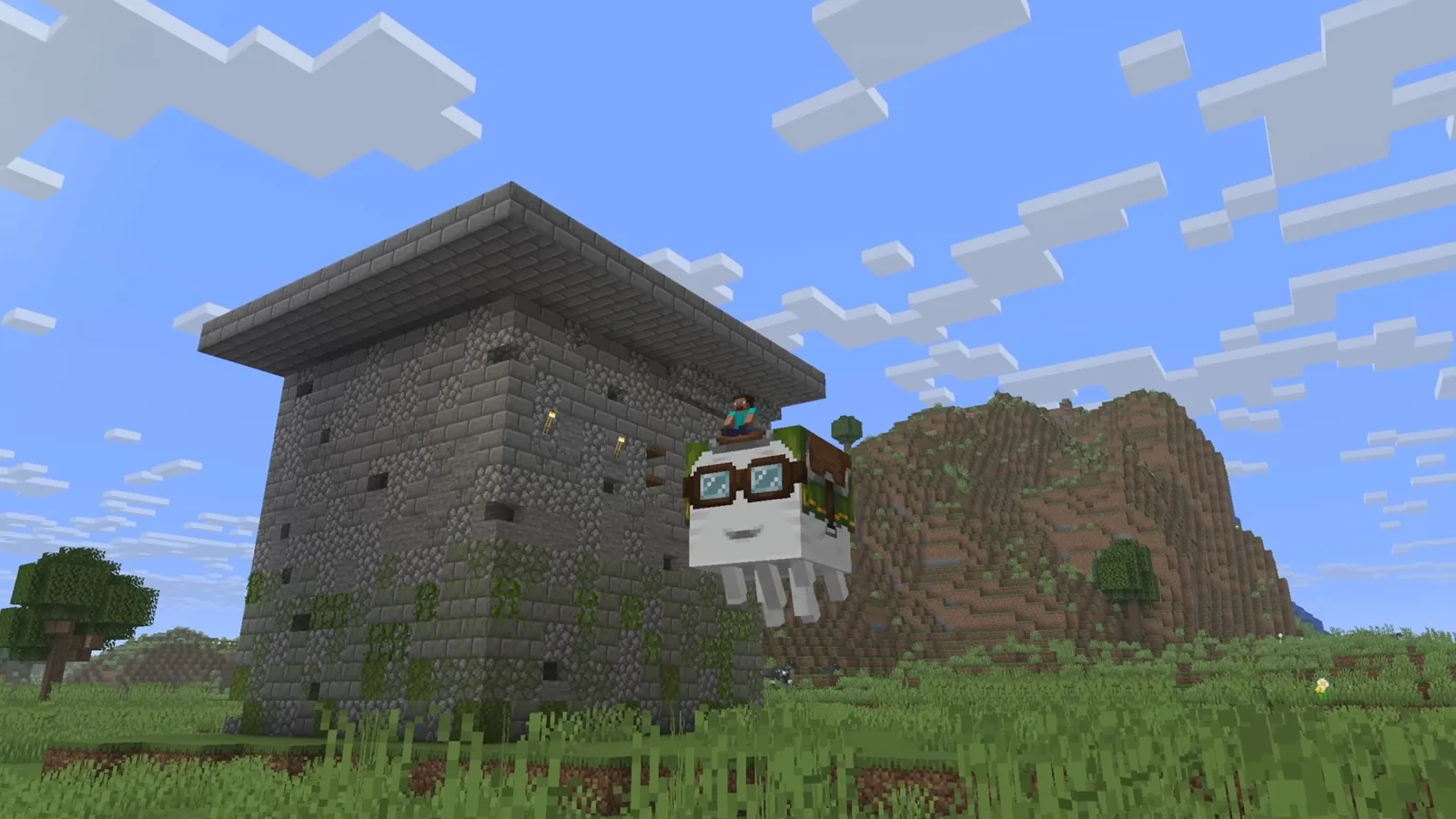
The most consequential feature in the drop started as a drawing. A boat hanging underneath the ghast was in the concept art from the very beginning, and to make it work the team went into the leashing code — which is where the scope quietly exploded.
What came out was a general rule the studio describes internally as leashing anything to anything, with an asterisk covering which mobs qualify. Instead of writing one special case for a boat beneath a ghast, they made leashing composable, and then let players find the consequences.
The consequences were immediate. Caravans of camels. Livestock convoys airlifted across an ocean in one trip. And the example a designer mentions with obvious delight: a player-built elevator that moves a cat up and down a glass tube by leashing it to a rising platform. None of that was designed. All of it fell out of one rule being general instead of specific.
Why this is the right way to add features
There is a broader lesson here that matches Mojang’s stated design philosophy: a general rule players can combine will always produce more than a specific feature the designers finished. The studio built the mechanism and left the applications to the community, which is the same pattern that produced redstone, and it is why redstone circuit builds still surprise people fifteen years in.

Building from the sky
The utility case that changed builds most is the least dramatic one. A happy ghast is a stable platform, so you can build while flying on it, at a height and with a hover behaviour that scaffolding and water elevators never gave you cleanly. Anyone who has built a large tower or a sky base knows how much of that work used to be scaffolding logistics rather than building.
Combined with the boat-and-leash system, it also means a build trip can carry materials, mobs and a second player in one journey. That is a genuine change to how a survival session is organised, not a cosmetic one.
The community theory Mojang likes
When the ghast was first shown at Minecraft Live, the community produced theories immediately, and the studio singles out one it is clearly fond of: that the fossils generating in Soul Sand Valley are the remains of ancient giant ghasts, and the dried ghast is one of their young. Mojang does not confirm it. They call it heartbreaking and beautiful, which is as close to an endorsement as a lore theory gets.
It is also a neat illustration of the studio’s approach to narrative. The game supplies objects — bones in the ground, a dried husk you can revive — and the players supply the story connecting them. Nobody at Mojang had to write that lore for it to exist.
What shipped alongside it
- The player locator bar, which shows where friends are on a server
- A new saddle recipe
- New music, and the rebuilt leashing system described above
All of it landed in the Chase the Skies drop in June 2025, which also carried Vibrant Visuals on Bedrock. Our 2025 year in review covers how that drop fits into the rest of the year.

The design takeaway
The Happy Ghast is a case study in additive design: it was made slow so it would not invalidate the elytra, made staged so players would care about it, and made compatible with a general leashing rule instead of a bespoke one. The result is a feature that expanded what players can do without taking anything away from what they already did — which is, on the evidence of the last fifteen years, the hardest thing to get right in this game.