Most structure mods put things in the wilderness. Tidal Towns puts them on the coastline, which is a more interesting constraint than it sounds, because the shore is the one part of a Minecraft world players actually travel along rather than through.
What it generates
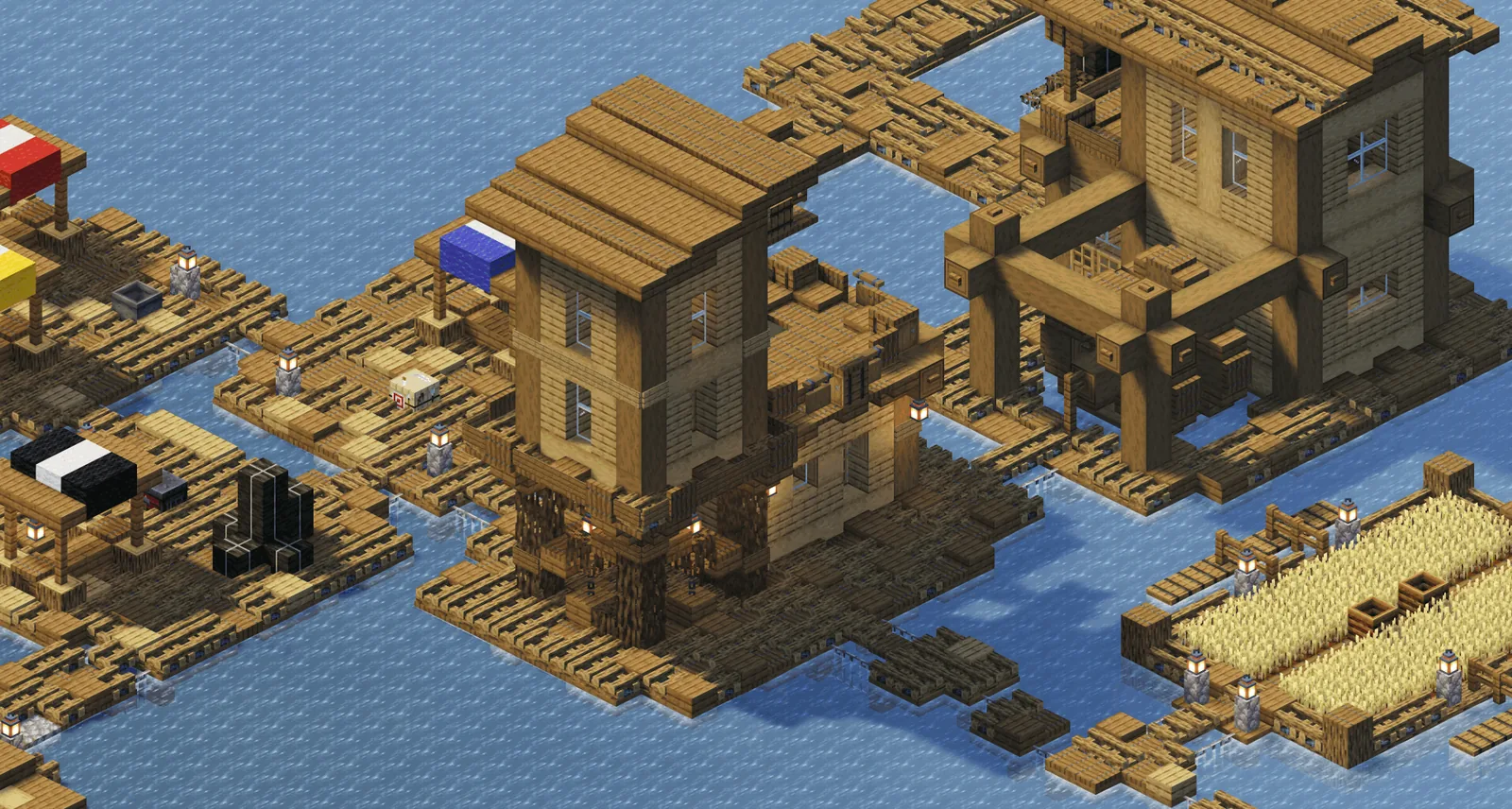
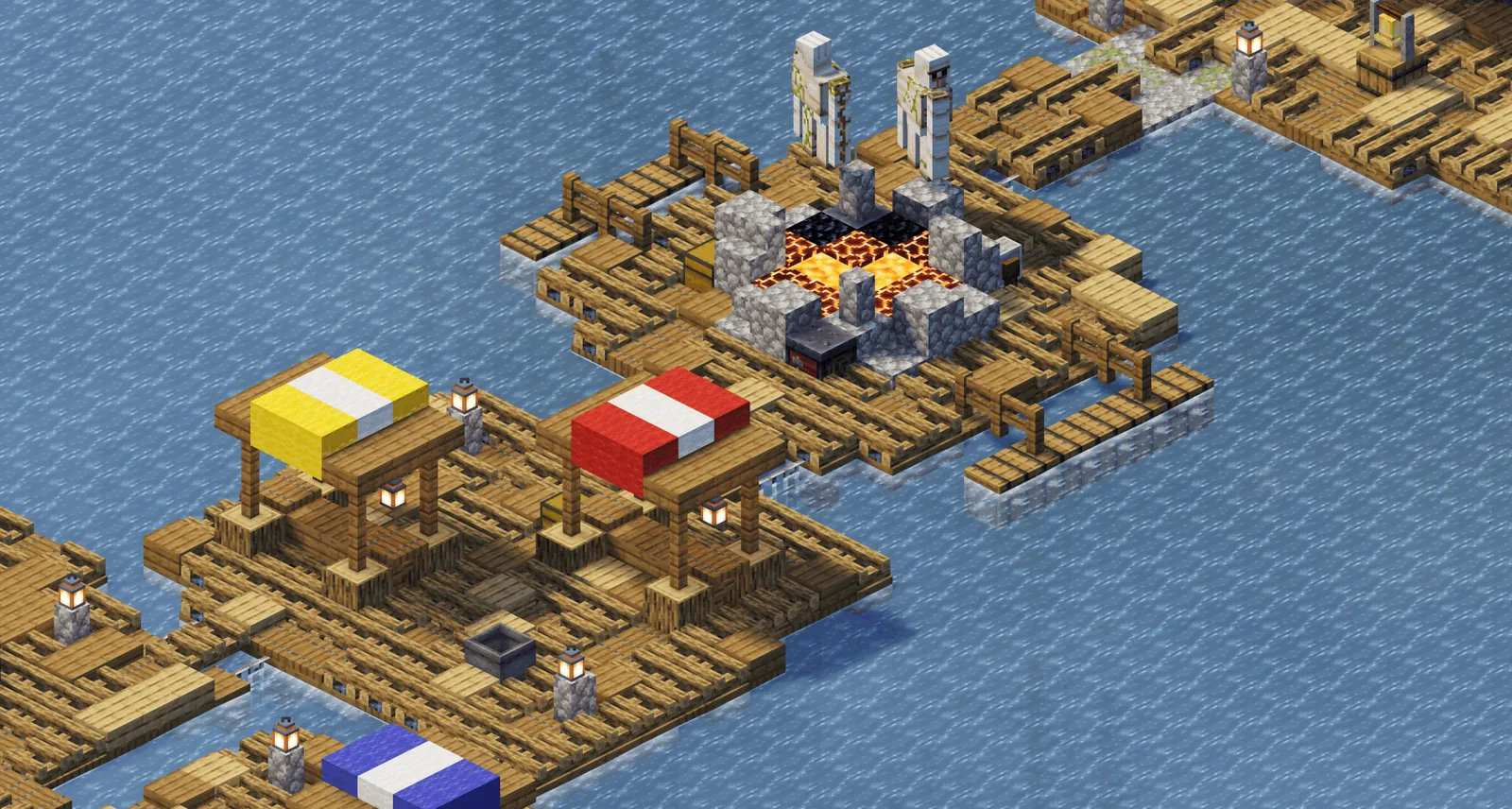
Coastal settlements: docks, stilted houses over shallow water, boathouses, breakwaters, small harbours with moored boats. The structures sit at the water’s edge rather than near it, which means they have to deal with the terrain generator’s least cooperative feature – the irregular, shelving boundary between land and ocean.
That is the technical achievement here. Anyone who has tried to build a dock by hand knows that Minecraft coastlines are rarely flat, rarely straight, and frequently drop three blocks in one step. Generating something that looks deliberate against that is harder than generating a tower in a field.
How it plays
The settlements are small. You are not finding a city; you are finding a hamlet of four to eight buildings with a jetty. That scale is the right call, because a large generated town on a shoreline would dominate every boat journey in the region.
Loot is modest and thematically appropriate – fishing gear, food, the occasional useful tool. This is a mod about making the map feel inhabited rather than about giving you a reason to raid something. If you want structures that fight back, the overhauled ocean monuments are a better fit.
The real gameplay effect is navigational. Once coastal settlements exist, sailing has landmarks, and a boat journey stops being a featureless grind between two known points. That is the same thing village overhauls do for overland travel, applied to water.
Build reference value
Even if you never loot one, the structures are worth flying to. Stilted construction over water is a build problem most players avoid because the foundation logic is unintuitive, and Tidal Towns has a stack of working examples: how high above water level to sit the floor, how to disguise the support posts, how to handle the transition from a pier to solid ground.
The jetties in particular are a better reference than most hand-built tutorials, because they have to work against generated terrain rather than a flat plot. If you have been putting off a waterfront dock project, generate a few and take screenshots before you start.
Compatibility and world placement
Tidal Towns generates against the coastline as the world generator produces it, which means it interacts with whatever biome and terrain mods you are running. On vanilla terrain, placement is clean. On a heavily modified overworld with dramatic cliffs and fjords, expect more variance – some settlements will sit beautifully in a cove, others will be wedged against a rock face.
That is not a bug so much as the cost of doing shoreline placement at all. If you run a large worldgen overhaul, generate a test world and fly the coast before committing, the same way you would for any worldgen mod added to an existing setup.
It also plays fine alongside other structure mods, because its niche is narrow enough not to collide. A world running Tidal Towns plus a dungeon mod plus a village overhaul will not produce overlapping structures in the way two competing village mods would.
What it does not do
No new mobs, no new blocks worth mentioning, no quest layer, no boss. It is a placement mod. If your complaint about Minecraft is that the world is empty, this helps. If your complaint is that there is nothing to do, it does not.
It also does not touch the ocean floor. Everything is surface and shoreline, so the underwater half of the world remains as sparse as vanilla leaves it.
Verdict
Tidal Towns solves a specific problem well: coastlines in Minecraft are visually prominent and completely uninhabited. Adding small, plausible settlements to them makes water travel meaningful without turning the sea into a theme park.
It is a good pick for exploration-focused worlds and an excellent one for anyone who builds near water and wants generated reference to steal from. It is a poor pick if you are looking for combat content or loot progression, and it would be a strange first structure mod to install on a world that has no village or dungeon content yet.
Install it early in a world’s life rather than late. Structure mods only affect chunks generated after they are added, and coastline is exactly the kind of terrain players explore in their first few hours.
Finding them once installed
Coastal structures are easy to miss because you are usually travelling with a destination in mind rather than following the shore. Two things help.
The first is to sail rather than fly for the first stretch of a new coast. At altitude the settlements are small enough to read as terrain noise; at water level they are unmistakable. The second is to follow the shoreline deliberately for a few thousand blocks in one direction rather than crossing open ocean, which is where the mod’s placement logic actually has something to work with.
If you are using a map mod, coastal structures show up well on a rendered world map because the block palette differs sharply from sand and water. That is the cheapest way to find several at once without spending an evening on it.
Images: Tidal Towns project gallery.