Key takeaways
- A good parkour map teaches a jump before it tests it – bad ones open with their hardest section.
- Java maps are world folders you drop into saves; Bedrock maps mostly come through the Marketplace as one-click installs.
- Checkpoint density matters more than difficulty. A hard map with frequent checkpoints is fun; a medium map without them is a chore.
Parkour is the one Minecraft format that strips everything else away. No inventory, no crafting, no mobs – a course, a set of jumps, and however many attempts you are willing to spend.
It is also the category where quality varies most wildly, because anyone can place blocks in a line and call it a map. Here is what separates the ones worth downloading.
What makes a parkour map good
It teaches before it tests
Every jump type in a well-built map appears first in an easy, forgiving version and later in a hard one. The first ladder jump is a single ladder over solid ground; the fifteenth is a ladder over a drop with a timing element. Maps that open with their signature trick are maps you quit in the first minute.
Checkpoints are frequent
The single biggest predictor of whether people finish a map. Losing thirty seconds to a failed jump is a challenge; losing four minutes is an insult. Good maps checkpoint every few jumps and say so.
It looks like somewhere
The best parkour maps are built inside a theme – a city, a temple, a machine – rather than as floating blocks in the void. Theme gives you visual landmarks, and landmarks are how you learn a route.
Where to find them
On Java, maps are distributed as world folders, usually through community sites and creator pages, and installed by hand. On Bedrock, the Minecraft Marketplace carries curated maps from professional studios with one-click installs and no file management at all.
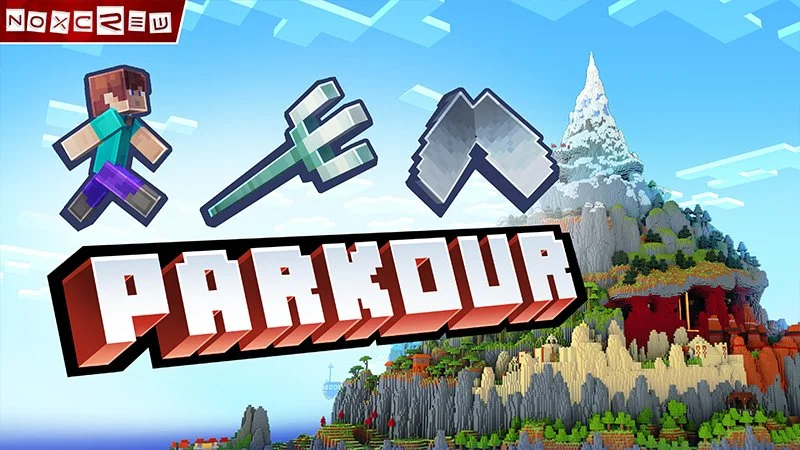
Noxcrew, the studio behind MC Championship, is the clearest example of the professional end – their catalogue includes movement-focused maps built to the same standard as the minigames they run for the tournament.
The obstacle-course cousins
Pure parkour overlaps with a family of movement maps that add a mechanic: one-block survival challenges, water and elytra courses, timed obstacle runs. If flat parkour gets repetitive, those are the next step rather than a harder version of the same thing – as are adventure maps, which swap movement for story.
Installing a map on Java
Download the map as a .zip, extract it, and drop the resulting folder into the saves folder inside your game directory. It will appear in the world list next time you open single player. If the folder you extracted contains another folder with the same name, move the inner one – a doubled folder is the most common reason a map does not appear.
Two things to check before playing: the Minecraft version the map was built for, and whether it needs a resource pack. Playing a map on a much newer version usually works but can break command blocks, which is what most parkour checkpoints are built from.
Difficulty labels mean nothing
There is no shared scale. One creator’s medium is another’s expert, and the same map will be described differently on two sites. The only reliable signal is the jump vocabulary: if the description mentions neo jumps, momentum jumps or head-hitters, it is aimed at people who already play parkour seriously.
For a first map, look for something described as a course or a tower rather than a challenge, and check the video if there is one. Ten seconds of footage tells you more than any label.
Playing them well
Turn off sprint-jumping as a default habit and learn the map’s spacing first. Most parkour failures are overshooting rather than falling short, and the standard four-block sprint jump is the widest gap in the game rather than the normal one.
Set your field of view somewhere in the middle. Very high FOV makes distances read as shorter than they are, which is why so many people miss jumps immediately after changing the setting.
Building your own
The entry cost is low and the skill ceiling is not. A first course can be twenty jumps in a straight line; what separates it from a good map is pacing – a hard section, then an easy one, then a harder one, with a visual change at each transition so the player can feel progress.
Test it on someone who does not play parkour. Every builder underestimates their own map by a wide margin, because they have already practised every jump a hundred times while placing the blocks.
Worth your evening
A well-built parkour map is forty minutes of concentration and one of the few Minecraft experiences with a clean ending. That is rarer than it sounds in a game that mostly runs until you stop.
And if you are building your own, the rule that matters is the first one: teach the jump before you test it. Everything else – theme, decoration, difficulty curve – is easier to fix afterwards than a map that loses everyone at the opening gap.