Key takeaways
- Every catch rolls against three pools: fish, treasure and junk. Enchantments shift the odds between them.
- Treasure only appears when the bobber is in open water, and the open water check is stricter than most players assume.
- Lure reduces wait time, Luck of the Sea improves the pool. They do different jobs and stack.
Fishing looks like the game’s idle activity and is actually one of its more precisely defined systems. The difference between a productive fishing spot and a useless one is a set of rules you can check.
Three pools, one roll
When something bites, the game picks a category first. Fish are the common outcome. Junk covers leather boots, sticks, bowls and lily pads. Treasure covers enchanted books, enchanted rods and bows, name tags, nautilus shells and saddles.
Treasure is the reason to fish at all beyond food, and it has a condition attached that junk and fish do not.
The open water rule
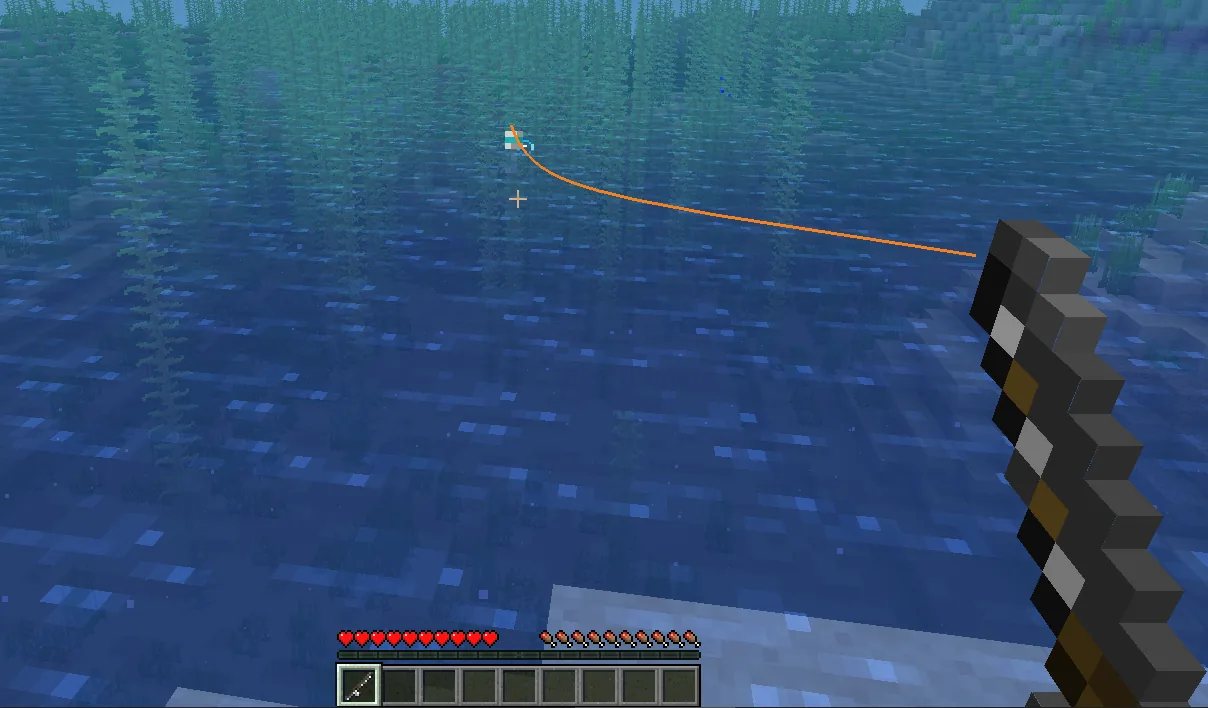
Treasure can only be caught in open water. The game checks a volume around the bobber and requires it to be water or air, with no solid blocks, no lily pads, no boats overlapping the check area. A fishing hole dug into a floor fails it. A pier with the bobber close to the supports often fails it too.
This is why players report catching nothing but junk from their carefully built fishing hut. The mechanic is not random, they are simply outside the treasure condition entirely.

What the enchantments do
Lure reduces the waiting time before a bite. It does not improve what you catch, and at high levels it interacts oddly with the treasure roll, so it is best understood as a speed enchantment.
Luck of the Sea shifts the probabilities: less junk, more treasure. On a rod used for treasure hunting, it is the important one. Unbreaking and Mending matter for a rod in constant use, and Mending is easy to obtain on a fishing rod precisely because books come out of the treasure pool.
Is it worth the time?
As a food source, no. A small wheat farm and a few cows outproduce fishing by a wide margin with less attention. As a source of enchanted books early in a world, before a librarian trading hall exists, it is genuinely competitive – and it needs no diamonds, no lapis and no experience investment.
Our honest read is that fishing’s value is mostly in that early window. Once a villager trading hall is running, buying the exact book you want from a librarian beats rolling for a random one, and the fishing rod goes back in a chest. The players who keep fishing afterwards are doing it because it is pleasant, which is a perfectly good reason.
Automation and its limits
Automatic fishing farms have been patched, unpatched and re-patched across versions, and any specific design should be tested on the version you are running rather than trusted from an old video. The mechanics they rely on – bobber behaviour and open water checks – are exactly the parts Mojang has adjusted most often.
For enchantment sources that do not depend on luck, see the guides hub, and the villager side of the economy is covered across the news section when trading changes ship.
Fishing as an early experience source
Each catch gives a small amount of experience, and over a long session that adds up without requiring a mob farm. In the first hours of a world, before an experience farm exists, fishing is a legitimate way to reach the levels needed for a first round of enchanting.
It is slow and it requires nothing but a rod, three sticks and two string, which is the trade being offered.
Weather and time
Rain increases the bite rate, so a storm is the best time to fish. Time of day does not affect catches directly, though it affects whether you are safe standing at the water’s edge.
Building a fishing spot that qualifies
Dig a pool at least five blocks across, keep the surrounding blocks at or below water level, avoid lily pads and boats near the bobber, and leave the area above open. A spot built this way passes the open water check and produces treasure at the expected rate.
Roof it if you like, but keep the roof high and the area around the bobber clear – the check looks at a volume, not just the block the bobber sits in.
When to stop fishing
Once you have a librarian selling mending and a mob farm producing experience, the rod goes in a chest. Fishing is an early-game tool with a specific window of value, and recognising when that window closes saves hours that a trading hall will repay far faster.
Images: Aquaculture 2 project gallery on Modrinth.