Key takeaways
- Attacking before the cooldown bar refills deals a fraction of the weapon’s damage. Timing beats click speed.
- Reach differs between survival and creative, and between players and mobs, which is why some hits feel like they should have connected.
- Sweeping, critical hits and knockback all interact with the cooldown, so the same weapon plays very differently depending on rhythm.
The combat update split the community and never fully un-split it, but the mechanics it introduced are still the ones the game runs on. Understanding them is the difference between losing to a skeleton and not.
The cooldown is a damage multiplier
Every weapon has an attack speed, and after each swing a cooldown bar refills. Attack at full charge and you deal full damage. Attack at half charge and you deal roughly half. Attack immediately after a swing and you deal very little.
This is why a player who clicks as fast as possible loses to one who waits. The fast clicker is landing more hits for less total damage, and is also failing to trigger the effects that require a charged swing.

Critical hits and sweeping
A critical hit requires falling at the moment of impact, without sprinting, and adds a substantial damage bonus. The familiar jump-and-hit rhythm exists because of this interaction, not as a stylistic choice.
Sweeping is the sword’s area attack, and it only triggers on a fully charged swing while standing on the ground and not sprinting. Against a group of zombies that is the difference between clearing a doorway and being surrounded.
Reach, and why it feels inconsistent
Survival reach for attacking entities is shorter than the distance you can break a block at, and shorter still than creative mode reach. Mob hitboxes also vary in size and do not always match the visual model, which is why an attack on a spider at an angle can miss when it looked like a hit.
Latency compounds this in multiplayer. The server decides whether a hit landed, using its own view of where both parties were, and on a high-ping connection that view is behind what you are seeing.
Weapon choice is not obvious
An axe deals more damage per hit than a sword of the same tier but has a slower cooldown and no sweeping. Against a single high-health target, the axe wins. Against a group, the sword wins. Against a shield user, the axe wins again, because it can disable the shield.
Our view is that the axe being a legitimate primary weapon is one of the better outcomes of the combat rework, and it is still underused. Most players pick a sword by default and never test the alternative against the situations where it is clearly stronger.
What combat mods change
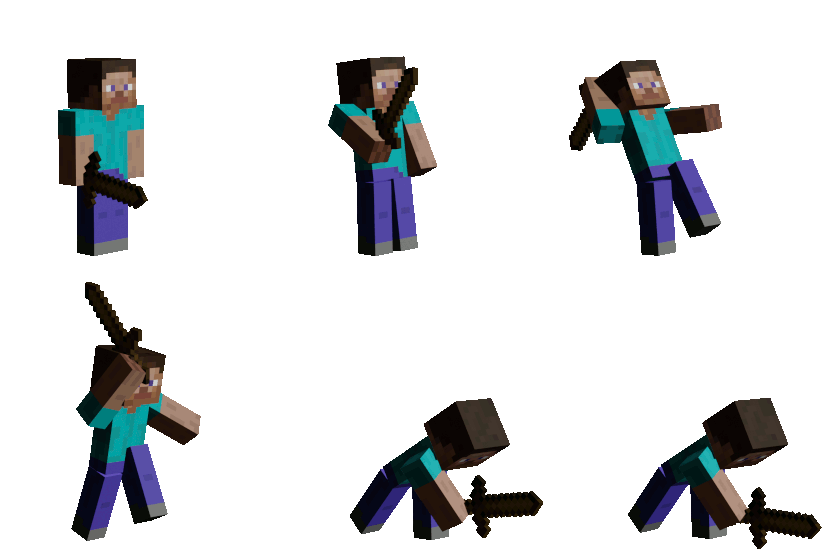
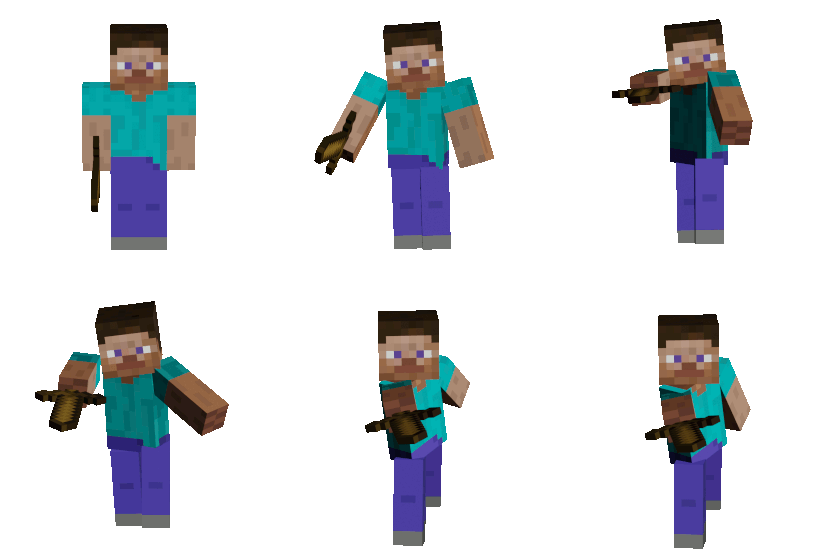
Combat overhaul mods generally replace the cooldown system with animation-driven attacks, directional swings and weapon-specific movesets. They make the game feel more like an action title and less like a timing puzzle. That is a genuine improvement in feel, and it also invalidates every technique above, so it is worth deciding which game you want to be good at.
For the mob side of the equation, the mods hub covers creature overhauls, and the rest of the survival guides are on the guides hub.
Shields and the timing that matters
A shield blocks from the moment it is raised, with a short delay after switching to it. It blocks melee, arrows and most projectiles, and it is disabled temporarily by an axe hit. Learning to raise it between your own swings is the single biggest defensive improvement available.
The rhythm is: swing at full charge, raise shield, wait for the enemy attack, drop shield and swing again. Against skeletons and pillagers, that pattern makes a fight almost free.
Knockback and spacing
Every hit applies knockback, and sprinting attacks apply more. That is useful for creating distance and harmful when it pushes a mob out of your reach or off a ledge you wanted the drops on. Sprinting also disables critical hits, so the two cannot be combined.
Against a creeper, knockback is the whole fight – hit, push back, let the fuse reset, repeat.
Armour, enchantments and diminishing returns
Armour points reduce damage on a curve rather than linearly, and protection enchantments stack with that on top. The practical effect is that the jump from iron to diamond matters more than the jump from diamond to netherite, and enchantment levels matter more than the material above a certain point.
For most survival play, enchanted iron beats unenchanted diamond, which is not obvious from the item tooltips.
Practice that transfers
Fight ten skeletons deliberately, using full-charge swings and a shield between them, and count how many hits you take compared with your usual approach. The difference is large enough to feel immediately, and it is the clearest demonstration that the cooldown system rewards rhythm over speed.
Images: Better Combat project gallery on Modrinth.