Minecraft has been in continuous development for more than fifteen years, and a fair amount of what players think of as the game is technically a mistake that survived. Mojang put out a studio video walking through where bugs come from, which famous ones changed Minecraft permanently, and what happens to a report after you submit it. It is the most detailed public look at that pipeline so far, and if you have ever filed a ticket and watched it sit there, it explains a lot.
Why a game like this generates so many
Mojang’s own framing is not that Minecraft is unusually buggy, but that it is unusually interconnected. The game is a stack of systems — physics, redstone, mob AI, world generation, inventory, networking — and each of them was built at a different time by different people. Every new feature is a new interaction surface against all of the old ones.
Add a player base this size and the arithmetic gets brutal. Millions of people are running combinations the studio never tested, at scales the studio never tested, on hardware the studio never tested. Mojang’s developers describe finding out about a problem the same way everyone else does: someone does something odd, it breaks, and it ends up on the tracker.
- Bugs cluster at the seams between systems, not inside them
- Serious ones — anything that loses player data — get priority over funny ones
- Some are never fixed because the fix would risk more than the bug costs
The flying squid, explained by the person who made it
The squid is the best story in the video because the developer who shipped it tells it himself. It was his first mob, and the fastest way to build a new mob at the time was to copy an existing one. He copied the cow — and forgot to remove the milking behaviour, so for a while you could milk a squid.
The second problem was worse and more famous. The movement code he wrote meant the server and the client disagreed about where the squid actually was, and the visible result was squids drifting through the air. That is the flying squid bug, and it is a textbook example of a desync: neither machine is broken, they simply do not agree, and the player sees the disagreement.
The booster rail, and Mojang’s rule about keeping bugs
The minecart booster is the case that matters most for design, because it is where Mojang made a rule it still follows. Placing a minecart next to another minecart made their bounding boxes overlap, and the engine resolved the overlap by pushing them apart. Players turned that into tracks that accelerated carts to absurd speeds, and for years booster loops were standard infrastructure in big builds.
Mojang removed it anyway. The stated reason is not that the exploit was unfair but that keeping bugs around makes the codebase less predictable — bugs you deliberately preserve become constraints on every future change, and they tend to breed more bugs. So the behaviour was cut and the powered rail was added in its place, giving players the same capability as an intentional feature with intentional rules.
One of the developers puts the useful version of this plainly: the bug exposed a need the game had, and the answer was to build the feature properly rather than to protect the accident. That is the pattern to watch for whenever a beloved exploit disappears — check the same update for the sanctioned replacement.
Bug #2025, fixed on 1 January 2025
Some tickets are older than most players. Bug #2025 — mobs occasionally glitching through blocks and walls — was reported extremely early in Minecraft’s life and resisted repeated fix attempts over more than a decade. It was finally closed on 1 January 2025, and Mojang openly admits the timing was not an accident: the number lined up with the year, and a developer patched it from a phone at midnight on New Year’s Eve while the fireworks were going off.
It is a joke and it is also a fair summary of how long tail bugs work. They do not get fixed when they are discovered. They get fixed when someone finally has the right mental model of the system that produces them.
What actually happens to your report
This is the part worth internalising if you file tickets. Reports go to bugs.mojang.com, where a layer of moderators and volunteer helpers confirms, deduplicates and organises them before developers see anything. That triage layer is the bottleneck and the filter, and it is why report quality changes outcomes so much.
How to file one that survives triage
- Search first — most reports are duplicates of an existing ticket, and a duplicate adds nothing
- Give exact version numbers for the game and, on Java, the mod loader if any
- List reproduction steps someone else can follow on a fresh world, not a description of your base
- Say what you expected and what happened, separately
- Attach a short clip or screenshot; visual bugs are confirmed far faster with one
- Confirm it happens in vanilla before reporting it, or say clearly that you have not
Once a ticket is picked up you can follow the work through the tracker’s changelog, and the fix ships in a later update. That visibility is genuinely unusual for a game this size — most studios keep the queue private.
Why Mojang keeps the funny ones around in conversation
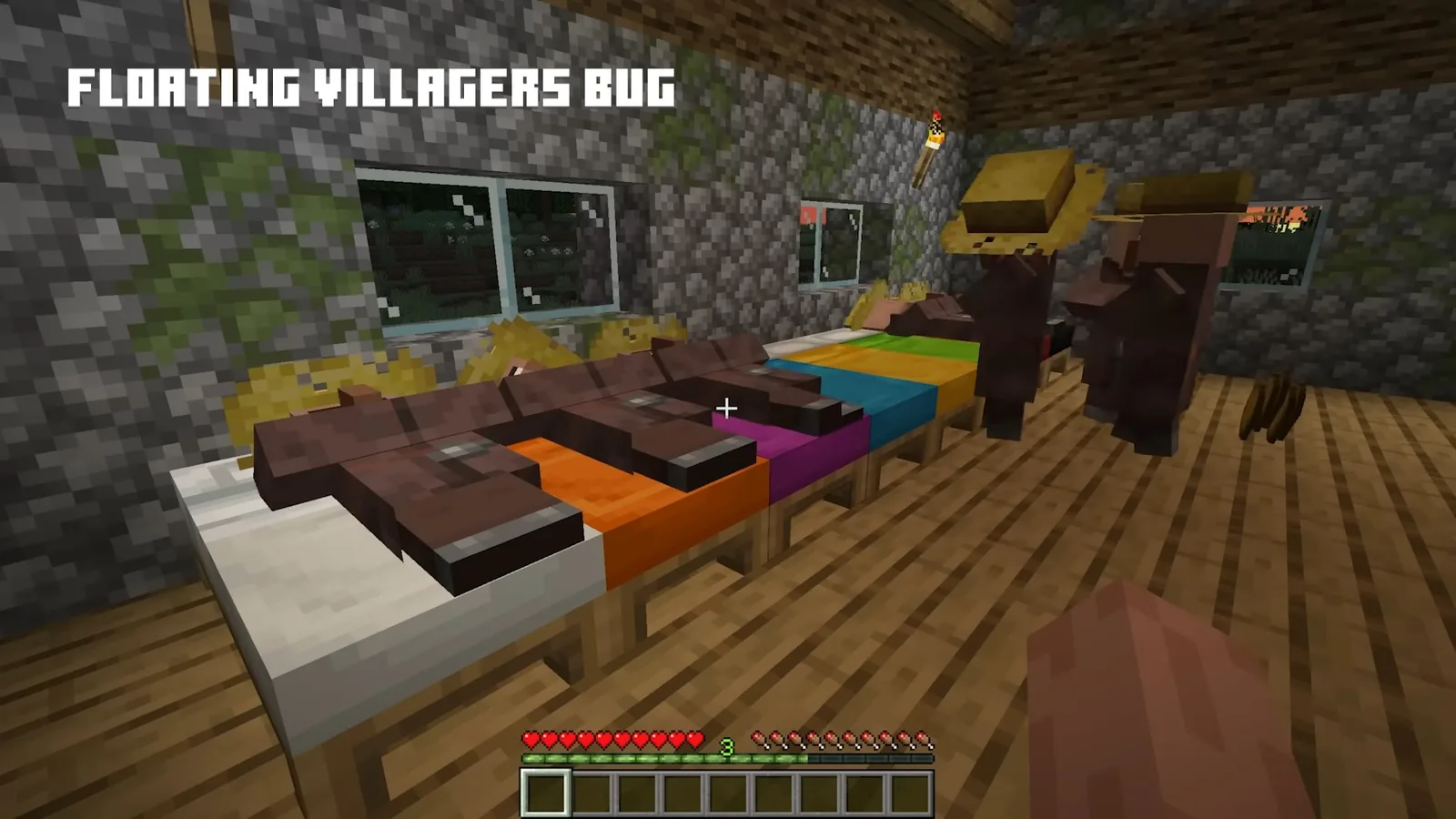
The developers are cheerfully unembarrassed about the comedy tier. Villagers getting nudged in bed and then drifting off into the sky is the example they keep coming back to, and they are clear that those bugs are part of the studio’s culture rather than a source of shame. That attitude is probably why the tracker works: a team that finds its own mistakes funny is a team that will let you see them.
It also sets expectations correctly. Cosmetic weirdness is low priority and may live for years. Anything that destroys inventories, corrupts worlds or crashes the client is treated as urgent, and those are the reports worth writing carefully.
The takeaway for players
Minecraft’s bugs are not noise around the game; several of them are the reason the game has the features it has. The powered rail exists because of a bug. The bug tracker exists because Mojang decided that the cheapest QA department in the world is a few hundred million people who already own the game.
If you run mods, reproduce in vanilla before you report — our guide to installing Iris and shader packs covers how to keep a clean profile alongside a modded one, which makes that check painless. And if you want the design philosophy behind those fix-or-keep decisions, Mojang’s world-design interview covers the reasoning in more detail.
