Underwater bases are the most technically demanding build in Minecraft and the most consistently disappointing. The construction problem – working in water – dominates the design problem, and most finished results are a glass box with a corridor.
Solve the construction first
Nothing about underwater building is enjoyable until you can breathe and see. Three things make it possible:
- Conduit – the correct answer. Water breathing, night vision and mining speed in a radius, permanently.
- Potion of Water Breathing – extended, for the phase before you have a conduit.
- Respiration III and Aqua Affinity on a helmet – cumulative with everything else.
A conduit needs prismarine and a nautilus shell, which means an ocean monument or a lot of fishing. Building the conduit before the base is the correct order and almost nobody does it.
Draining versus building in water
Two approaches. Drain a volume with sponges or by filling and removing, then build in air. Or build in the water and let the interior be flooded until the shell is sealed.
Draining is faster with sponges and impossible without them. Sponges come from elder guardians, which means the monument again.
The glass box problem
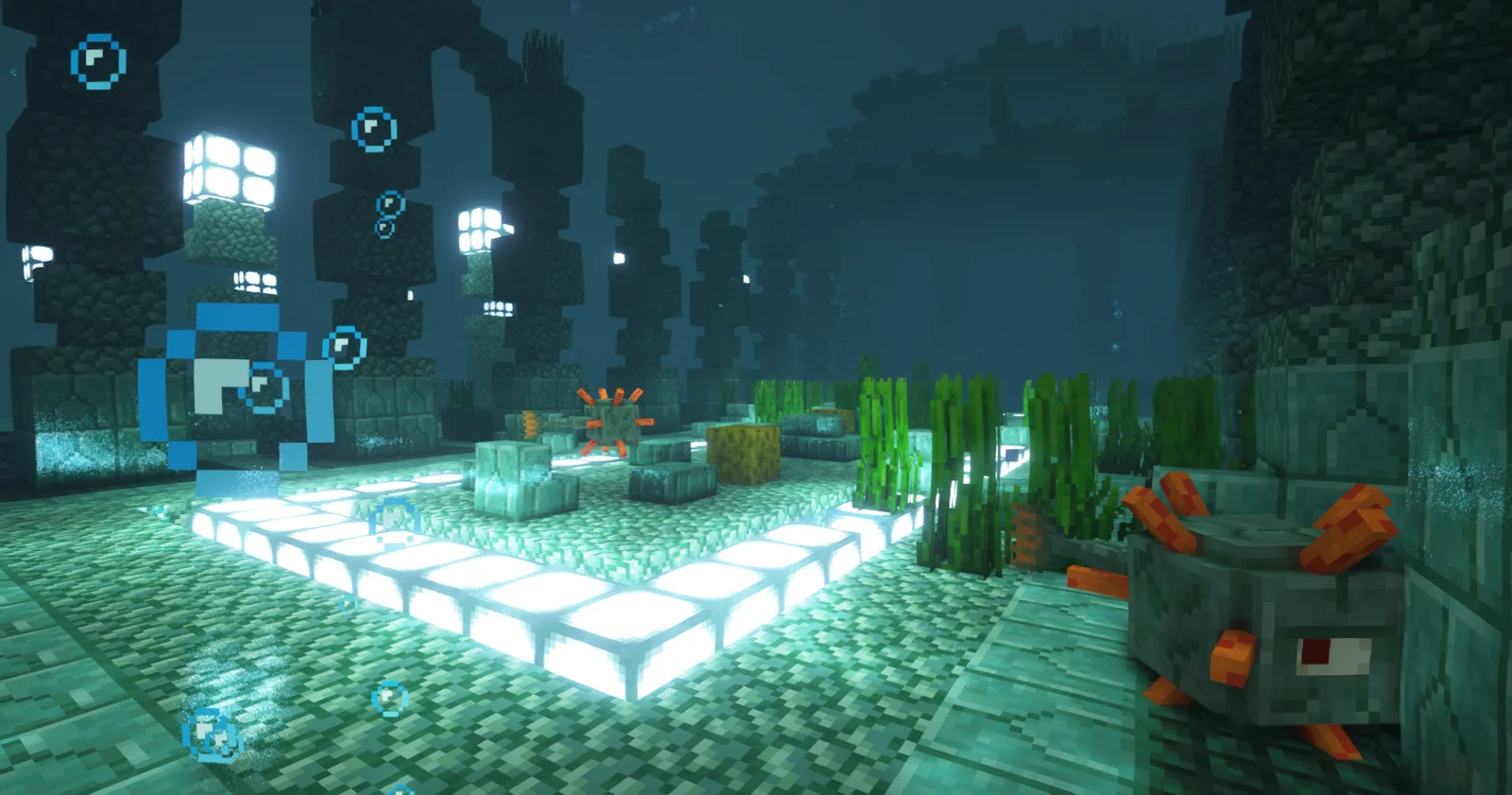
The obvious underwater base is a glass dome, and it is obvious because it is the only shape that uses the one thing underwater building offers – the view.
The trouble is that a glass dome has no architecture. It is a shape, not a building, and once the novelty of the view fades there is nothing to look at.
What works better
- Solid structure with deliberate openings – prismarine or stone with framed glass panels, so the views are chosen.
- Built into the seabed – most of the base is rock, with the glazed sections facing outward.
- Adapting a monument – build inside or around an existing structure.
- Half-submerged – the best option, with an above-water element that makes the base findable.
The half-submerged approach solves the biggest practical problem, which is that a fully underwater base is invisible and hard to return to.
Materials
Prismarine, dark prismarine and prismarine bricks are the native palette and they are good – three related tones with a blue-green cast that reads as underwater.
- Prismarine bricks as the dominant material.
- Dark prismarine for framing and floors.
- Sea lanterns as the light source, which is also native.
- Copper, oxidised, as an accent – it reads as submerged metal.
Oxidised copper against prismarine is one of the best colour pairings in the game and almost nobody uses it.
Lighting underwater
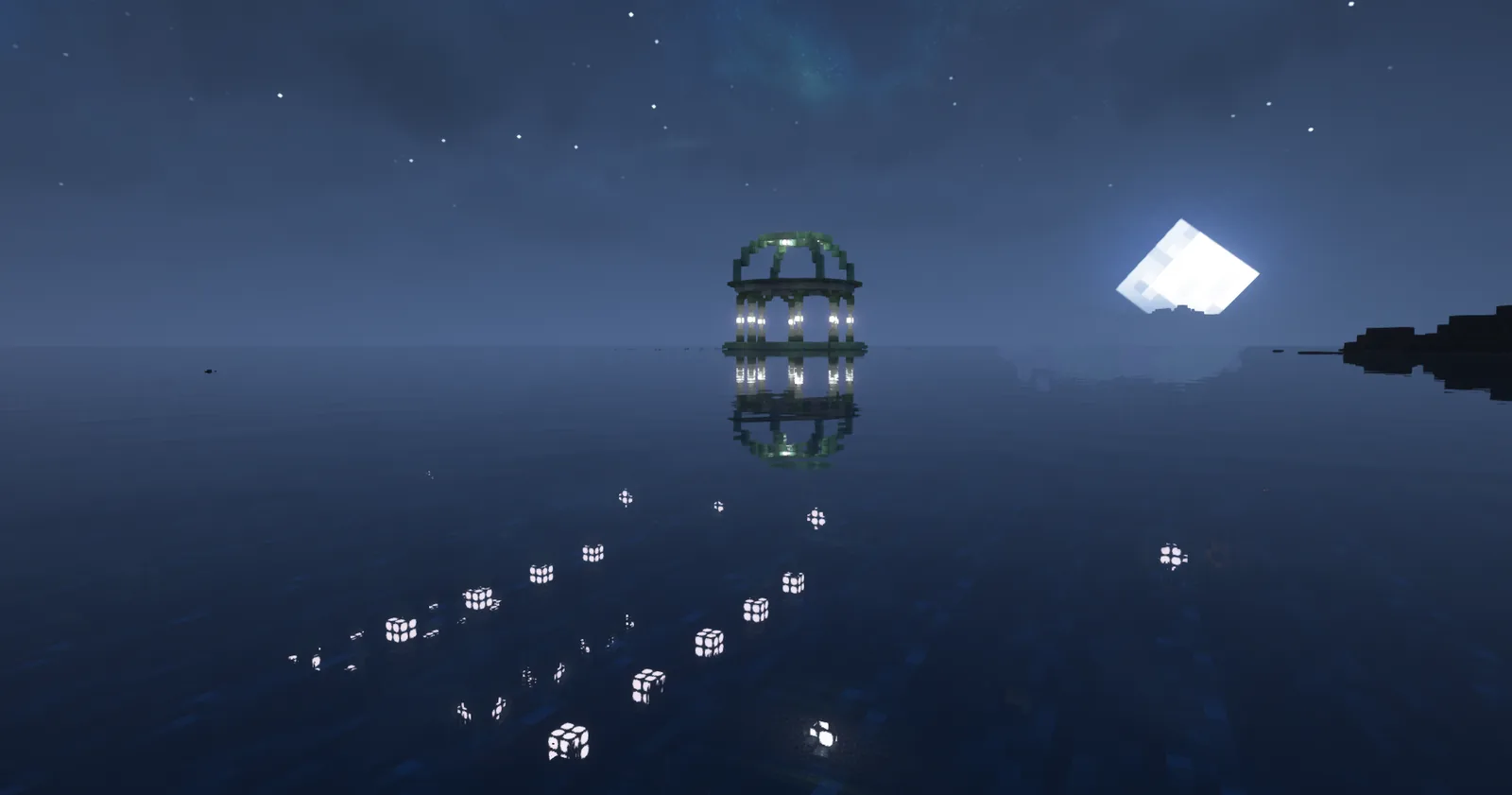
Light behaves differently below the surface – it is dimmer, bluer, and falls off faster. Sea lanterns are the native answer and they are cold, which suits the setting.
Warm light in an underwater base reads as artificial in a good way – a warm interior seen from cold water outside is a strong effect, and worth doing deliberately rather than by accident.
Getting in and out
An airlock is not required mechanically – you can swim in – but it is required for the build to make sense. A door, a small chamber, and a second door reads as an entrance in a way a hole does not.
Bubble columns from soul sand make a fast vertical exit, and a magma block column makes a fast descent. Both are cheap and both should be built early.
Practical concerns
- Drowned spawn in water and will get inside any opening.
- Guardians near a monument attack anything in range, permanently.
- Water flows into any breach instantly – seal before you drain.
- Item drops float, which makes losing things underwater unusually easy.
The guardian problem is the one that decides site selection. Building near a monument is atmospheric and means being shot at forever unless you clear it.
Is it worth it?
As a project, yes – it forces techniques you would not otherwise learn. As a base, usually not, because everything you actually do in Minecraft is easier on land.
The players who keep underwater bases tend to have them as a second base with a specific purpose, most often a guardian farm, rather than as a home.
Preparation checklist
- Conduit built and active, or a stack of Water Breathing potions.
- Respiration III and Aqua Affinity helmet.
- Depth Strider boots.
- Sponges if you intend to drain.
- A marked surface entrance so you can find the site again.
Getting an elder guardian drop means clearing a monument, which needs its own preparation – the potion side of that is covered in the brewing guide, and Water Breathing extended is non-negotiable for it.
The conduit, in detail
A conduit needs a frame of prismarine, prismarine bricks, dark prismarine or sea lanterns – 16 blocks for a partial frame, 42 for full power. At full power it gives conduit power in a 96-block radius.
- Water breathing, indefinitely, in range.
- Night vision underwater, which matters as much.
- Mining speed as if you were on land.
- Damage to hostile mobs within 8 blocks, at full power.
Building it before the base rather than after turns underwater construction from an ordeal into ordinary building.
Clearing a monument
The reward is sponges, which make draining possible, and prismarine, which is the palette. It is one of the harder vanilla raids and it is worth the preparation.
Water Breathing extended, Respiration III, Depth Strider, and a plan for the elder guardians’ mining fatigue – which is the mechanic that actually stops people, because it makes breaking blocks nearly impossible until the guardians are dead. Milk removes it, and carrying several buckets is the standard approach. The potion side of the preparation is in the brewing guide.
Images: YUNG’s Better Ocean Monuments project gallery on Modrinth.