The fastest way to make a good build look amateur is to leave a vanilla tree next to it. Vanilla trees are small, symmetrical and made of two blocks, and they were designed to be generated by the million rather than to sit beside something you spent a weekend on.
Custom trees are the highest-return landscaping work available, and they are mostly a matter of four rules.
Why vanilla trees look wrong
Three reasons, and naming them makes the fix obvious.
Scale. A vanilla oak is five or six blocks tall. A building is fifteen. Real trees near buildings are usually taller than the building, and one that is a third of its height reads as a shrub.
Trunk width. One block. At a distance a one-wide trunk disappears entirely, so the canopy looks like it is floating.
Canopy shape. A generated blob with a flat bottom. Real canopies are irregular, they thin at the edges, and light comes through them.
Rule one: two-wide trunks minimum
Any tree taller than about eight blocks needs a trunk at least two by two. Three by three at the base, tapering to two, for anything approaching building height.
Mix the trunk material. Logs, stripped logs and wood blocks in the same trunk produce variation in the bark that a single block type cannot. A few blocks of a darker wood at the base reads as shadow and damp.
Roots are the detail that separates a tree from a pole. Two or three logs angling out from the base into the ground, with a block of coarse dirt or podzol where they meet, and the tree stops looking placed.
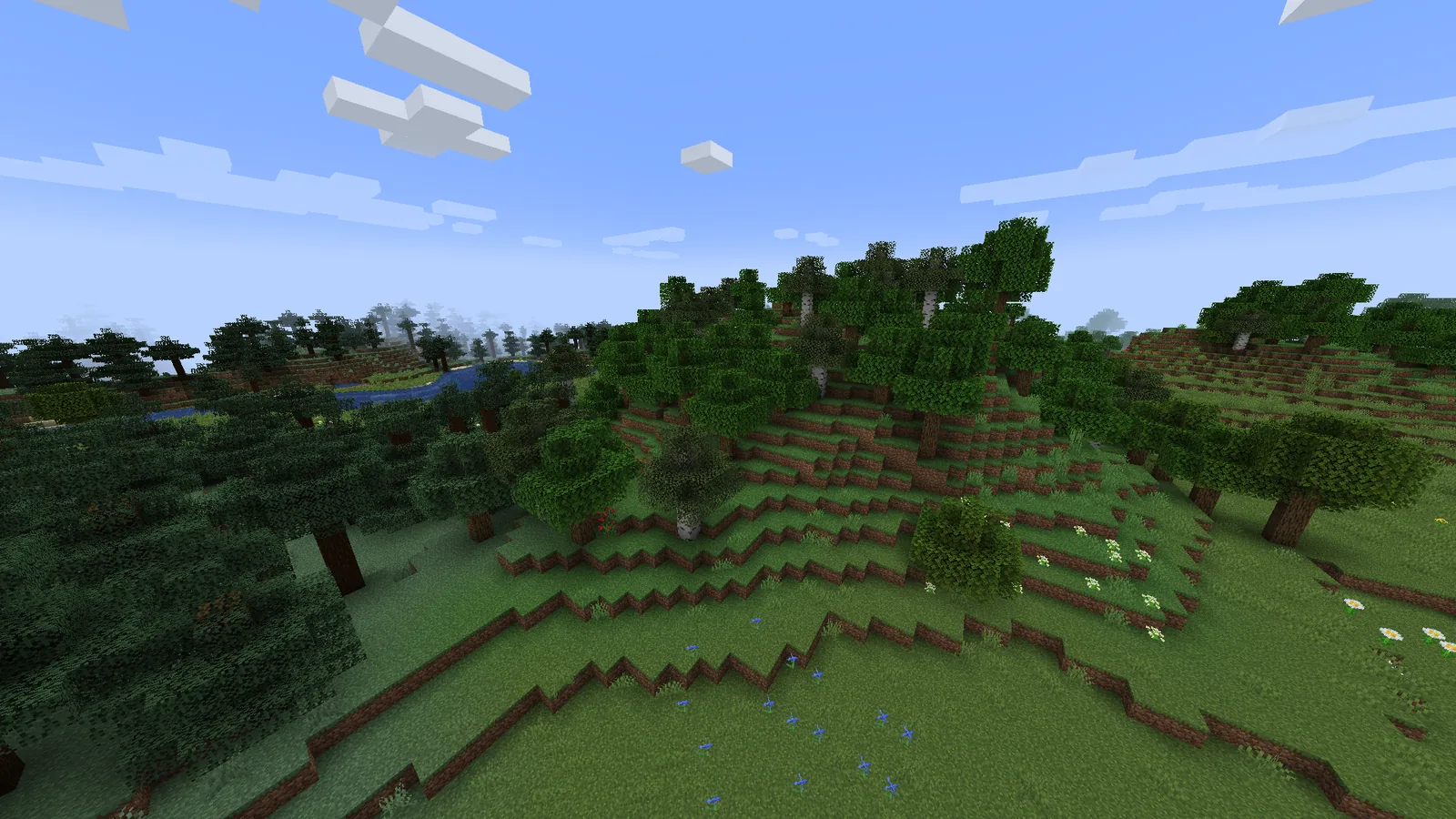
Rule two: branches before canopy
Build the whole skeleton first – trunk, then branches, with no leaves at all. If the bare tree looks like a tree, the leaves will work. If it looks like a stick with twigs, more leaves will not save it.
Branches should come off at different heights, go different distances, and not be symmetrical. Two branches at the same height on opposite sides is the single most common mistake and it reads instantly as artificial.
Branches also thin as they go out. A branch that starts two blocks thick and ends one is doing work that a uniform branch is not.
Rule three: canopy in layers, not as a blob
Leaves should be placed as several overlapping masses, each roughly spherical, at different heights and offsets – not as one solid volume.
Two things make the difference. Gaps, so light and sky come through, which is what stops a canopy reading as a green brick. And a ragged edge, achieved by removing leaf blocks from the outside until the silhouette is uneven.
Leaves from more than one wood type in the same canopy adds colour variation, and on 26.3 the poplar leaves in yellow, red and orange are useful for exactly this, well outside their biome.
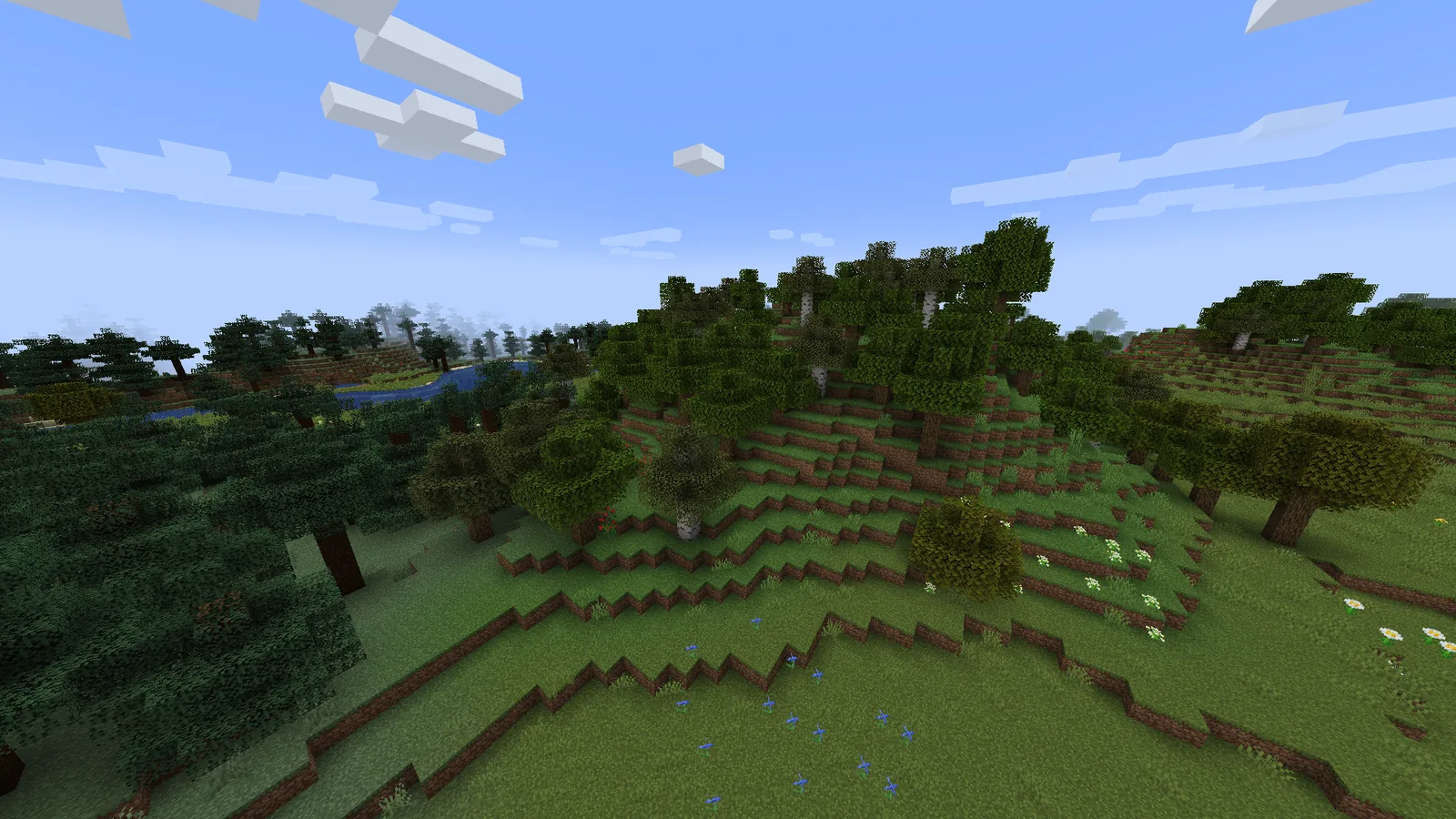
Rule four: trees come in groups
One custom tree beside a building is better than one vanilla tree. Three at different sizes is better than one, by a large margin.
A group needs a large one, a medium one and something small – a sapling-height shrub, a stump, a fallen log. That range implies the group has been there long enough for trees to be at different ages, which is the same argument as varying the buildings in a settlement.
Under the group, the ground should change. Coarse dirt, podzol, a few blocks of grass at different heights, scattered leaf litter using carpets or slabs. A perfect grass lawn under a tree is the giveaway.
Mods, and whether you need them
Better Leaves is the highest-value addition here – it replaces the leaf block model with cross-shaped foliage, and a hand-built canopy improves more from it than a vanilla one does, because the gaps you left start reading as depth.
It is a resource pack, so it costs nothing on a server and requires no permission. That makes it the first thing to try before any mod.
Building mods that add extra log and leaf variants help, and none of them are necessary. The four rules above are all doable in vanilla with the wood types already in the game.
A twenty-minute upgrade
- Remove the vanilla trees within sight of the build.
- Build one large tree, skeleton first, two-wide trunk with roots.
- Add a medium one and something small nearby.
- Rough up the ground underneath with coarse dirt and podzol.
- Take a screenshot from where you normally stand and compare.
Step five is the check that matters. Trees are landscaping, and landscaping is judged from the viewpoint you actually use – the same discipline as terraforming around a build.
Shrubs and the middle layer
A landscape built from trees and grass has a gap in it. Real vegetation has a layer between ankle height and tree height, and Minecraft builders skip it because vanilla gives them almost nothing for it.
The blocks that work are leaves on a short stub of log, azalea, moss blocks and carpets, and big dripleaf where it fits. Two or three blocks tall, clustered rather than scattered, and placed where a tree would shade the ground.
That middle layer is what makes the edge of a wood look like an edge rather than a line where trees stop. It costs nothing and almost nobody does it.
Images: Serene Seasons project gallery.