Water is the easiest thing in Minecraft to build next to and the hardest to build with. Most waterfront builds are a normal build that happens to have a lake behind it, plus a flat wooden rectangle called a dock.
The fix is to treat the waterline as the main design constraint rather than a background feature.
The waterline is the horizon of the build
Every structure on a shore reads against one strong horizontal line. That line is fixed, it runs the full width of the view, and nothing you build will be more visually dominant than it.
So the first decision is how your build meets it. Three options, and picking one deliberately is most of the work:
- Stand back from it – the build sits above the water on land, with the shore as foreground. Safest, least interesting.
- Sit on it – the build meets the water at its own base, on a retaining wall or quay. Reads as a harbour.
- Cross it – the build extends over the water on piles or arches. Most striking, most work.
Mixing all three along one shoreline is what makes a waterfront look like it grew rather than like it was placed.
Piles, and why most docks look wrong
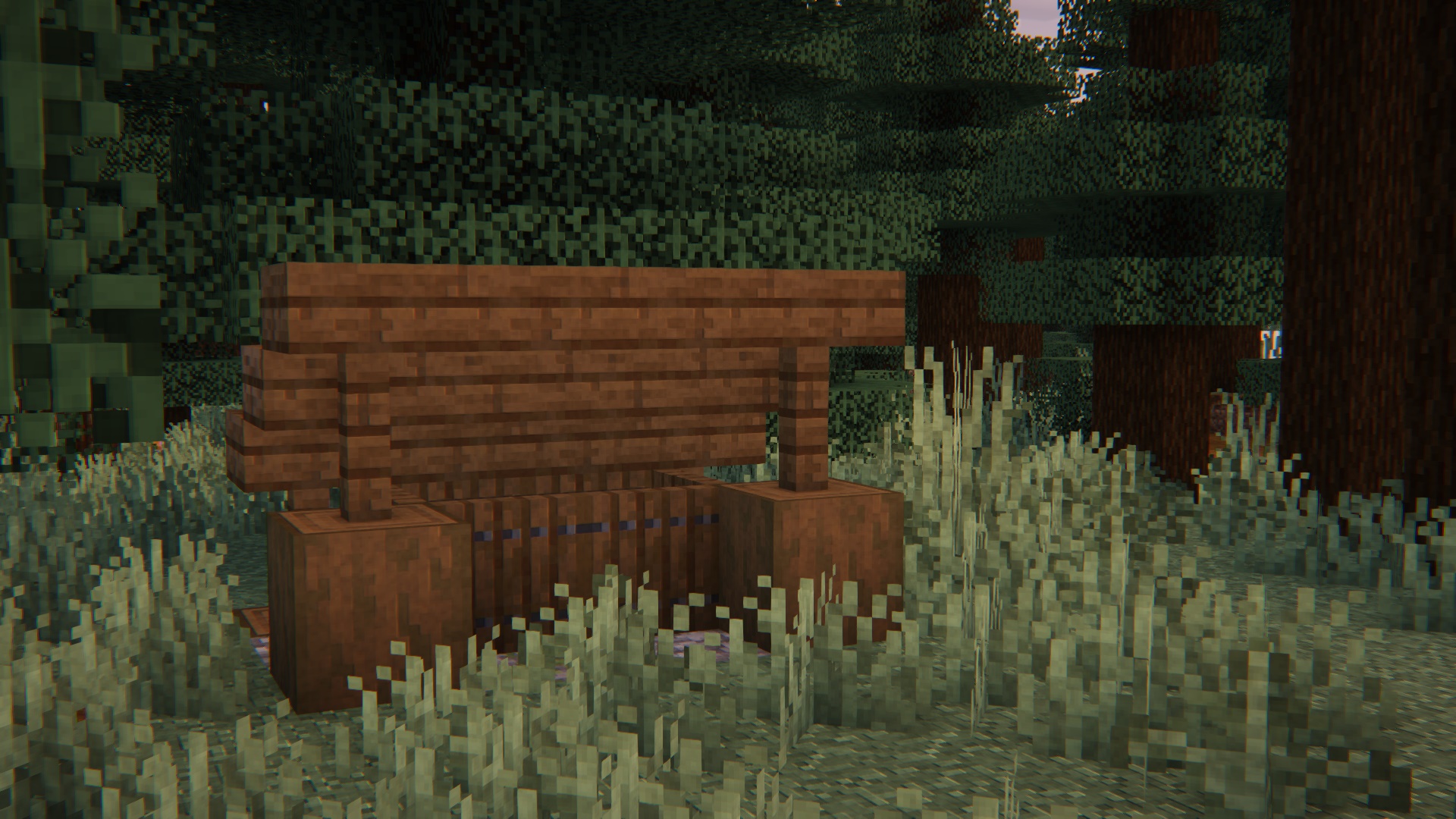
A dock is a platform held above water by something. The usual version omits the something – planks floating at water level with nothing beneath.
The fix is one block of structure: fences, stripped logs or walls descending from the platform into the water at regular intervals. Two blocks of visible pile below the deck is enough.
Two details make it read properly. Piles should be a different material from the deck – darker, rougher, wetter. And the platform should sit one block above the water surface, not level with it, so there is a visible shadow line underneath.
The depth problem
Vanilla shorelines are shallow and flat. A dock built on one has boats sitting on the sea floor a block below the deck, which destroys the illusion that anything could float there.
Dig. Three or four blocks of depth immediately outside the dock, sloping back up further out, costs ten minutes and does more than any amount of detailing. A harbour needs somewhere for water to be deep.
While you are down there, the floor is worth varying too – gravel, sand, clay, a few blocks of stone. Clear water shows what is underneath it, and a uniform sand floor is as flat-looking as a uniform wall.
What a working waterfront has
Buildings alone do not make a harbour. The things that do are small, and every one of them is a cue that this place has a purpose.
- Cargo – barrels, crates made from any container block, stacked unevenly rather than in a grid.
- Lifting gear – a crane arm from fences and trapdoors, a pulley, a rope of chains.
- Mooring – fence posts on the deck edge, chains going down to the water.
- A slipway – a sloped ramp from land into the water, for pulling boats out.
- Waste – the working edge of a harbour is untidy. Loose planks, a broken crate, a patch of seagrass against a pile.
Item five is the one that separates a harbour from a model of a harbour. Clean is the wrong target here, and the techniques for it are the same ones in decay and weathering, applied gently.
Light on water
Water reflects, and Minecraft’s water reflects more convincingly than most of its surfaces – especially with shaders. That makes lighting a waterfront a higher-return activity than lighting anything else.
Lanterns hung low over the water, on chains from a crane arm or a building overhang, do the most work. Light sources at deck height and above are wasted, because the reflection needs the source close to the surface to be visible in frame.
The rest of the lighting principles apply unchanged – one functional light per area, everything else for the look.
Boats that stay put
Boats drift. A moored boat that has floated to the middle of the lake by the time you come back is the most common annoyance of building a harbour.
Enclosing a mooring on three sides with piles holds a boat in place well enough. Trapdoors or lily pads at the waterline work as a soft barrier. For a purely decorative boat, placing it inside a one-block pocket surrounded by piles means it cannot go anywhere at all.
Order of work
Dig the depth first, then place the piles, then build the deck on them, then put the buildings behind it, then detail.
Building the deck first and adding piles afterwards is the usual sequence and it produces a platform with decoration underneath rather than a structure that is held up. The distinction is the same one that governs foundations on land – what carries the weight should be built before what sits on it.
Images: Explorify project gallery.