Towers are the easiest way to make a base visible from distance and the easiest thing to build badly. A vertical column with a roof on it is not a tower; it is a chimney. What makes one work is what happens at the top, the bottom and the transitions between.
Proportion
Height should be around three to four times the base width. A five-wide tower wants to be fifteen to twenty tall; taller than that and it reads as a spire, shorter and it reads as a block.
Below five blocks square, a tower has no usable interior and reads as decoration. Seven square is the practical minimum for a tower you can build inside.
The three parts
- Base – wider than the shaft, ideally by one to two blocks, with a visible transition.
- Shaft – the body, divided horizontally at floor levels.
- Cap – the top, which is where the tower earns its existence.
A tower that is the same width from ground to roof is the most common failure. Even a single-block batter at the base changes how it sits.
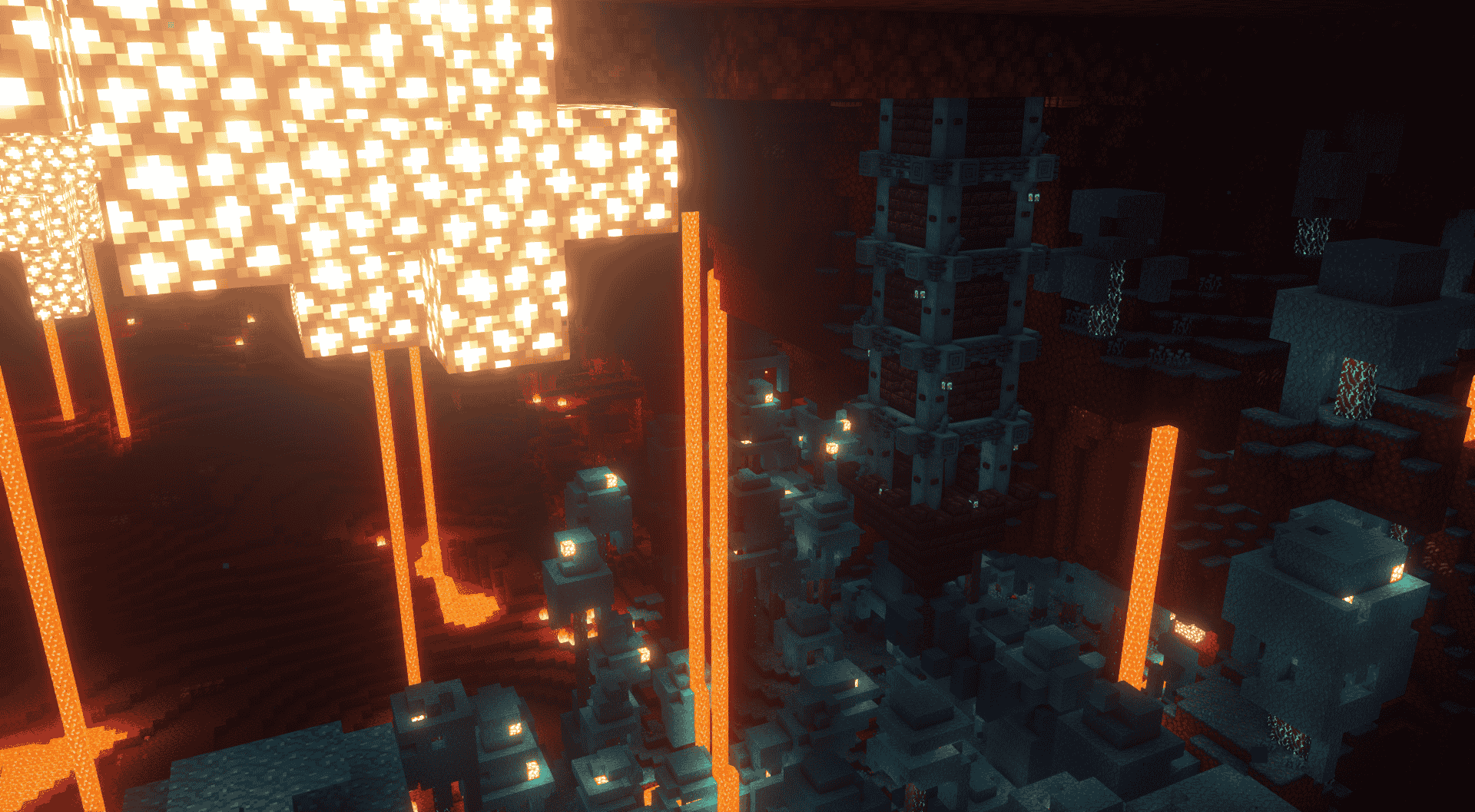
Dividing the shaft
A long uninterrupted vertical surface has nothing for the eye to hold. String courses – a horizontal band of a contrasting block at each floor level – divide the height into readable sections.
- A slab or stair course projecting one block.
- A band of a different material, one to two blocks tall.
- A row of windows at each level, aligned vertically.
- A change in the wall plane, stepping in slightly at the upper levels.
Stepping in as it rises is the most convincing and the most work. Even one step at two-thirds height transforms the profile.
The cap
The top is the whole point. Options, roughly in order of difficulty:
- Crenellated parapet – alternating blocks around the top. Simple, reads as fortification.
- Conical roof – stairs converging to a point. Suits round or octagonal towers.
- Overhanging machicolations – a projecting course on supports beneath the parapet. The best-looking option.
- Open platform with a canopy – posts and a small roof, for a watchtower.
Machicolations are worth learning. A one-block overhang supported on stair brackets, with the parapet above, is what makes a tower read as medieval rather than as a cylinder.
Round, square or octagonal
Square is easiest and reads as solid. Round is hardest in Minecraft and reads as elegant. Octagonal is the compromise and is usually the right answer at diameters above nine.
A circle below eleven blocks across is not convincing in a block game. Above that it works. Below it, build an octagon.

Interior
A tower interior is a stack of small rooms connected by stairs, and the stairs are the problem – they eat the floor area. A spiral around the outer wall leaves a usable centre; a straight flight does not.
Alternatively, leave the interior open as a single tall volume with a ladder and platforms, which is easier and often looks better.
What a tower is for
- A landmark, visible from the approach.
- A vertical anchor for a horizontal base.
- Housing for something that needs height – a mob farm, a lookout.
- A portal room, elevated so the beam or the frame is visible.
Towers built for a reason look better than towers built because a base needed one, largely because the reason suggests what the top should be.
Grouping
One tower is a landmark. Two identical towers flanking something is a gate. Three or more of varying heights is a skyline, and it is far more impressive than one tall one.
Varying height between grouped towers is essential. Equal heights read as a fence.
Lighting
A tower is seen at night from a distance, which makes its lighting a long-range signal. Light at the top, light at the windows, and nothing in between produces the strongest silhouette.
Hidden sources are still the rule up close, and the general approach is covered in interior lighting – but for a tower, the exterior read at distance matters more than the interior.
Sitting it in terrain
A tower on a flat plain has nothing to relate to. On a rock outcrop, at the end of a ridge, or rising from a cliff edge, it gains half its impact from the site.
Choosing the site is cheaper than building the drama, and where that is not possible, the ground work around the base is what substitutes – sitting a build into terrain covers the techniques.
Common mistakes
- Uniform width from bottom to top.
- A flat roof with nothing on it.
- Windows scattered rather than aligned in vertical runs.
- Too thin – four blocks square is a column.
- Built on flat ground with no base treatment.
Building a round tower
The eleven-block circle is the smallest one that reads as round rather than as an octagon with ambitions. Build one layer using a circle guide, then copy it upward – the hard part is done once.
Thirteen and fifteen are the next good diameters. Even-numbered circles have no centre block, which makes spiral stairs and conduits awkward, so odd diameters are generally easier to work with.
Stairs inside a tower
- A spiral hugging the wall leaves the centre usable and looks right.
- A straight flight against one wall is easier and wastes a quarter of each floor.
- Ladders are compact and read as utilitarian, which suits a watchtower.
- A central open shaft with platforms is the least work and looks best in a mill or lighthouse.
Towers with a purpose
A bell tower, a lighthouse, a watchtower, a windmill and a keep all have different tops because they do different things, and picking one before building solves the cap problem entirely.
Images: Structory: Towers project gallery on Modrinth.