Elytra flight is the fastest travel in Minecraft and the one most likely to kill you. The mechanics are simple – gliding converts height into distance, rockets convert gunpowder into speed – but the failure modes are unforgiving and mostly happen on landing.
Getting one
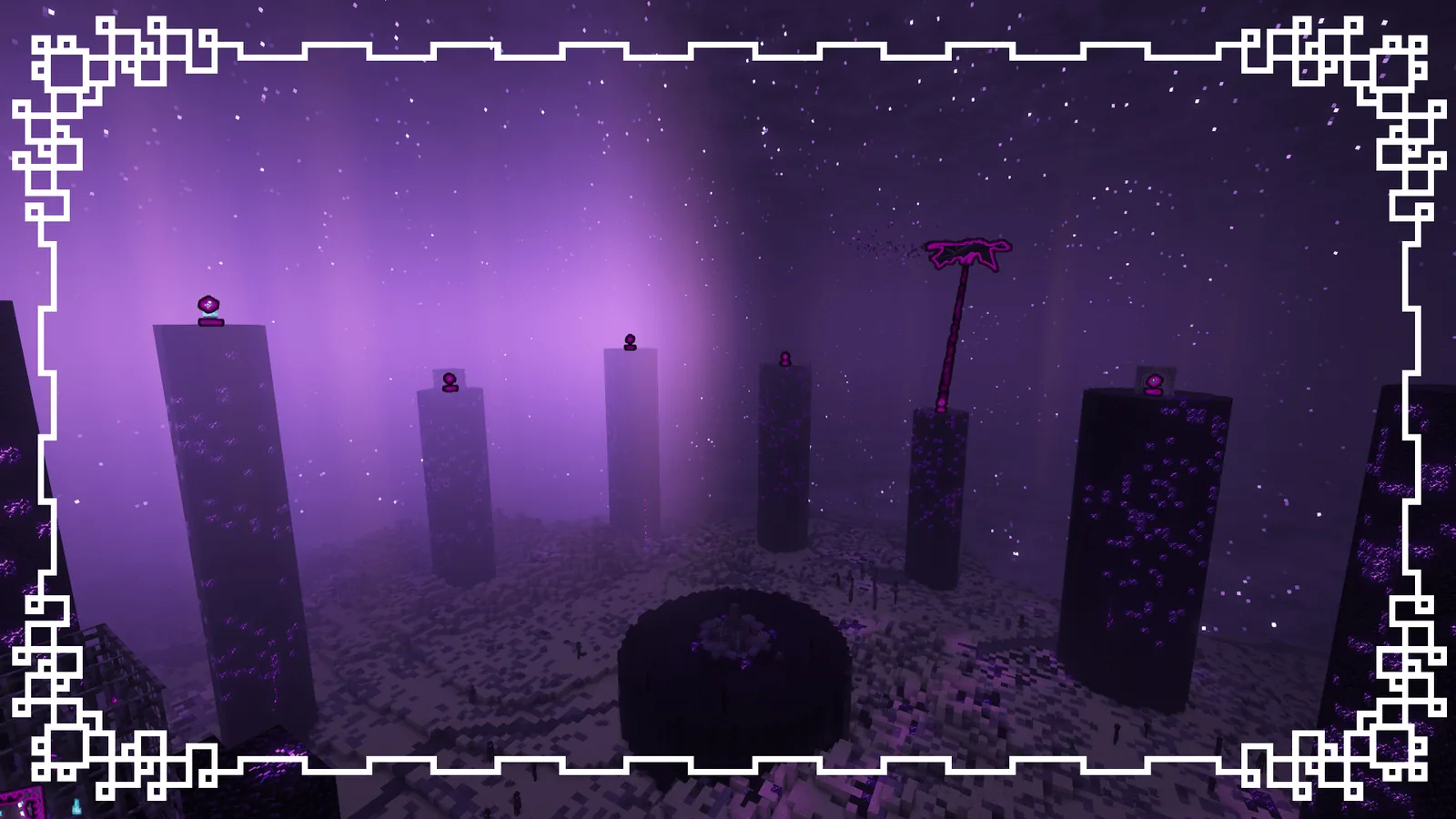
End cities, in the ship that sometimes generates beside them. One elytra per ship, and ships do not always appear. The practical approach is to reach the outer End islands and check several cities rather than exhausting one.
Getting there means going through the End gateway that appears after the dragon, which is the part most players do not realise exists. Cities, elytra and the outer islands covers the route.
The physics, briefly
Gliding trades altitude for horizontal distance at roughly a 1:10 ratio when you hold a shallow angle. Point down and you gain speed at the cost of height; point up and you climb briefly and then stall.
The optimal glide is a gentle downward angle, not level flight. Trying to fly flat produces a slow stall.
Rockets
A firework rocket while gliding gives a burst of acceleration. Duration-1 rockets are cheapest and fastest to use; higher durations accelerate longer but are not proportionally better for travel.
- One paper, one gunpowder – a duration-1 rocket, three at a time.
- Two gunpowder for duration 2, three for duration 3.
- Do not add firework stars to travel rockets. They damage you.
That last point is not hypothetical. A rocket with a star used while flying deals real damage, and a stack of the wrong rockets will kill you over a long journey.
Gunpowder supply
A creeper farm is the standard answer and it is a significant build. Wandering traders sell gunpowder, and witches drop it, which covers a casual player’s needs without a farm.
A hundred rockets is roughly ten thousand blocks of travel. Most players dramatically underestimate how many they need for exploration.
Durability and Mending
Elytra durability decreases one per second of flight and the elytra breaks at 1 durability rather than 0 – it becomes unusable but not destroyed. Repair with phantom membranes at an anvil, or put Mending on it.
Mending on an elytra is close to essential, and it is the reason to prioritise finding a librarian. The anvil route runs into the prior work penalty quickly, since an elytra needs repairing often.
Landing
This is what kills people. Gliding into terrain at speed is fatal, and the standard techniques are:
- Water. A one-block pool is enough, and a bucket placed while falling works.
- Slow Falling potion, which removes the problem entirely.
- Flare out – pull up sharply just before contact to bleed speed.
- Feather Falling IV boots, which turn a fatal landing into a survivable one.
Feather Falling is the one to have on permanently. It is the difference between a mistake and a death, and elytra mistakes are frequent.
Routes and hazards
- Never glide into unloaded chunks at speed – you will hit terrain that renders late.
- Watch the Nether roof if you fly there; the ceiling is instant death at speed.
- Rain damages elytra flight in the sense that it obscures vision, not mechanically.
- Phantoms will interrupt a night flight if you have not slept.
The unloaded chunk problem is the biggest one and is worse on a server with a low view distance. Flying faster than the game can load terrain means flying into a wall that was not there a second ago.
Nether elytra travel
Combining elytra with the Nether’s 8:1 ratio is the fastest travel in the game by a wide margin. It is also the most dangerous, because the terrain is enclosed and the ceiling is unforgiving.
Flying at Y=120 in a cleared corridor is the standard approach for serious distance. Anything below that involves terrain.
What to carry on a long flight
- Rockets, more than you think – three stacks for real exploration.
- A water bucket.
- A spare elytra if you have one, or phantom membranes and an anvil at the destination.
- Food, because flying burns hunger slowly but constantly.
- Blocks, for the landing you did not plan.
Losing an elytra mid-flight over an ocean is a specific and recoverable disaster if you are carrying a bucket and blocks, and a long swim if you are not.
What you lose if you die
An elytra death is usually at speed and at height, which means items scattered over a wide area and frequently in water or lava. The recovery rules are the same as any other death but the geometry is worse – what you can and cannot get back is relevant here more than anywhere else in the game.
Worth knowing
Elytra fundamentally change the scale of a world. Distances that were expeditions become commutes, and bases that were remote become adjacent. Most players reorganise their entire world after getting one, which is a reasonable measure of how much it changes.
Images: Stellarity project gallery on Modrinth.